
North Korean Hackers Claim 76% Of Crypto Theft In 2026

The global cybercrime landscape in 2026 shows a sharp convergence of state-sponsored hacking, transnational fraud networks, and highly industrialized scam operations. Cryptocurrency remains at the center, offering both high-value targets and efficient laundering methods. Recent reports from TRM Labs and law enforcement reveal a stark reality. A few sophisticated actors account for a disproportionate share of losses, while large-scale scam operations exploit individuals at unprecedented levels.
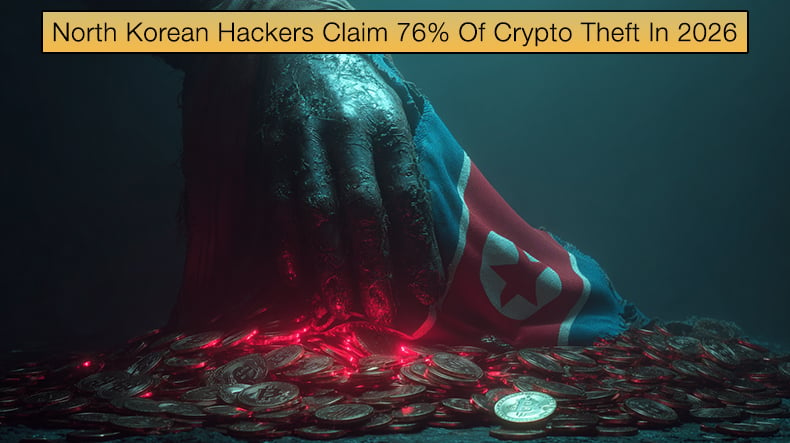
North Korea has become the dominant force in cryptocurrency theft, changing how nation-state cyber operations generate revenue. Multiple analyses show North Korean threat actors accounted for about 76% of all cryptocurrency stolen in 2026. This was accomplished through just two major attacks.
The operations targeted decentralized finance platforms like Drift Protocol and KelpDAO. The losses totaled roughly 577 million USD in weeks. The scale stands out for both its financial impact and precision. A handful of attacks now outweigh the cumulative effect of dozens of smaller incidents.
This shift highlights a broader evolution in North Korea's cyber strategy. Instead of more frequent attacks, operators now focus on maximizing impact. They use meticulous planning, extended reconnaissance, and advanced social engineering.
In the Drift Protocol breach, attackers spent weeks staging the operation. They manipulated insiders for months, then executed the theft in minutes. This operational discipline shows a shift from opportunistic hacking to strategic campaigns. Each intrusion is designed to extract maximum value.
Artificial intelligence is increasingly suspected to support this precision. Analysts note that AI tools may enhance reconnaissance, automate social engineering, and better target high-value individuals or systems. Attribution remains complex. Still, the rising sophistication of attacks suggests state-backed groups are integrating advanced technologies into their workflows.
North Korea's dominance in cryptocurrency theft is not new, but it is accelerating. The country's share of global crypto theft has risen steadily, reaching record levels in 2026. Since 2017, North Korean actors have stolen more than $6 billion. This reflects a long-term strategy to use cybercrime to bypass sanctions and fund state priorities. The sustained campaign has transformed cyber operations into a core part of national revenue.
Nation-state actors are only one dimension of the broader threat landscape. Alongside these high-profile heists, transnational criminal networks exploit individuals on a large scale. Many fraud schemes use cryptocurrency as the primary payment method. Law enforcement actions in 2026 have revealed the industrialization of these scams, especially in Southeast Asia.
A recent U.S. crackdown on a Myanmar-based fraud ring shows the scale and organization of these criminal networks. These groups often operate as full-scale enterprises. They set up call centers, use scripted playbooks, and force labor.
Victims are often targeted through social media, dating platforms, or investment forums. They are manipulated into sending funds under the guise of legitimate opportunities. These schemes, known as "pig butchering," combine emotional manipulation and financial deception. The result is devastating losses for individuals.
Key characteristics of these fraud operations include:
- Highly structured environments resembling corporate call centers, often staffed by trafficked or coerced workers
- Use of scripted engagement tactics that gradually build trust before introducing fraudulent investment opportunities
- Heavy reliance on cryptocurrency to facilitate cross-border payments and evade traditional financial controls
AI Enhanced Tactics
The financial damage from such scams is immense. According to U.S. law enforcement, cryptocurrency and AI-enabled scams have cost Americans billions of dollars in recent years. Losses keep rising as criminals improve their methods. These schemes use new technologies, including AI-generated content and voice cloning, to appear credible and manipulate victims more effectively.
The combination of cryptocurrency and AI is especially concerning. Criminals are using AI to automate interactions, create fake personas, and scale their operations. This mirrors state-sponsored activities, in which AI enhances reconnaissance and targeting. Both nation-state actors and criminal groups use the same technological advances. This blurs the lines between geopolitical and financially motivated cybercrime.
Another key part of this ecosystem is the laundering of stolen funds. North Korean actors have demonstrated advanced techniques for moving and converting cryptocurrency across different chains. Cross-chain bridges and decentralized exchanges are crucial in this process. Attackers use them to hide transaction trails and convert assets into liquid forms, like Bitcoin. Services without centralized control or compliance make it even harder to recover stolen funds.
Criminal fraud networks mirror this laundering infrastructure. They use cryptocurrency wallets, over-the-counter brokers, and underground banking systems to move illegal proceeds. These networks operate globally, making enforcement tough. Operations often cross multiple jurisdictions with varying levels of oversight.
Despite these challenges, law enforcement agencies are stepping up efforts to disrupt these activities. Recent operations have targeted fraud rings and cryptocurrency scams. There is more international cooperation and intelligence sharing. Agencies are also working with private partners, like cryptocurrency exchanges and analytics firms. This collaboration helps track illicit activity in real time.
Several key trends are shaping the response to this evolving threat:
- Increased collaboration between governments, financial institutions, and technology companies to share threat intelligence
- Expansion of regulatory frameworks aimed at improving transparency and accountability within the cryptocurrency ecosystem
- Development of advanced analytics tools capable of detecting suspicious patterns across multiple blockchain networks
These coordinated efforts have yielded some successes, including the recovery of stolen funds and the disruption of major fraud operations. However, the scale and adaptability of the threat actors involved mean that challenges remain significant.
The broader implications go beyond financial loss.
Nation-states use cybercrime as a source of revenue, raising geopolitical concerns. This is especially true when funds may support weapons programs or destabilizing activities. Fraud schemes cause financial ruin and psychological harm. This highlights the growing societal cost of cybercrime.
In 2026, advanced technology, organized crime, and state-sponsored activity have merged. This has created a rapidly changing cybercrime landscape. North Korea's dominance in crypto theft shows how a few actors can have a large impact. Fraud networks show how cybercrime can scale quickly.
Addressing this challenge requires a coordinated, multi-layered approach. Defenders must move as fast as attackers. They need technological innovation, regulatory reform, and international collaboration. By leveraging advanced AI and analytics, defenders can anticipate and counter emerging threats.
Share:
 Facebook
 X.com
X.com
 LinkedIn
 Copy Link

Karolis Liucveikis
Experienced software engineer, passionate about behavioral analysis of malicious apps
Author and general operator of PCrisk's News and Removal Guides section. Co-researcher working alongside Tomas to discover the latest threats and global trends in the cyber security world. Karolis has experience of over 8 years working in this branch. He attended Kaunas University of Technology and graduated with a degree in Software Development in 2017. Extremely passionate about technical aspects and behavior of various malicious applications.
PCrisk security portal is brought by a company RCS LT.
Joined forces of security researchers help educate computer users about the latest online security threats. More information about the company RCS LT.
Our malware removal guides are free. However, if you want to support us you can send us a donation.
DonatePCrisk security portal is brought by a company RCS LT.
Joined forces of security researchers help educate computer users about the latest online security threats. More information about the company RCS LT.
Our malware removal guides are free. However, if you want to support us you can send us a donation.
Donate
▼ Show Discussion