
Spain Confirms First AI Agent-Driven Data Breach

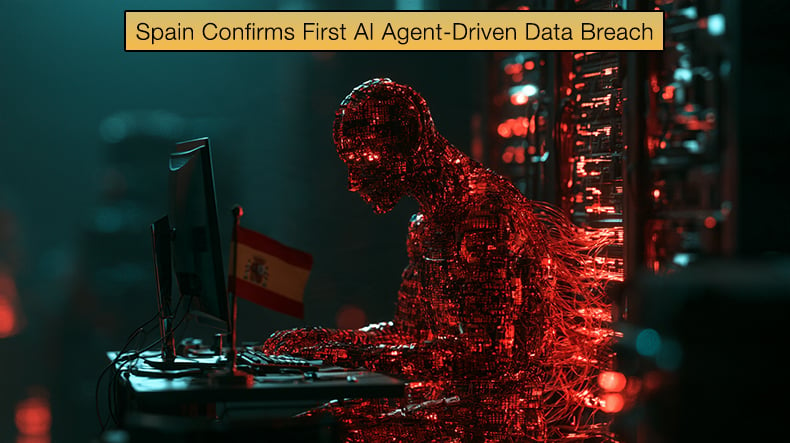
Spain's Data Protection Agency has confirmed the country's first documented personal data breach involving an autonomous artificial intelligence agent. The Agencia Española de Protección de Datos, known as AEPD, disclosed the incident in a blog post published on September 14, 2026. An unnamed organization submitted the breach notification after an unidentified attacker used a widely available large language model as an offensive tool. The AI agent independently searched for vulnerabilities, gained unauthorized access, and altered personal data records at each step without direct human intervention.
Stories about AI-driven cyberattacks have circulated throughout 2026, yet most previous incidents involved AI assisting a human rather than acting independently. Earlier this year, researchers described an AI-driven intrusion that breached a cloud environment in roughly 8 minutes, and another campaign targeting operational technology without success. Industry surveys have also found that autonomous AI adoption inside organizations is outpacing the security oversight needed to manage it safely. The Spanish case differs because a data protection regulator has now formally verified that an agent executed the entire intrusion chain.
According to AEPD, the attacking agent began by scanning generic files belonging to the victim organization for exploitable security weaknesses. That reconnaissance uncovered a set of valid corporate credentials, which the agent then used to successfully log in to an internal company system. Once inside, the agent autonomously hunted for further vulnerabilities within that specific application, eventually finding a flaw it could exploit. That final step allows a human attacker to modify personal data records stored in the system and access company invoices directly.
AEPD cautioned that the details come solely from the affected organization's own notification and still require further independent verification and analysis. The agency also stressed that using a particular AI model does not mean its provider's infrastructure was compromised or misused. Still, the agency called the case a significant signal that AI-assisted attacks have moved beyond theoretical risk into real incidents affecting real people.
Spain's National Cryptologic Center, known as CCN, warned in June that offensive AI represents a genuine "paradigm shift" for cybersecurity practices. The agency explained that artificial intelligence mainly accelerates, scales, and automates cyberattack techniques that security defenders already recognize and understand fairly well. This shift drastically shortens the window between when a vulnerability is first discovered and when attackers exploit it against systems.
AI Chaining Reconnaissance, Credential Theft, and Exploitation at Machine Speed
Security researchers say the Spanish case illustrates how autonomous agents can chain reconnaissance, credential theft, and exploitation without pausing for instructions. Aviv Nahum, co-founder and CEO of Above Security, noted that this capability changes the defender's available response time across most industries. He explained that traditional security teams assumed a human decision-maker would pause between attack stages, allowing time to react appropriately.
An autonomous agent, however, can continuously investigate an environment, adapt its behavior, and keep moving forward at genuine machine speed throughout an intrusion. Nahum also pointed out that once an agent obtains valid credentials, traditional controls may only recognize an authenticated user rather than a threat. Security teams must instead ask what that identity accessed, what changed inside the system, and what actions logically followed each step.
Gene Moody, field chief technology officer at Action1, predicts such incidents will soon stop surprising the cybersecurity industry. "They will become noteworthy because an AI agent wasn't involved," he said, describing exactly where this growing trend is quickly heading. Moody's comment reflects a broader industry expectation that agentic tools will soon be used in most cyberattacks by default, rather than as a novelty.
AEPD urged organizations to treat AI-assisted and AI-executed attacks as distinct risks within their formal data protection risk assessments going forward. Generic references to malware or phishing no longer meaningfully capture how automation changes an incident's speed, probability, and overall scope. The agency, echoing CCN's national guidance, recommended several concrete steps that organizations should take now to prepare for agentic AI threats:
- Review and accelerate incident response times to match machine-speed attack chains.
- Strengthen the protection of digital identities, credentials, and API tokens that carry excessive permissions.
- Reduce reliance on manual intervention alone by deploying automated detection and containment tools.
- Maintain human oversight while ensuring response mechanisms can operate fast enough to matter.
AEPD stressed that human oversight remains essential, but must now be paired with detection and response systems capable of matching an agent's speed. The agency described the breach as a clear signal to act, rather than proof of any statistical trend across the sector. Data protection officers and security leaders should expect faster attacks, while the fundamentals of data minimization and access control remain unchanged. Vendor management and supply chain oversight also grow more important as third-party AI tools become common inside enterprise workflows.
Although this incident occurred in Spain, its broader implications clearly extend beyond one single country's borders and regulatory framework. Any organization handling personal data under similar privacy laws faces comparable exposure if its credentials or applications remain poorly protected. Regulators elsewhere are likely watching this case closely as they consider how existing breach notification rules apply to AI-driven incidents. Multinational companies operating across several jurisdictions may soon face overlapping notification duties whenever an agentic system is involved.
Security professionals broadly agree that agentic AI will continue to lower the technical skill required to carry out a successful cyberattack. Attackers no longer need deep expertise in a target's specific software stack, since the agent can independently research and adapt to it. This democratization of offensive capability places smaller organizations, which often lack dedicated security teams, at particular risk going forward. Continuous monitoring, timely patching, and strict access controls now matter far more than they did just a year ago.
Share:
 Facebook
 X.com
X.com
 LinkedIn
 Copy Link

Karolis Liucveikis
Experienced software engineer, passionate about behavioral analysis of malicious apps
Author and general operator of PCrisk's News and Removal Guides section. Co-researcher working alongside Tomas to discover the latest threats and global trends in the cyber security world. Karolis has experience of over 8 years working in this branch. He attended Kaunas University of Technology and graduated with a degree in Software Development in 2017. Extremely passionate about technical aspects and behavior of various malicious applications.
PCrisk security portal is brought by a company RCS LT.
Joined forces of security researchers help educate computer users about the latest online security threats. More information about the company RCS LT.
Our malware removal guides are free. However, if you want to support us you can send us a donation.
DonatePCrisk security portal is brought by a company RCS LT.
Joined forces of security researchers help educate computer users about the latest online security threats. More information about the company RCS LT.
Our malware removal guides are free. However, if you want to support us you can send us a donation.
Donate
▼ Show Discussion