
Privacy Bee Review: Features, Pricing, Pros & Cons

✓
Fact-checked by:
Tomas Meskauskas
Last updated:
January 14, 2026
Our reviews are written by Internet security experts.
Learn more.
PCRisk score:
4.2
When searching for a comprehensive personal data removal service, we recommend shortlisting Privacy Bee.
What we liked:
✓ Broad data removal: Targets many brokers and people-search sites, surpassing most competitors.
✓ Useful extra tools: Includes tracker blocking, inbox scans, and do-not-call opt-outs for added privacy.
✓ Hands-off use: After setup, it runs automatically with ongoing monitoring and reports.
What we disliked:
✗ High price: More expensive than many alternatives, which may deter budget-conscious users.
✗ Limited transparency: The dashboard can be unclear, with unexplained "N/A" statuses and missing details.
✗ US-focused: Mainly covers U.S. brokers; users outside the U.S. may see fewer benefits.
Privacy Bee at a Glance: When it comes to Privacy Bee, a privacy protection service that scrubs your personal information from data broker databases and public listings, this review, written by the PCrisk team, will be a solid reference. Combining automated technology and personal support, Privacy Bee is essentially an all-out assault on people search sites, marketing lists, and even the dark web, where your personal information can be found.
Going beyond the standard data broker opt-out process, Privacy Bee also offers a browser extension to block trackers, a scan for exposed emails, and options to blur your home on Google Street View. It was showered with accolades and received the PC Magazine Editor's Choice award in 2024 and 2025. However, it comes at a higher price, and some users have given mixed feedback about the transparency and continuous effectiveness of the service. In this review, we'll take a closer look at Privacy Bee's pricing, features, user-friendliness, and real-world results to determine if it's the right privacy tool for you.
Pricing and Subscription Options
When signing up to Privacy Bee, you can choose from three personal plans. Essentials, Pro, and Signature, and there isn't a completely free version of the service. However, you can start with a basic Privacy Evaluation, which provides a scan of any online exposures but doesn't remove any data. The paid plans automatically bill you annually, but you can opt for a more expensive month-to-month option. All plans come with a 30-day money-back guarantee. The annual cost for each of the paid plans are:
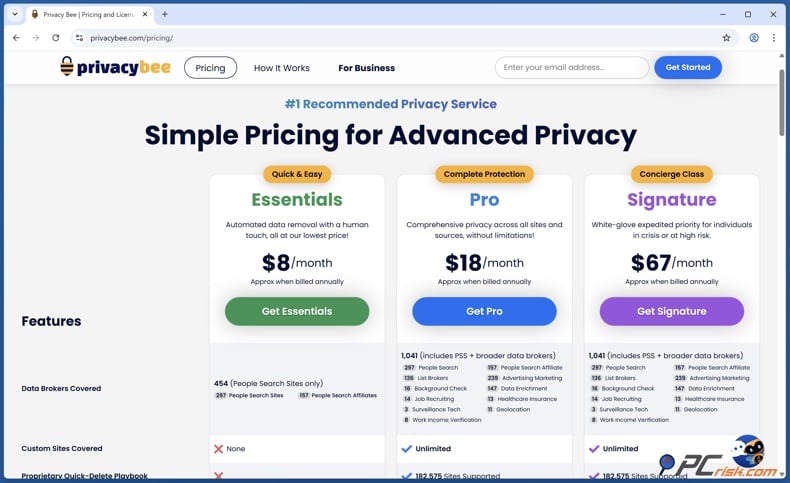
Privacy Bee Essentials – The Essentials plan costs approximately $96 per year, or roughly $8 per month, when billed annually. Entering the world of data protection, this plan is ideal for individuals seeking to get started with automated data broker removals on a tight budget, while still requiring some basic privacy protection.
It's got the core features: scanning hundreds of data brokers and people search websites, sending opt-out requests on your behalf, and monitoring your data across a broad network of common data brokers that Privacy Bee targets, plus monthly privacy reports. It's, however, more automation-driven, so although your removal requests are given top priority, they're handled mainly by Privacy Bee's algorithms, dubbed SARA, with minimal human oversight.
The plan won't delve into complex cases, nor can it fully clean sites that aren't on its list. Instead, the dashboard will provide you with DIY guides to remove any other exposed information. It's essentially a "set it and forget it" approach for those seeking a low-cost data-scrubbing service and are willing to wait a bit longer for the results.
Privacy Bee Pro – Privacy Bee's Pro plan costs approximately $18 per month or $216 per year when billed annually. The Pro plan is the most popular option, providing access to the entire feature set and complete coverage.
Well-known data brokers and people search sites are covered in full with no restrictions, and Privacy Bee claims to be able to wipe out your personal info from over 1,000+ data sources, plus another 180,000+ "custom" sites, which are essentially any websites that aren't listed on the main feed but still contain your personal information.
In the Pro plan, removal requests get priority treatment, the automated system gets a boost from the company's Global Response Team of human analysts who step in on the more challenging cases, and this plan also includes features that the lower-tier Essentials doesn't, like dark web monitoring, mass marketing, and telemarketing opt-outs, and more.
This plan is best suited for individuals who prioritize complete privacy protection, are willing to pay a higher annual fee, and are comfortable with minimal activity.
Privacy Bee handles everything for you once you've signed up and provided the necessary information. Privacy Bee Pro currently costs approximately $200 per year, which is often billed at around $18 per month.
Privacy Bee Signature – When considering Privacy Bee, the Signature service is the top-tier, VIP offering, essentially a 'white-glove' service for those at risk or with very urgent privacy concerns, such as high-level executives, public figures, or individuals being actively harassed or doxxed. Coming in at $799 per year, billed annually, Signature includes all that Pro has to offer, plus the best possible service and top priority. This means that Privacy Bee aims to address any new exposures within 24 hours or less.
You also gain exclusive access to a US-based team of analysts who are available to handle the most challenging and sensitive data removals and coordinate with authorities as needed. They'll take charge of things like getting your personal info out of background check databases, real estate listings, facial recognition systems, and more. Well-known as a 'concierge' service, the team does everything for you, provides extensive hands-on support, and delivers results quickly.
Multi-Person Plans: You can add a partner, family member, or another person to your account for a discounted rate when signing up for Privacy Bee. Coming under one roof like that will be cheaper than buying separate plans for each. The service's Family plan is designed to remove any personal data from major data brokers.
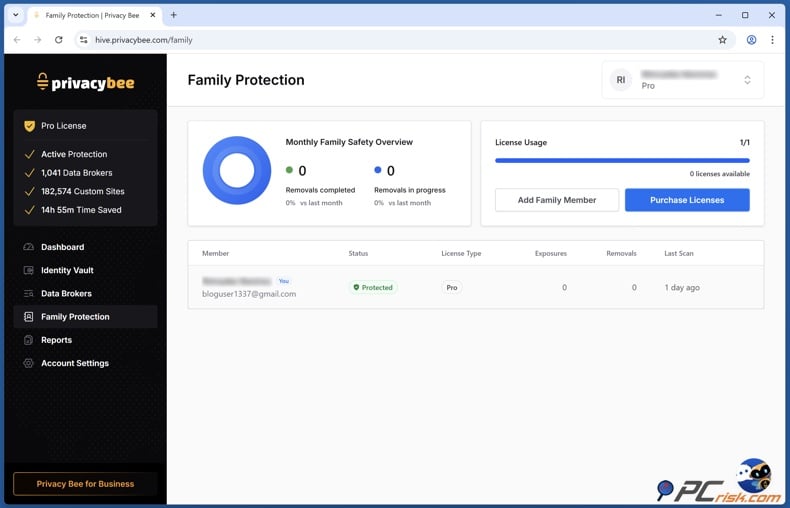
Privacy Bee's business and enterprise plans are designed for companies that want to protect their employees or executives from data brokers, offering features not found in smaller plans, including SSO integration and admin tools. Privacy Bee is on the pricier end of the spectrum, but it justifies its cost with very broad coverage and numerous features. This is more than what Incogni or DeleteMe offers.
Based on our experience, it's worth opting for the annual plan to avoid monthly billing and utilizing the 30-day money-back guarantee if the service doesn't meet your needs.
Our In-House Data Removal Test Results
We created a company account with one of our employees' personal data, which included their name, address, email, phone number, and other details, when we tested Privacy Bee's Data Broker Removal Service. We wanted to see how well the service would clean up their online footprint over the next few weeks. Privacy Bee's service was able to identify the employee's personal data scattered across the internet, even after several weeks of being active. It then proceeded to remove 90% of that data within weeks, completely erasing their online presence, although 10% remained.
Initial Scan and Exposures Found: Upon signing up for Privacy Bee and providing our personal information, we initiated a scan for any exposed data. The Privacy Bee dashboard showed us a score for how exposed we were, which, in our case, didn't flatter us. Coming across hundreds of places where our test identity was listed in data broker databases was a real wake-up call, and it made us realize that we're all over these people search sites, such as Whitepages, Spokeo, and MyLife, as well as smaller background check websites and marketing databases. The hundreds of exposures Privacy Bee found weren't a pleasant surprise, but are pretty consistent with how fast and far-reaching personal information can spread online. Privacy Bee's simple interface made it easy to understand the count of exposures and start categorizing them.
Removal Requests Initiated: After completing the scan, we initiated the removal process. Privacy Bee's team, having obtained our electronic signature on a Limited Power of Attorney form, sent out requests on our behalf. Privacy Bee began contacting all the websites they'd found our information on, asking them to delete it. According to the dashboard, they sent out removal requests to all the data brokers simultaneously, and for the first two days, we received regular updates: the Privacy Bee system was working its way through the list, and we could see the progress in our dashboard. We observed the number of "removal requests sent" zooming upwards and is getting closer to the total number of exposures they found.
This platform uses a combination of automated scripts and human follow-up. Essentially, within the Essentials plan, everything is handled by the computer. However, since we used a Pro account for testing, they included both automated and human assistance to address the requests.
Data Removals and Results: It was a month before Privacy Bee had removed a significant portion of our test data, when it started sending requests to the 25 data brokers on our behalf. When we searched for our name on the people-search sites that initially displayed our contact information, we found that many of them had removed those listings, even after manually checking or searching for our name on Google. The Excruciating Details section in the Privacy Bee dashboard showed that dozens of the brokers reported that our records had been completely erased. Privacy Bee's impressive scope allowed it to track down some lesser-known data aggregators that we hadn't previously heard of. The test didn't eliminate every single record; a few sites didn't process our request in time, and then republished our data. However, Privacy Bee is still monitoring those sites and sending out reminders.
Ongoing Monitoring: It doesn't mean that's the end of the road when Privacy Bee finishes the initial cleanup of your data. The service is set up to monitor for any new appearances of your data, something that can occur as data brokers reacquire or update their information.
The Privacy Bee dashboard sends monthly reports to the user. During our trial, after the initial removal of a large number of exposures, the activity naturally subsided. However, Privacy Bee still caught a couple of new data appearances, probably as the brokers updated their databases, and promptly sent out new requests to remove them. Privacy Bee takes the stress out of this "whack-a-mole" battle and does all the legwork for the user.
Test Result Verdict: When we put Privacy Bee through the test, it demonstrated its claim of eradicating data brokers. Our data was significantly reduced within a month of signing up, and it essentially ran in the background, removing our personal information from numerous websites.
No data removal service can guarantee that your entire online presence is completely removed, especially since public records and reposting can be difficult to control, and we have seen a few cases of information persisting. However, Privacy Bee made a massive dent in our online presence, something that we couldn't have achieved manually in the same amount of time. The extensive coverage and automation of repeated requests are two of its most significant assets. We will delve into the features that make this happen in the following sections and also discuss some areas for improvement, such as the dashboard.
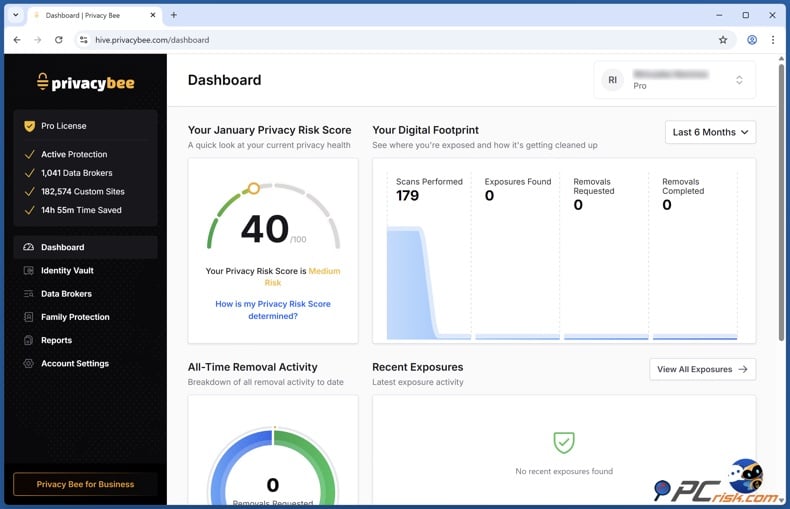
Its dashboard offers a clear Privacy Risk Score and tracks the progress of removing your data when you use Privacy Bee. The service found a significant amount of your personal data "exposed" and sent removal requests to each of those sites. The counters on the Privacy Bee dashboard update as the removals are carried out, giving you a quick check-in on the number of listings that have been scrubbed from the internet.
Key Data Removal Features
Privacy Bee's core functionality is centered on identifying where your personal information is exposed and forcing those sites to delete it. Here are the main data broker removal–related features and capabilities that Privacy Bee offers:
Broad scanning for exposures
Privacy Bee's workflow starts by scanning for exposures: where your identity data appears across people-search sites, data brokers, and similar databases. A removal service is only as effective as its detection because you can't remove what you can't find. Good scanning also means repeat scanning, because brokers continually refresh their content, and "new" listings may simply be old data resurfacing under a new page.
Automated opt-outs and deletion requests
It sends opt-out and deletion requests on your behalf, giving you a massive time-saving advantage when Privacy Bee discovers that your personal information has been exposed. The actual value of Privacy Bee isn't just the convenience of having a system do the legwork; it's the fact that it eliminates repetitive tasks. Many brokers deliberately make opt-outs difficult, and some even require you to repeat the process every few years, which can be a real pain. Well-known privacy services can be a godsend when they remove that recurring stress and continue to send those requests.
Authorization workflow and data minimization
You'll need to give them the authority to act on your behalf, usually a limited power of attorney or consent form, which is a standard procedure in the industry when requesting a removal service.
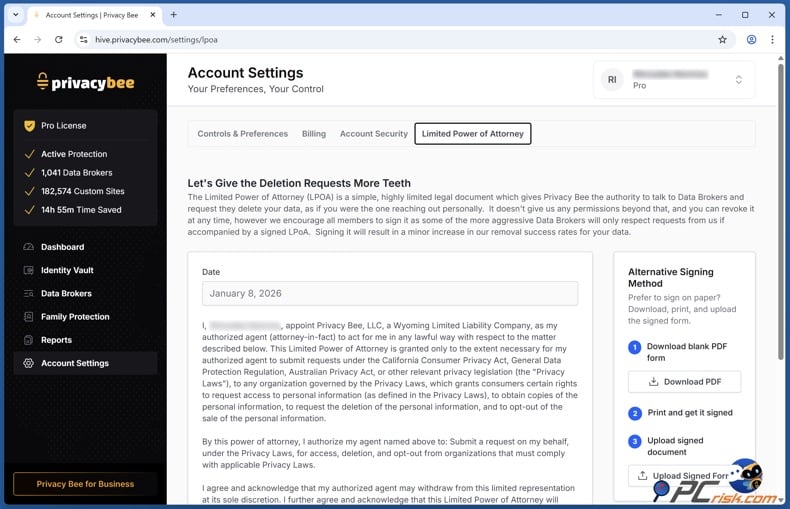
Coming down to the sensitive stuff, what's really important in an opt-out request is what kind of personal data is being passed to the broker, and how the service goes about limiting that exposure, such as using controlled comms and only sending over what the broker needs to find and squash the record.
When using Privacy Bee, you'll need to provide sufficient personal details for accurate matching. However, if you don't, the record may not be found, and if you disclose too much, you may feel uneasy. The best services strike a balance by asking for the bare minimum and protecting it effectively.
Ongoing monitoring and re-removal
It's not a static action when you remove your data from a data broker. These brokers constantly buy, merge, and republish new datasets, which can cause your removed listings to reappear. Privacy Bee's continuous monitoring model is designed to catch and re-remove these listings. This maintenance layer is what sets Privacy Bee apart, as human manual opt-outs tend to break down over time.
Custom removals and harder cases
It can accommodate custom removal requests that extend beyond the standard list of brokers when Privacy Bee is set to a higher tier. Coming across a single high-stakes listing on an unknown website can be more concerning than a multitude of low-risk ones on well-known platforms. In addition, a broker that doesn't respond, requires extra verification, or employs a confusing suppression process will necessitate a significant amount of manual follow-up.
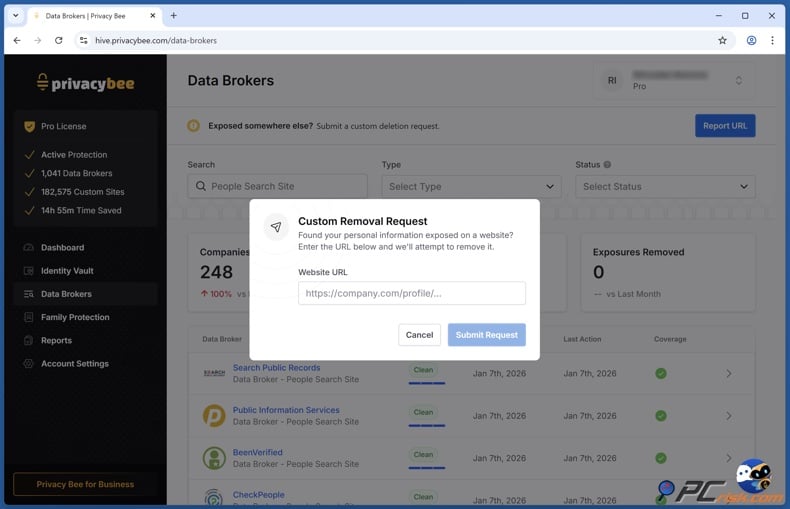
Progress tracking and reporting
Privacy Bee uses a dashboard approach to summarize:
- exposures found,
- requests initiated, and
- removals completed.
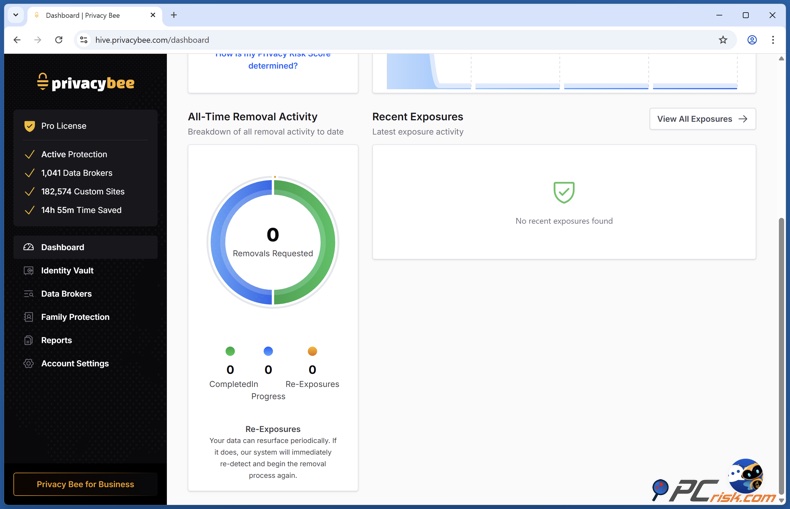
For PCrisk.com readers, the details matter: whether the service provides clear statuses (removed, pending, failed), whether dates are meaningful, and whether the platform makes it easy to verify outcomes without spending hours manually checking.
Limitations to keep in mind
No broker-removal service can guarantee a "clean internet." You may still appear in:
- public record sources that are legally publishable,
- news or blog content that is not a broker listing,
- social media posts and profiles you (or others) created, and
- cached or mirrored content outside a broker's control.
A good service reduces the biggest and most common exposure channels, but it can't rewrite history.
Additional Privacy Features
It introduces tools that reduce data collection and visibility, even going beyond the usual broker opt-outs, when Privacy Bee sets out to differentiate itself from the crowd. These features won't be able to replace top-of-the-line cybersecurity software, but they can plug up privacy leaks and make it more difficult for people to be targeted by annoying ads. Below are the notable additional features Privacy Bee offers:
"Manage Your Trust" controls and tracker blocking
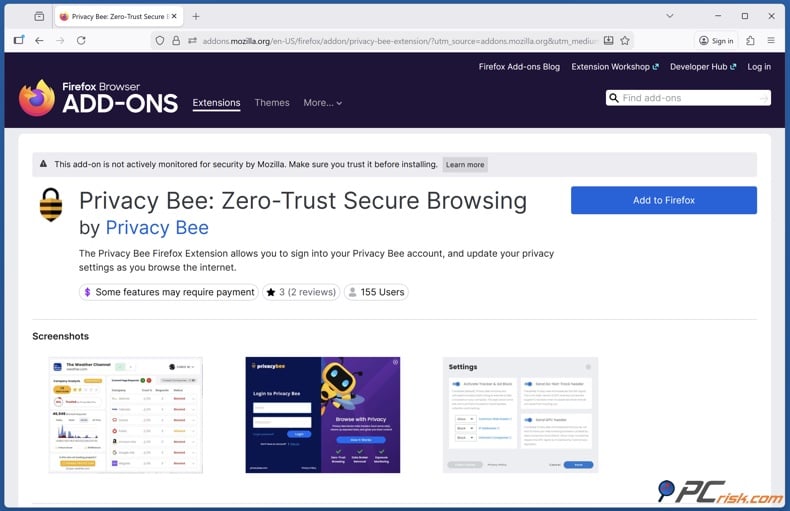
You're essentially creating a list of companies that are either trusted or untrusted when using Privacy Bee's "trust" feature. The Privacy Bee extension can then apply those preferences by clamping down on the tracking done by the companies you don't trust.
Well-known for its user-friendly interface, Privacy Bee's trust model is a good option for those seeking a straightforward way to block online trackers. It won't, however, replace the functions of a full-fledged content blocker, and it is best seen as an additional layer to those.
Email exposure / inbox scan
Privacy Bee can scan an inbox (often Gmail-focused) to identify which companies email you and, by extension, which companies likely hold your data. That can be used to:
- identify high-volume marketing relationships,
- organize and prioritize unsubscribe/suppression actions, and
- reduce inbox noise over time.
As with any inbox scanning feature, users should weigh the convenience of granting mailbox access against the sensitivity of doing so. The safest approach is enabling it only if you're comfortable with the permission scope and have a clear reason to use it.
Marketing and telemarketing opt-outs
Regarding privacy issues, many people care just as much about reducing spam, unwanted calls, and physical junk mail as they do about removing their profile from people-search sites. Privacy Bee includes a suite of opt-outs that zeroes in on pre-screened offers and telemarketing, essentially giving you a way to put the brakes on unwanted communications:
- junk mail driven by credit/insurance prescreen lists,
- telemarketing calls, and
- marketing "data sharing" relationships that you didn't knowingly agree to.
Map and property image blurring
Privacy Bee includes options to request blurring of a residence on mapping services (where available). This is a minor feature, but for doxxing concerns and personal safety, reducing the "visual addressability" of a home is meaningful. It also complements broker removals because even if your address leaks, blurred imagery makes it harder for strangers to identify a specific property.
Private search and privacy utilities
Some plans come with a built-in search tool or privacy utilities that can help cut down on tracking during search activities, when using a browser. If you use a privacy-focused search engine, you may already be covered, but this built-in feature can be a nice bonus for those who don't.
Identity Vault (Secure Data Storage)
When it comes to identity protection, Privacy Bee's vault is essentially a secure storage facility, and its most significant advantage is organisation. You can consolidate all your old addresses, nicknames, and contact details in one place, so the service knows exactly what to delete and what to search for.
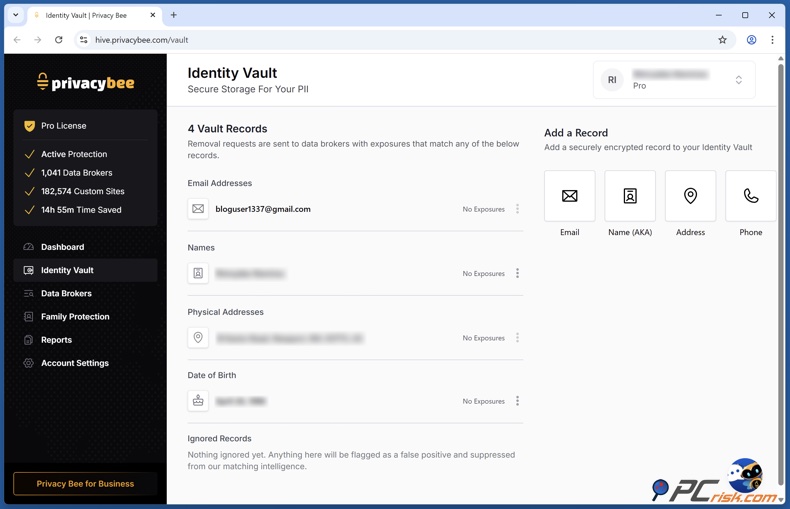
When using Privacy Bee, you're essentially getting a suite of privacy services, all rolled into one package, which includes data broker removal, tracker blocking, email cleanups, spam reduction, dark web alerts, and lots more, all of which we found to be working well.
Coming rushing from a technical standpoint, some of these features may already be covered by more advanced users, for instance VPNs and secure email services, but the convenience of having them all in one place is what Privacy Bee provides.
The standout feature for us was the one-click opt-outs for telemarketing and junk mail, and the browser extension's intuitive method to rating the trustworthiness of websites as you browse. However, Privacy Bee's Gmail scan and private search require a level of faith in the service.
Since Privacy Bee puts itself forward as a privacy-first company, most people won't mind this, but the cautious will want to thoroughly read the privacy policy.
Now we'll be looking at how user-friendly Privacy Bee is, from setting up the account to navigating the control panel and tools.
Ease of use
Onboarding and setup
Privacy Bee's setup is not complicated, but it is sensitive: you provide identity details so the service can match and remove you from broker records. Expect an onboarding process that collects your core identifiers and requests authorization to submit deletion requests. That "paradox" (sharing data so a service can remove data) is typical in this category.
Dashboard clarity
The dashboard's main view is typically straightforward: exposure counts, request counts, and progress. The real usability test is the details page—whether it explains:
- what each status means,
- what action was taken,
- what still needs time, and
- what (if anything) requires user input.
In our previously overviewed in-house results, we heavily evaluated reporting clarity because unclear dashboards force users to submit support tickets and undermine trust.
How much work is required from the user?
A paid removal service should minimize user work beyond setup. If a plan routinely pushes DIY instructions back onto the user, it's closer to a "guide" than a service. In practice, higher tiers typically require less user effort and more human follow-up on complex cases.
Support experience
Support matters in this space because some brokers delay or resist requests. Therefore, you should evaluate:
- response speed,
- accuracy of guidance,
- escalation behavior for stuck removals, and
- whether support outcomes are measurable (not just polite replies).
Cancellation and account control
For privacy products, account control is a key component of trust. Users should be able to:
- cancel renewal without friction, and
- request account deletion if they want to leave.
We recommend checking these controls early—ideally during any refund window—so you understand precisely how the company handles lifecycle requests.
User Reviews and Community Feedback
Upon reviewing Privacy Bee, we consulted various review platforms, including Trustpilot, social media, and Reddit forums. Upon reviewing a large number of positive user reviews, many people have found Privacy Bee to be highly effective; however, a few complaints caught our attention.
Trustpilot Reviews: Examining Privacy Bee on Trustpilot, the picture isn't complete. It has just a handful of reviews, which may indicate that the service hasn't yet reached a large user base or that users are not leaving reviews. At this stage, Privacy Bee's Trustpilot rating is approximately 4.0 out of 5, with a 75% success rate, and nearly all of those reviews are five-star.
Coming from the reviews, it's clear that Privacy Bee effectively halted the flow of robocalls and phone spam that its clients were previously receiving.
For example, a recent five-star reviewer was "pleased that my robocalls have slowed considerably since I used Privacy Bee", and in doing so has really made a tangible difference in the lives of its users. Another five-star reviewer, who had tried other services, gave a ringing endorsement of Privacy Bee's ability to excel in terms of the number of deletions, using its Pro plan to wipe away numerous problematic entries.
The users were also delighted with the 'thorough cleaning of personal information' and found the price of Privacy Bee to be a good value compared to other professional reputation services.
Negative or Mixed User Feedback: Upon reviewing Privacy Bee, a few negative reviews were found. A 3-star review in November 2024, for example, mentioned that the service really got going with them right after they signed up, was very responsive to their support requests, but since then, they haven't received any further updates. Coming from the initial push, activity dropped off to virtually nothing, leaving them unsure if anything else was being done. Well-known issues with services like this can arise because the initial work is completed fairly quickly, and monthly reports are the only thing left to look forward to.
Another criticism came from a 1-star review, and this time, it was primarily because Privacy Bee requires you to input a lot of personal data in order to delete your information, and then found the process of deleting the account itself to be "extremely difficult". We investigated this and found that Privacy Bee does allow you to delete your account, even for the free ones. However, it's possible that at the time the user wrote that, the process wasn't entirely clear, or they may have stumbled upon it.
Privacy Bee needs to be given access to your data so they can remove it for you, and that doesn't sit well with everyone, particularly those who don't want anyone else to have their personal information.
Reddit and Forum Discussions: Privacy Bee often comes up when discussing data broker opt-out services on Reddit. Coming from a privacy-focused crowd, opinions about Privacy Bee have been mixed but mostly positive. Several users who tried the service reported that Privacy Bee significantly reduced the number of spam calls and emails they received. One user, in particular, accidentally signed up for a year of Privacy Bee but was glad they did, noticing a drastic reduction in telemarketing calls.
People have described Privacy Bee as "legit and effective", and more so than DeleteMe or Incogni. Privacy Bee, in one user's words, is said to have the "widest data broker coverage," which is undeniably a significant plus, considering that all the major data brokers essentially cover you.
However, the price of Privacy Bee is often mentioned, and people can't get past it. One user stated that Privacy Bee offers more control and better coverage, but it's too expensive for them, a sentiment echoed throughout the discussions, and a price that many people are unwilling to pay.
Privacy Bee's Engagement and Reputation: It's clear that the company is very active in engaging with its community. The team responds to posts in forums and Reddit, and this engagement has been there since at least 2020. A 2020 blog post criticizing the company's early practices caught the attention of a
Privacy Bee employee, who took to Reddit to address the criticisms.
The representative walked users through the significant changes they've implemented, explaining their use of masked emails, and providing minimal required data to brokers, and outlining the algorithm they had put in place. Correcting one of the main complaints, Privacy Bee does indeed now operate globally and is working hard to improve.
One instance of Privacy Bee being taken seriously in the privacy space is receiving the Editors' Choice award in the data removal category by PCMag consecutively for two years, and an excellent 2024 TechRadar review, courtesy of an expert, calling Privacy Bee one of the best data removal services, but with the note on its expensive pricing.
Comparisons to Competitors: Evaluating Privacy Bee, you'll be weighing it against services like Incogni, DeleteMe, Optery, Kanary, and others.
Well-known for its extensive coverage and feature set, Privacy Bee is, however, pitted against Incogni's slicker approach and lower price tag, a combination that is much to be admired. Privacy Bee and DeleteMe have drawn criticism for being vague about which brokers they cover. In contrast, Incogni lays it all out for you, and that's something that privacy enthusiasts really appreciate.
Several users, after having used multiple services, say that Privacy Bee found and eliminated more data instances; in fact, one Trustpilot reviewer declared that Privacy Bee "outperformed the competition", which is quite a testimonial. Coming from the opposing side, some users on forums said they could almost achieve the same results with less work on their own, which is essentially saying that Privacy Bee doesn't unnecessarily complicate things and can get the job done for you.
People say that Privacy Bee delivers what it promises: taking the hassle of data cleanups away from you, and it does it reasonably well.
According to user reviews of Privacy Bee, the consensus is that it's a highly effective tool for clearing a person's online footprint. The people who have used Privacy Bee praise its tangible results, such as fewer spam calls and their personal information gone from search sites. However, the cost is the most common criticism, with some concern, to a lesser extent, over having to put their trust in the service.
Privacy Bee has taken steps to alleviate the drop in activity after the initial removal, and we didn't find any severe red flags that would raise an eyebrow, such as data misuse. One of the significant questions will be whether the high cost makes Privacy Bee worth considering, which largely depends on the user.
Is It Worth Buying Privacy Bee?
Privacy Bee is best evaluated through a simple lens: how much is your time worth, and how much does maximum coverage matter to you?
If you only want to remove yourself from a handful of well-known people-search sites, you can do it manually (with persistence) or use a cheaper tool. If you wish to have broader coverage, fewer chores, ongoing monitoring, and additional privacy utilities in one account, Privacy Bee becomes more compelling—especially at the Pro tier.
When it makes sense
- You have a high exposure footprint (multiple addresses, a common name, old phone numbers, family-linked records).
- You've been targeted by scams, harassment, or persistent spam and want a systematic cleanup.
- You value convenience and want the service to handle follow-up and re-removal over time.
- You want "privacy hygiene" extras (marketing opt-outs, map blurs, tracker controls) bundled with broker removals.
When it may not make sense
- You're on a tight budget and cannot justify a premium annual subscription.
- Your risk profile is low, and you're comfortable doing periodic manual opt-outs.
- You need strict, evidence-based verification for every single removal, and you don't trust automation to do enough without manual review.
Which plan is the best value?
Essentials: suitable as an entry point if you mainly want standard broker removals and can accept slower timelines or fewer concierge options.
Pro: typically the sweet spot—higher priority removals plus the feature bundle that differentiates Privacy Bee as a privacy "suite."
Signature: best reserved for high-risk or urgent situations where speed and human case management are worth the premium.
Regarding the choice of a privacy solution, Privacy Bee may not be the most affordable option, but it's geared towards individuals who seek comprehensive protection and a comprehensive suite of privacy tools. If you're faced with a real threat, such as being doxxed, or are worried about identity abuse, persistent harassment, or seeing your name pop up in countless broker listings. The notion that you should 'pay to stop doing it yourself' can be pretty compelling. From a user's perspective, Pro makes the most sense as the practical tier for anyone interested in this service.
Frequently Asked Questions (FAQ):
Does Privacy Bee remove my personal information from the internet?
When you sign up for Privacy Bee, the service will thoroughly search for and remove your personal information from data broker websites, people-search databases, and marketing directories, send opt-out and deletion requests for you, and follow up to ensure those requests are completed. They can't take down every mention of your name that's out there, but they're pretty good at knocking out the most pervasive and annoying listings.
Is Privacy Bee legitimate and safe to use?
Regarding privacy services, Privacy Bee, a U.S.-based company, has a strong reputation and industry recognition. It has received industry recognition and positive expert reviews. It uses robust encryption and safety measures to secure users' data. Privacy Bee claims it doesn't sell user information, and hands over data only to process removal requests, which is a relatively rare and strict practice.
Does Privacy Bee offer a free trial or money-back guarantee?
You're not getting a full-featured free trial, but you can see how exposed your data is with the free privacy scan, which gives you a good idea of what you're up against. Privacy Bee's Essentials and Pro plans come with a 30-day money-back guarantee, giving you a month to see if the results meet your expectations.
How long does it take to see results with Privacy Bee?
You'll send your initial requests for data removal to the brokers when you first set up Privacy Bee. Well-known data brokers may comply quickly, but others may take a couple of weeks. After a month, you'll likely see a noticeable reduction in your online exposure, and Privacy Bee will continue to monitor the situation and make further improvements.
Can I use Privacy Bee outside the United States?
When it comes to Privacy Bee, the platform is global and can be accessed by users outside the US. Still, its main focus is on US-based data brokers, meaning results may be less effective for international users, depending on where their data is listed.
Will Privacy Bee remove Google search results or social media content?
It won't take down Google search results or social media posts when using Privacy Bee. It removes the underlying data broker pages that appear in search results, usually sending those links to oblivion over time. If you want to control your social media profiles and content, you need to manage those separately.
How do I cancel my Privacy Bee subscription?
When you cancel your subscription, you're effectively turning off auto-renewal, and you will have protection until the end of the current billing period. Privacy Bee also lets you delete your account and wipe all your data.
Does Privacy Bee remove information from credit bureaus or public records?
In removing your personal data from the internet, Privacy Bee is quite effective but has its limits. It can't eliminate data from credit bureaus or official public records, such as court filings, property records, and so on. What Privacy Bee can do, though, is remove your information from the data brokers that collect, republish, and aggregate this data, dramatically reducing how much of your info is available to the general public.
Will my data be permanently removed once Privacy Bee deletes it?
Not always. Data brokers often re-add information as their databases update. Privacy Bee addresses this by continuously monitoring for reappearances and submitting new removal requests as long as your subscription remains active.
Does Privacy Bee help reduce spam calls, emails, or junk mail?
Yes. By removing your contact details from data brokers and enabling mass marketing opt-outs, many users experience fewer robocalls, marketing emails, and physical junk mail. Results vary, but spam reduction is a common benefit reported by users.
Can Privacy Bee help if I'm being harassed or doxxed?
Privacy Bee is a great solution for removing personal data. They'll strip your home address, phone number, and family connections from public databases, and higher-tier plans include super-fast responses and one-on-one support when you need it most.
What happens to my data if I cancel or delete my Privacy Bee account?
The company will cease monitoring and submitting removal requests for you. It will delete the personal data you've stored in its system in accordance with its privacy policy when you cancel your account with Privacy Bee. Since Privacy Bee isn't continuously monitoring, any of your previously stored data may reappear on broker sites.
Share:
 Facebook
 X.com
X.com
 LinkedIn
 Copy Link

Karolis Liucveikis
Experienced software engineer, passionate about behavioral analysis of malicious apps
Author and general operator of PCrisk's News and Removal Guides section. Co-researcher working alongside Tomas to discover the latest threats and global trends in the cyber security world. Karolis has experience of over 8 years working in this branch. He attended Kaunas University of Technology and graduated with a degree in Software Development in 2017. Extremely passionate about technical aspects and behavior of various malicious applications.
▼ Show Discussion