

Get free scan and check if your device is infected.
Remove it nowTo use full-featured product, you have to purchase a license for Combo Cleaner. Seven days free trial available. Combo Cleaner is owned and operated by RCS LT, the parent company of PCRisk.com.
What is Dropbox Update Setup virus?
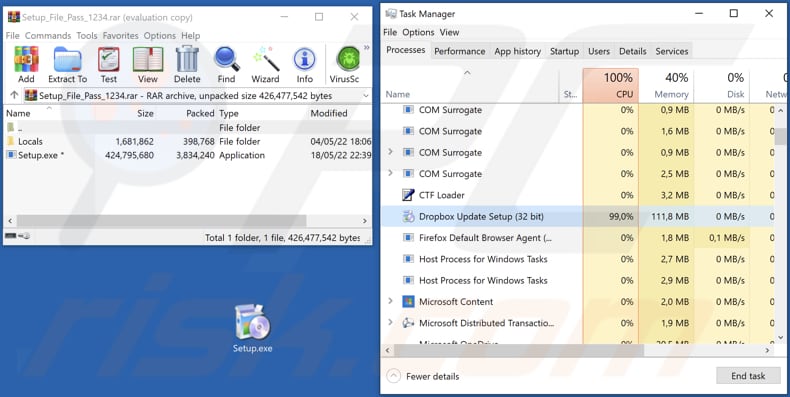
We have discovered the Dropbox Update Setup while examining various cracked software distribution websites. We have inspected the downloaded "Setup.exe" file and found that it runs in the Task Manager as "Dropbox Update Setup". It causes high CPU usage, which means it may be crypto-mining malware. However, some antiviruses detect it as an information stealer.
More about the Dropbox Update Setup virus
The malicious file distributed via cracked software download pages is named "Setup.exe" (its name may vary). After execution, it starts running in the Task Manager as "Dropbox Update Setup". Dropbox is a legitimate file hosting service. It has nothing to do with the file or process mentioned above.
We have noticed that the "Dropbox Update Setup" process consumes lots of CPU resources. Therefore, it can be assumed that this process belongs to a cryptocurrency miner. Software of this type uses computer hardware to mine cryptocurrency (which consumes more electricity and loads the system thereby rendering it unusable). It is popular among cybercriminals to employ crypto-mining malware to mine crypto using other people's computers.
As we mentioned in the introduction, some security vendors detect the "Dropbox Update Setup" as an information-stealing malware. It is important to know that info stealers can be designed to collect passwords, credit card details, data from web browsers and other apps, clipboard data, etc. Also, they can be designed to log keystrokes (record keyboard input).
| Name | Dropbox Update Setup malware |
| Threat Type | Cryptocurrency miner, information stealer, other malware |
| Detection Names | Avast (FileRepMalware), Combo Cleaner (Gen:Variant.Lazy.185022), ESET-NOD32 (A Variant Of Win32/Packed.Obsidium.KF), Kaspersky (HEUR:Trojan-Spy.Win32.Stealer.gen), Sophos (Troj/Steal-CPV), Full List (VirusTotal) |
| Malicious Process Name(s) | Dropbox Update Setup |
| Symptoms | High CPU usage and electricity consumption, hijacked personal accounts. |
| Distribution methods | Websites hosting cracked software and software cracking tools. |
| Damage | Higher electricity bills, loss of unsaved data, identity theft, financial losses, loss of access to personal accounts. |
| Malware Removal (Windows) |
To eliminate possible malware infections, scan your computer with legitimate antivirus software. Our security researchers recommend using Combo Cleaner. Download Combo CleanerTo use full-featured product, you have to purchase a license for Combo Cleaner. 7 days free trial available. Combo Cleaner is owned and operated by RCS LT, the parent company of PCRisk.com. |
Dropbox Update Setup virus in general
"Dropbox Update Setup" is the name of a malicious process possibly belonging to some cryptocurrency miner or an information stealer. Either way, it is not a legitimate process. It is important to mention that cybercriminals can use cracked software download pages to distribute ransomware, remote access Trojans, and other types of malware.
How did Dropbox Update Setup virus infiltrate my computer?
This malware is distributed via websites supposedly hosting cracking tools or cracked/pirated software (note that it is against the law to use pirated software). Also, malware is often distributed using emails (by sending malicious links or attachments) and untrustworthy sources for downloading software/files (like P2P networks, free file hosting sites, and third-party downloaders).
In other cases, cybercriminals aim to trick users into executing malicious drive-by downloads, fake updaters/installers, etc. Either way, they only succeed when users execute malware by themselves.
How to avoid installation of malware?
Do not download files and software from unreliable sources (cracked software distribution pages and other shady pages, P2P networks, etc.). Use official pages and direct links to download them. Also, do not open links or files/attachments sent from suspicious or unknown addresses. Especially when received emails are not relevant.
Keep the operating system and installed software up to date. Use tools or functions provided by the official developers to activate and update the software. If you believe that your computer is already infected, we recommend running a scan with Combo Cleaner Antivirus for Windows to automatically eliminate infiltrated malware.
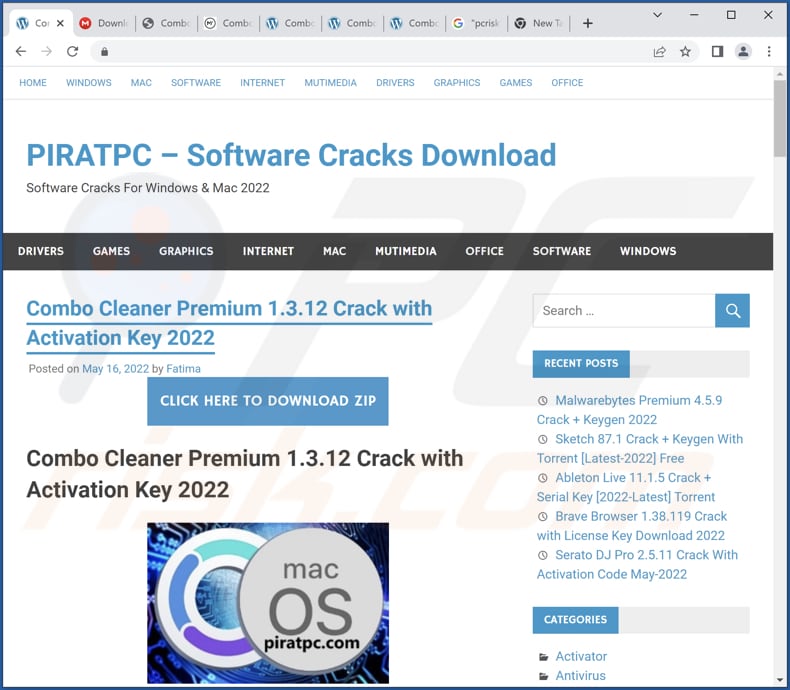
Screenshot of a crack website used to spread Dropbox Update Setup virus (the download button leads to Mega[.]io site):
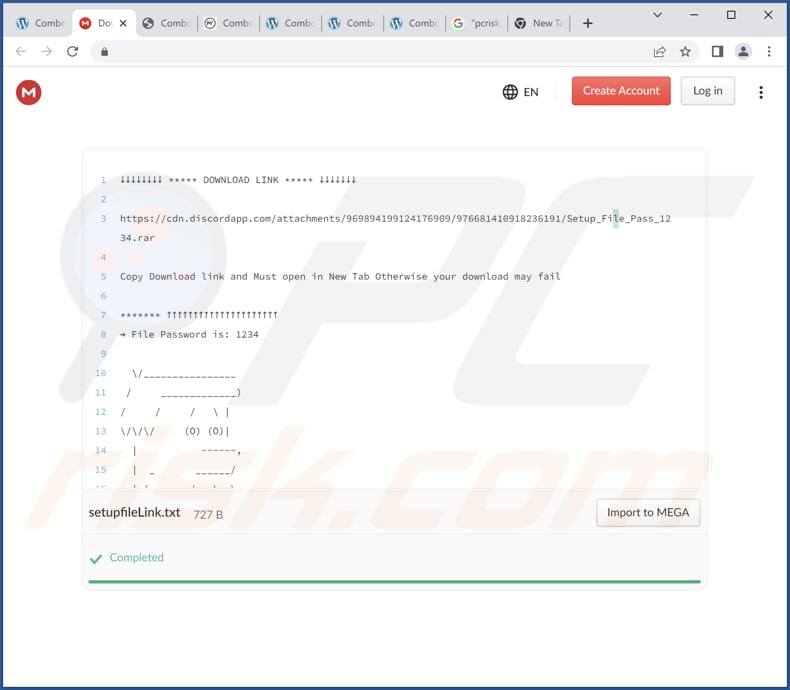
Screenshot of Mega[.]io page which the aforementioned crack website redirects to:
How to remove malware manually?
Most trojan infections can be removed by running a full system scan with Combo Cleaner. The full manual procedure below is for cases where automatic removal failed, where you want to verify a scan caught everything, or where the threat has multiple persistence points.
Disconnect from the network
Unplug your Ethernet cable and turn off Wi-Fi. If you're on a laptop, the airplane-mode key works fastest.
Many trojans exfiltrate data - saved browser passwords, banking sessions, screenshots - and accept remote commands. Cutting the network stops both immediately. Keep it disconnected until Phase 4.
Boot into Safe Mode with Networking
Safe Mode loads a minimal set of drivers and stops most malware from auto-running. "With Networking" lets you download tools - re-enable Wi-Fi only after you've booted in.
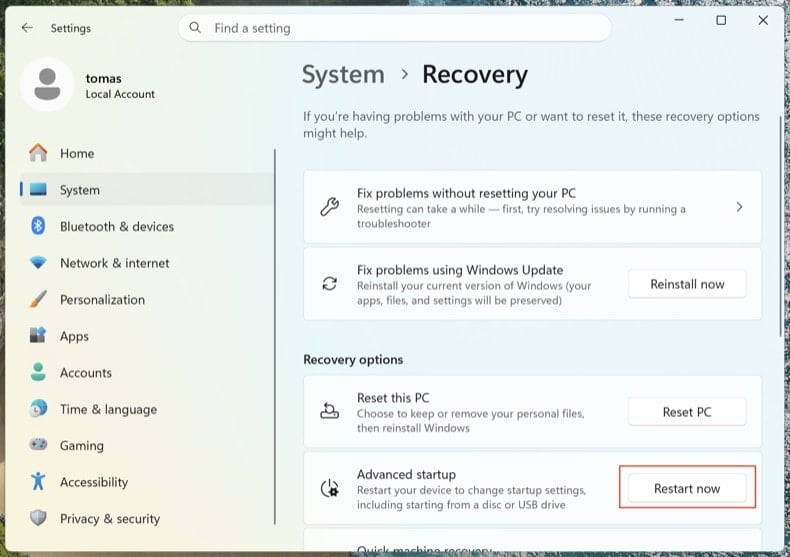
Open . Click Restart now next to Advanced startup.
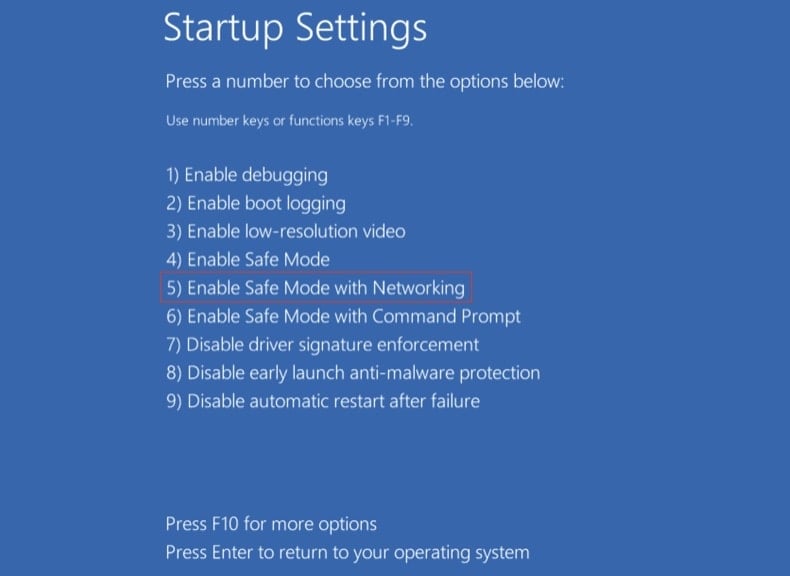
Your computer will restart into the "Choose an option" menu. Click . After the second reboot, press 5 or F5.
Click the Windows logo, hold Shift, click the Power icon and choose Restart. In the Choose an option screen, click . Press F5.
Windows 8
Go to the Start Screen, type Advanced, select Settings → Advanced startup options → Restart now → Troubleshoot → Advanced options → Startup settings → Restart → F5.
Note: Windows 8 reached end-of-life in January 2023 - running on it puts you at much higher risk of reinfection.
Windows 7
Click Start → Shut Down → Restart → OK. As the system boots, press F8 repeatedly until the Windows Advanced Options menu appears, then choose Safe Mode with Networking.
Note: Windows 7 reached end-of-life in January 2020 - running on it puts you at much higher risk of reinfection.
Inspect running processes with Process Explorer
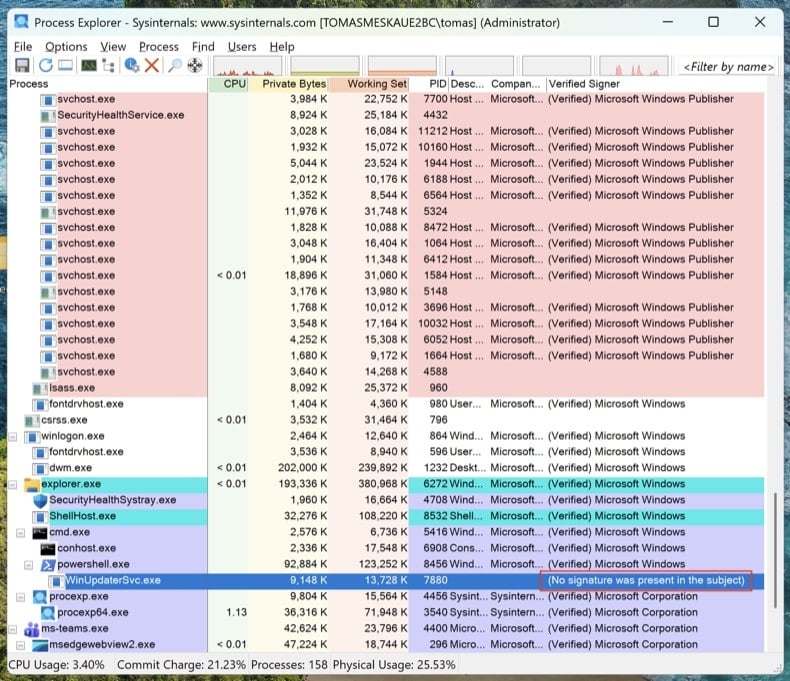
Download Process Explorer from Microsoft Sysinternals. Run it as Administrator. Click and .
Sort by "Verified Signer." Anything unsigned running from %AppData%, %LocalAppData%, %Temp%, or %ProgramData% is suspicious. Right-click → Properties to see the full image path. Right-click → "Search Online" to look up unfamiliar process names.
Task Manager hides full file paths, doesn't show digital signatures, and groups processes in ways that make malware easy to miss. Process Explorer is the same tool Microsoft engineers use.
Map every persistence point with Autoruns
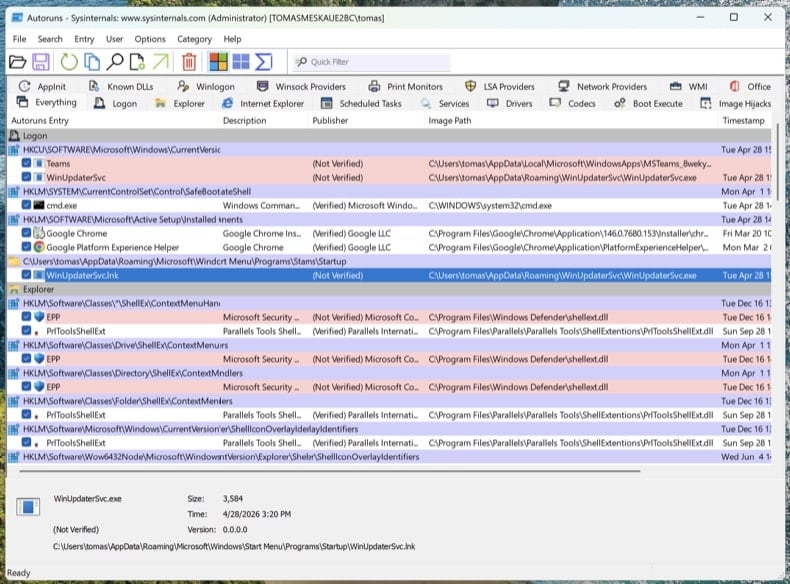
Download Autoruns. Right-click Autoruns.exe and choose Run as administrator - without elevation, Autoruns can't inspect protected registry hives.
In the menu, open and , then click Refresh.
Modern trojans don't just live in startup. Walk through these tabs and look for unsigned or unfamiliar entries:
- Logon - classic Run/RunOnce keys
- Scheduled Tasks - frequent hiding spot, especially tasks with PowerShell, MSHTA, or rundll32 actions
- Services - unsigned services in non-Microsoft folders
- WMI - Event Subscriptions are a stealthy persistence mechanism (MITRE T1546.003)
- Image Hijacks - Image File Execution Options "Debugger" abuse
- AppInit - DLLs loaded into every GUI process
- Browser plug-ins - unsigned add-ons across all installed browsers
Right-click any suspicious entry → "Jump to Image" to see the actual file. Right-click → "Search Online" opens VirusTotal for the file hash. Don't delete yet - just write down the file paths and entry names. We'll remove them after the scans.
Check the hosts file and DNS settings
Trojans often redirect bank, antivirus, and update domains to attacker-controlled servers by editing the hosts file or DNS settings.
Hosts file: Open Notepad as Administrator and open C:\Windows\System32\drivers\etc\hosts. Legitimate entries are commented with #. Any uncommented IP-to-domain mapping is suspicious - especially redirects for microsoft.com, windowsupdate, or your bank.
DNS settings: Open Command Prompt as Administrator and run ipconfig /all. Confirm your DNS servers point to your ISP, your router, or a known public resolver (Cloudflare 1.1.1.1, Google 8.8.8.8). Then open and verify both DNS and DNS over HTTPS (DoH) settings haven't been hijacked.
A clean PC with hijacked DNS is still a compromised PC. You'll think you're at chase.com and you'll be at the attacker's clone.
No single antivirus catches everything. The order below is intentional: offline scan first (catches rootkits before Windows fully loads), then on-demand scanners on the running system, then manual cleanup of anything they missed.
Run Microsoft Defender Offline
Reboot to normal Windows. Open . Select Microsoft Defender Antivirus (offline scan) and click Scan now. Your computer will restart into a stripped-down environment and scan before the full operating system loads.
Rootkits and bootkits hide from any scanner running on the same Windows session that's already infected. A pre-boot offline scan sees the disk before the malware can hide itself.
VB100 certified. Includes anti-trojan, registry/persistence scanning, anti-spyware in one pass. The 7-day free trial is available.
Download Combo CleanerRun Combo Cleaner full system scan
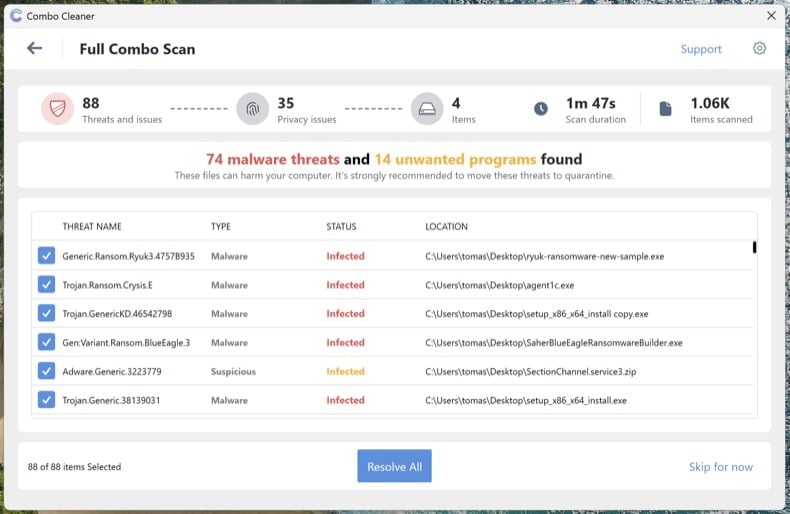
Install Combo Cleaner and run a full system scan (not the quick scan). Let it complete fully, review the detected threats, and apply the recommended actions. Combo Cleaner will quarantine known trojans and registry persistence.
Run Microsoft Safety Scanner as a second-opinion scan
Download Microsoft Safety Scanner (MSERT.exe), Microsoft's free on-demand tool. The binary expires every 10 days, which means every download has the latest signatures. Run a full scan after Combo Cleaner to catch anything one engine alone might miss.
Different scanning engines catch different threats. Running an additional Microsoft scan after Combo Cleaner is the single most underused verification step in malware removal.
Manually remove anything still listed in Autoruns
Reopen Autoruns. Anything you flagged in Step 4 that's still present hasn't been caught by the automated scans. For each remaining suspicious entry: right-click → Delete in Autoruns (this removes the persistence registration), then navigate to the file path and delete the actual file. Empty the Recycle Bin.
Some malware files reappear after deletion because something else on the system recreates them. If you delete a file and it returns within minutes, you have a remaining persistence point that Autoruns didn't show - usually a service or scheduled task running under SYSTEM. Re-run the scans from Steps 6-8 or proceed to a clean install (see end of guide).
Reset browsers and clear notification permissions
Trojans and adware frequently hijack browsers - change the default search engine, install rogue extensions, or grant themselves notification permissions to keep displaying scam pop-ups even after the malware is gone.
- Chrome: visit
chrome://settings/resetand click "Restore settings to their original defaults." Then visitchrome://settings/content/notificationsand remove any unfamiliar sites. - Edge: visit
edge://settings/reset. Then checkedge://settings/content/notifications. - Firefox: open
about:supportand click Refresh Firefox (Firefox uses "Refresh," not "Reset"). Then check Settings → Privacy & Security → Permissions → Notifications.
Review installed extensions in each browser and remove anything you don't recognize, especially extensions you didn't install yourself.
Re-enable Defender, Tamper Protection, and update everything
Many trojans disable security software. Open and confirm Real-time protection, Cloud-delivered protection, and Tamper Protection are all turned on. Tamper Protection prevents malware from disabling Defender silently.
Then run Windows Update () and update your browsers and applications. The infection vector that let the trojan in originally usually involves outdated software.
Change passwords from a clean device
If the trojan was an info-stealer (Lumma, RedLine, Vidar, and similar are extremely common), assume every password saved in your browser is compromised. Change them from a different, known-clean device - your phone is fine if it's not infected.
Recommended order:
- Primary email first - it's the recovery hub for everything else
- Banking and financial accounts
- Password manager master password (if you use one)
- Social media, shopping, and remaining accounts
Where available, enable phishing-resistant multi-factor authentication (passkeys / FIDO2 hardware keys / authenticator apps) - SMS-based MFA is bypassable by sophisticated attackers.
Verify the clean and monitor for 7 days
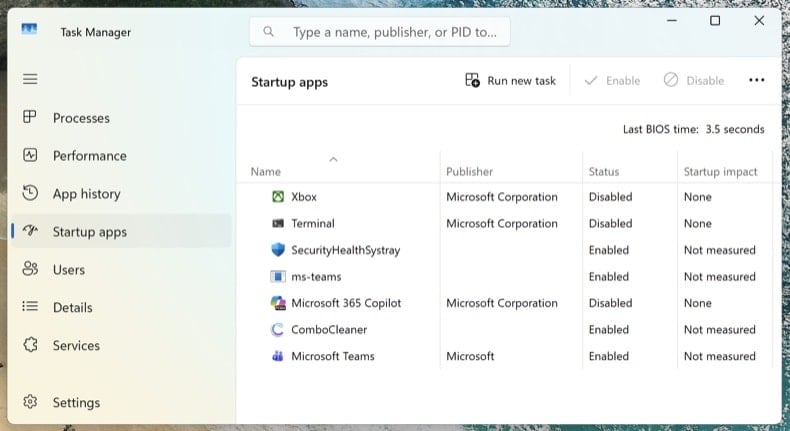
Reconnect to the network and run one final full scan with Combo Cleaner. Open Task Manager (Ctrl + Shift + Esc) and switch to the Startup apps tab - confirm nothing suspicious has reappeared.
Over the next 7 days, watch for symptom recurrence: unexpected high CPU usage, unknown processes returning, browser redirects, or pop-ups. If anything returns, you missed a persistence point and the procedure needs to be repeated - or you may have a deeper compromise that requires a clean install.
When to clean install Windows instead
Manual removal isn't always the right answer. Reinstalling Windows from scratch is the only way to be 100% certain when:
- The malware reappears after every removal attempt
- A bootkit or UEFI rootkit was detected (this class of threat sits below the operating system and survives a normal Windows reinstall)
- A confirmed credential-theft trojan ran with administrator privileges (Lumma, RedLine, Vidar) - the system likely has multiple unknown payloads
- The PC is used for online banking, business email, or anything where partial doubt isn't acceptable
A clean install is a 30-60 minute process: Windows 11 reinstall via . Back up documents to external storage first, scan the backup with Combo Cleaner before restoring it, and reinstall applications fresh - never restore them from a backup of the infected system.
Important: Manual removal requires advanced computer skills. If you're not confident identifying system files from malicious files, run an automated scan with Combo Cleaner and Windows Defender and stop there - that path catches the vast majority of consumer trojans without the risk of breaking Windows by deleting the wrong file.
Frequently Asked Questions (FAQ)
My computer is infected with Dropbox Update Setup virus, should I format my storage device to get rid of it?
No, Dropbox Update Setup virus can be removed without formatting. It can be removed by following the steps in our malware removal guide.
What are the biggest issues that malware can cause?
It can lead to identity theft, financial losses, decreased computer performance, further infections, data loss, and other problems.
What is the purpose of Dropbox Update Setup?
There is a reason to believe that this malware operates as a cryptocurrency miner. However, some antiviruses detect it as an information stealer.
How did a malware infiltrate my computer?
It is known that Dropbox Update Setup malware is distributed via cracked software download pages (screenshots of those pages are provided below the article about this malware). In other cases, computers become infected after executing malicious drive-by downloads and files downloaded from untrustworthy sources like unofficial pages, P2P networks, etc., or through emails (links or attachments in emails used to deliver malware).
Will Combo Cleaner protect me from malware?
Yes, Combo Cleaner will eliminate malware from the operating system (it can detect almost all known malware). High-end malware can hide deep in the operating system. In such cases, it is required to run a full system scan to eliminate malware.
Share:
 Facebook
 X.com
 LinkedIn
 Copy Link

Tomas Meskauskas
Expert security researcher, professional malware analyst
I am passionate about computer security and technology. I have an experience of over 10 years working in various companies related to computer technical issue solving and Internet security. I have been working as an author and editor for pcrisk.com since 2010. Follow me on Twitter and LinkedIn to stay informed about the latest online security threats.
PCrisk security portal is brought by a company RCS LT.
Joined forces of security researchers help educate computer users about the latest online security threats. More information about the company RCS LT.
Our malware removal guides are free. However, if you want to support us you can send us a donation.
DonatePCrisk security portal is brought by a company RCS LT.
Joined forces of security researchers help educate computer users about the latest online security threats. More information about the company RCS LT.
Our malware removal guides are free. However, if you want to support us you can send us a donation.
Donate
▼ Show Discussion