
How to spot fake emails like "Some Bad News That You Are About To Hear"
Phishing/ScamAlso Known As: Some Bad News That You Are About To Hear sextortion scam

Get free scan and check if your device is infected.
Remove it nowTo use full-featured product, you have to purchase a license for Combo Cleaner. Seven days free trial available. Combo Cleaner is owned and operated by RCS LT, the parent company of PCRisk.com.
What kind of scam is "Some Bad News That You Are About To Hear"?
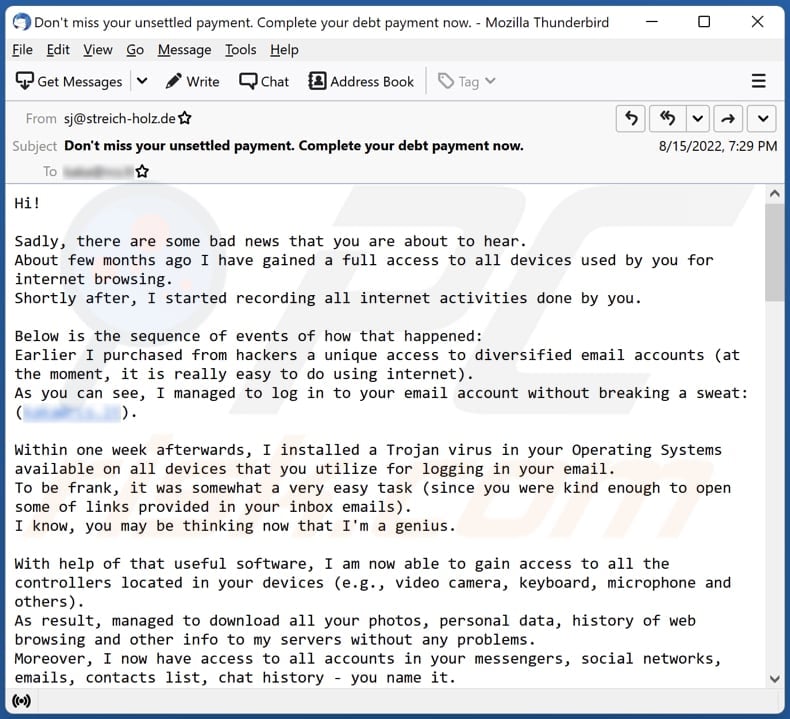
After examining this email, we concluded that it is a fake sextortion email claiming that a computer has been hacked and that the scammer has obtained intimate recordings of recipients. Scammers behind this email aim to extort money from unsuspecting recipients. Such emails should be ignored and reported.
More about the "Some Bad News That You Are About To Hear" sextortion scam
Scammers claim that they have gained full access to all devices used by recipients for Internet browsing and recorded all activities. They also claim that they have downloaded all photos, personal data, browsing history, accessed messengers, social networking and email accounts, contact lists, chat history, etc.
The purpose of this email is to trick recipients into believing that scammers have recorded intimate videos of them and will disclose those videos. Scammers demand to be paid $1450 in Bitcoins for not sharing any of the supposedly recorded material. They urge recipients to make the payment within 48 hours.
| Name | Some Bad News That You Are About To Hear Email Scam |
| Threat Type | Phishing, Scam, Social Engineering, Fraud |
| Fake Claim | Computer has been hacked and recored intimate material will be disclosed |
| Ransom Amount | $1450 in Bitcoins |
| Cyber Criminal Cryptowallet Address | 1G9HkwPLZKLjDWirY5KMStNrcEugJBi35q, 1ReCKyhNPdHkbNCjf3EyRgr6XZX78rURd, 17nwWzU9WA9tmRrQLaJqHRszzjLt2xMgmG, 15L57f8G22cPmDtq2devcQw6J4SbC8EX8b, 1Fgiv3CQ15pkaMG4BzNzNiZGjy5NxaiLt5, 16cL1ocheApPSihjLMNLvEUATS4u33s111 |
| Distribution methods | Deceptive emails |
| Damage | Monetary loss |
| Malware Removal (Windows) |
To eliminate possible malware infections, scan your computer with legitimate antivirus software. Our security researchers recommend using Combo Cleaner. Download Combo CleanerTo use full-featured product, you have to purchase a license for Combo Cleaner. 7 days free trial available. Combo Cleaner is owned and operated by RCS LT, the parent company of PCRisk.com. |
Similar scams in general
As a rule, sextortion scams are used to trick people into believing that some intimate photos and (or) videos will be published online/sent to other people if they do not pay a specified amount of money (usually in cryptocurrency). None of the claims in such scams are true.
Sometimes, scammers provide passwords. Usually, they obtain passwords in data leaks from online servers. Pretty often, those are some old passwords that are not being used by recipients anymore. However, those passwords help scammers to make their scams more convincing.
Examples of similar scams are "I Regret To Inform You About Some Sad News For You Email Scam", "I Am A Russian Hacker Who Has Access To Your Operating System Email Scam", and "I Broke Into Your Computer System Using The Wireless Network Router Email Scam". It is important to know that threat actors can use email to deliver malware.
How do spam campaigns infect computers?
An email used to proliferate malware contains a malicious attachment (file) or link. Cybercriminals behind it aim to trick recipients into downloading and opening a malicious file (e.g., MS Office, PDF document, ISO file, archive file, executable file).
Not all files infect computers right after opening them. For example, malicious MS Office documents cannot inject malware until users enable macros commands (enable editing/content). Archive files (like ZIP, RAR) cannot infect computers unless users execute their contents, etc.
How to avoid installation of malware?
Do not trust irrelevant emails sent from unknown, suspicious addresses. Especially when such emails contain attachments or links. Download software from official pages and stores. Do not trust other sources (e.g., P2P networks, free file hosting sites, third-party downloaders, questionable websites).
Keep the operating system and installed programs installed up to date. Use tools provided by the official developers to update and activate all software. If you've already opened malicious attachments, we recommend running a scan with Combo Cleaner Antivirus for Windows to automatically eliminate infiltrated malware.
Appearance of the email (GIF):
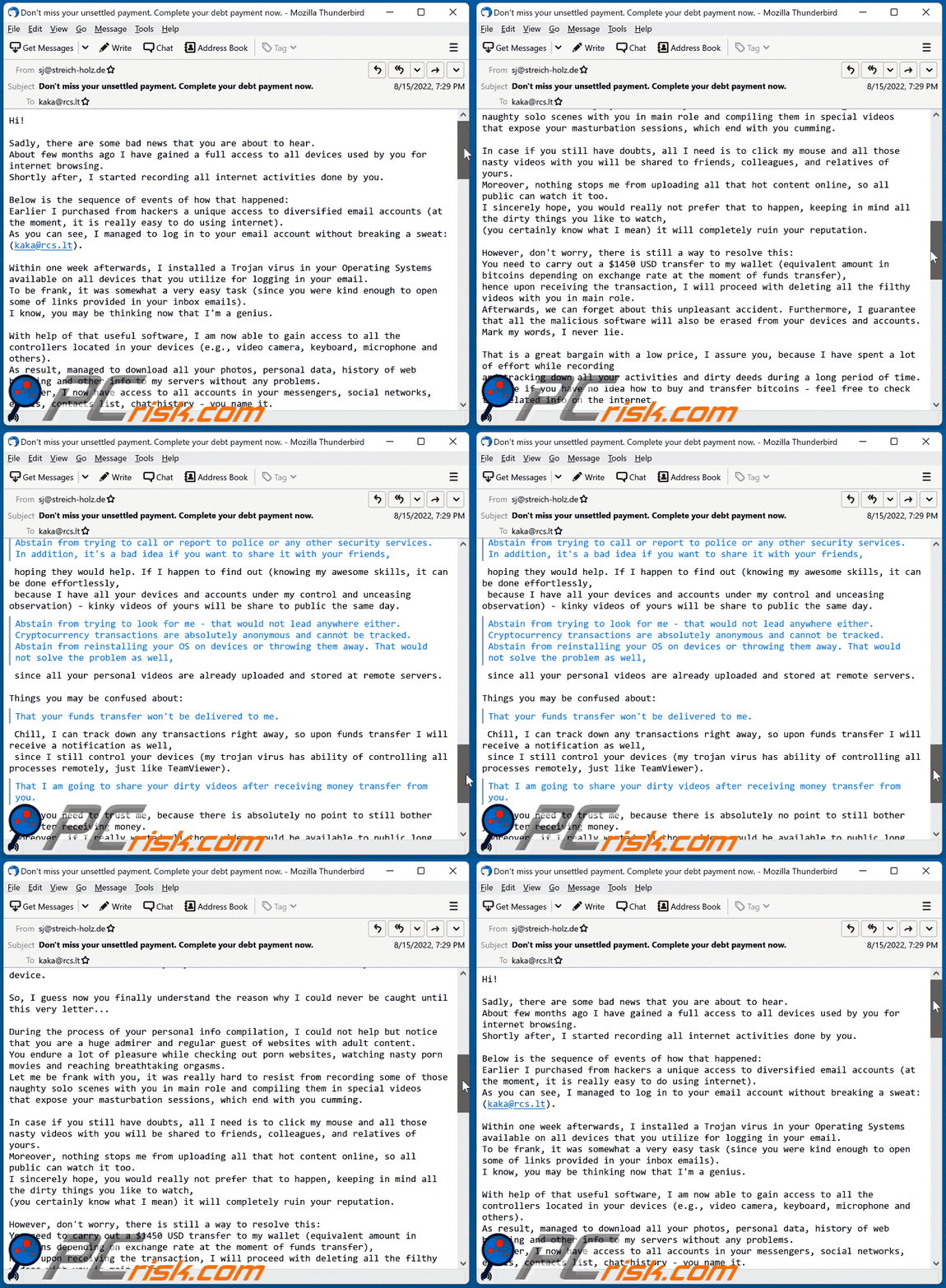
Text presented in the email letter:
Subject: Don't miss your unsettled payment. Complete your debt payment now.
Hi!Sadly, there are some bad news that you are about to hear.
About few months ago I have gained a full access to all devices used by you for internet browsing.
Shortly after, I started recording all internet activities done by you.Below is the sequence of events of how that happened:
Earlier I purchased from hackers a unique access to diversified email accounts (at the moment, it is really easy to do using internet).
As you can see, I managed to log in to your email account without breaking a sweat: (*********).Within one week afterwards, I installed a Trojan virus in your Operating Systems available on all devices that you utilize for logging in your email.
To be frank, it was somewhat a very easy task (since you were kind enough to open some of links provided in your inbox emails).
I know, you may be thinking now that I'm a genius.With help of that useful software, I am now able to gain access to all the controllers located in your devices (e.g., video camera, keyboard, microphone and others).
As result, managed to download all your photos, personal data, history of web browsing and other info to my servers without any problems.
Moreover, I now have access to all accounts in your messengers, social networks, emails, contacts list, chat history - you name it.
My Trojan virus continues refreshing its signatures in a non-stop manner (because it is operated by driver),
hence it remains undetected by any antivirus software installed in your PC or device.So, I guess now you finally understand the reason why I could never be caught until this very letter...
During the process of your personal info compilation, I could not help but notice that you are a huge admirer and regular guest of websites with adult content.
You endure a lot of pleasure while checking out porn websites, watching nasty porn movies and reaching breathtaking orgasms.
Let me be frank with you, it was really hard to resist from recording some of those naughty solo scenes with you in main role and compiling them in special videos
that expose your masturbation sessions, which end with you cumming.In case if you still have doubts, all I need is to click my mouse and all those nasty videos with you will be shared to friends, colleagues, and relatives of yours.
Moreover, nothing stops me from uploading all that hot content online, so all public can watch it too.
I sincerely hope, you would really not prefer that to happen, keeping in mind all the dirty things you like to watch,
(you certainly know what I mean) it will completely ruin your reputation.However, don't worry, there is still a way to resolve this:
You need to carry out a $1450 USD transfer to my wallet (equivalent amount in bitcoins depending on exchange rate at the moment of funds transfer),
hence upon receiving the transaction, I will proceed with deleting all the filthy videos with you in main role.
Afterwards, we can forget about this unpleasant accident. Furthermore, I guarantee that all the malicious software will also be erased from your devices and accounts.
Mark my words, I never lie.That is a great bargain with a low price, I assure you, because I have spent a lot of effort while recording
and tracking down all your activities and dirty deeds during a long period of time.
In case if you have no idea how to buy and transfer bitcoins - feel free to check the related info on the internet.Here is my bitcoin wallet for your reference: 1ReCKyhNPdHkbNCjf3EyRgr6XZX78rURd
From now on, you have only 48 hours and countdown has started once you opened this very email (in other words, 2 days).
The following list contains things you should definitely abstain from doing or even attempting:
> Abstain from trying to reply this email (since the email is generated inside your inbox alongside with return address).
> Abstain from trying to call or report to police or any other security services. In addition, it's a bad idea if you want to share it with your friends,
hoping they would help. If I happen to find out (knowing my awesome skills, it can be done effortlessly,
because I have all your devices and accounts under my control and unceasing observation) - kinky videos of yours will be share to public the same day.
> Abstain from trying to look for me - that would not lead anywhere either. Cryptocurrency transactions are absolutely anonymous and cannot be tracked.
> Abstain from reinstalling your OS on devices or throwing them away. That would not solve the problem as well,
since all your personal videos are already uploaded and stored at remote servers.Things you may be confused about:
> That your funds transfer won't be delivered to me.
Chill, I can track down any transactions right away, so upon funds transfer I will receive a notification as well,
since I still control your devices (my trojan virus has ability of controlling all processes remotely, just like TeamViewer).
> That I am going to share your dirty videos after receiving money transfer from you.
Here you need to trust me, because there is absolutely no point to still bother you after receiving money.
Moreover, if I really wanted all those videos would be available to public long time ago!I believe we can still handle this situation on fair terms!
Here is my last advice to you... in future you better ensure you stay away from this kind of situations!
My advice - don't forget to regularly update your passwords to feel completely secure.
Instant automatic malware removal:
Manual threat removal might be a lengthy and complicated process that requires advanced IT skills. Combo Cleaner is a professional automatic malware removal tool that is recommended to get rid of malware. Download it by clicking the button below:
DOWNLOAD Combo CleanerBy downloading any software listed on this website you agree to our Privacy Policy and Terms of Use. To use full-featured product, you have to purchase a license for Combo Cleaner. 7 days free trial available. Combo Cleaner is owned and operated by RCS LT, the parent company of PCRisk.com.
Quick menu:
- What is Some Bad News That You Are About To Hear sextortion scam?
- Types of malicious emails.
- How to spot a malicious email?
- What to do if you fell for an email scam?
Types of malicious emails:
 Phishing Emails
Most commonly, cybercriminals use deceptive emails to trick Internet users into giving away their sensitive private information, for example, login information for various online services, email accounts, or online banking information.
Such attacks are called phishing. In a phishing attack, cybercriminals usually send an email message with some popular service logo (for example, Microsoft, DHL, Amazon, Netflix), create urgency (wrong shipping address, expired password, etc.), and place a link which they hope their potential victims will click on.
After clicking the link presented in such email message, victims are redirected to a fake website that looks identical or extremely similar to the original one. Victims are then asked to enter their password, credit card details, or some other information that gets stolen by cybercriminals.
 Emails with Malicious Attachments
Another popular attack vector is email spam with malicious attachments that infect users' computers with malware. Malicious attachments usually carry trojans that are capable of stealing passwords, banking information, and other sensitive information.
In such attacks, cybercriminals' main goal is to trick their potential victims into opening an infected email attachment. To achieve this goal, email messages usually talk about recently received invoices, faxes, or voice messages.
If a potential victim falls for the lure and opens the attachment, their computers get infected, and cybercriminals can collect a lot of sensitive information.
While it's a more complicated method to steal personal information (spam filters and antivirus programs usually detect such attempts), if successful, cybercriminals can get a much wider array of data and can collect information for a long period of time.
 Sextortion Emails
This is a type of phishing. In this case, users receive an email claiming that a cybercriminal could access the webcam of the potential victim and has a video recording of one's masturbation.
To get rid of the video, victims are asked to pay a ransom (usually using Bitcoin or another cryptocurrency). Nevertheless, all of these claims are false - users who receive such emails should ignore and delete them.
How to spot a malicious email?
While cyber criminals try to make their lure emails look trustworthy, here are some things that you should look for when trying to spot a phishing email:
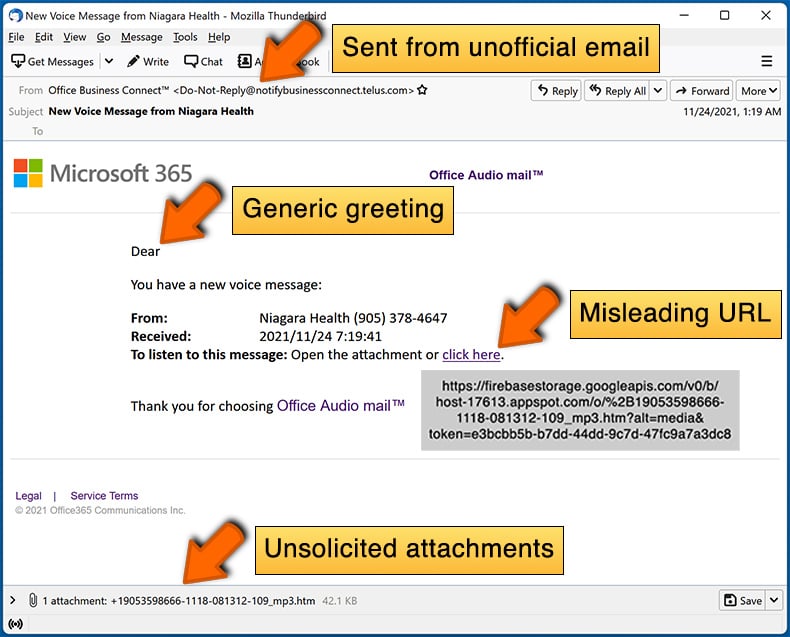
- Check the sender's ("from") email address: Hover your mouse over the "from" address and check if it's legitimate. For example, if you received an email from Microsoft, be sure to check if the email address is @microsoft.com and not something suspicious like @m1crosoft.com, @microsfot.com, @account-security-noreply.com, etc.
- Check for generic greetings: If the greeting in the email is "Dear user", "Dear @youremail.com", "Dear valued customer", this should raise suspiciousness. Most commonly, companies call you by your name. Lack of this information could signal a phishing attempt.
- Check the links in the email: Hover your mouse over the link presented in the email, if the link that appears seems suspicious, don't click it. For example, if you received an email from Microsoft and the link in the email shows that it will go to firebasestorage.googleapis.com/v0... you shouldn't trust it. It's best not to click any links in the emails but to visit the company website that sent you the email in the first place.
- Don't blindly trust email attachments: Most commonly, legitimate companies will ask you to log in to their website and to view any documents there; if you received an email with an attachment, it's a good idea to scan it with an antivirus application. Infected email attachments are a common attack vector used by cybercriminals.
To minimise the risk of opening phishing and malicious emails we recommend using Combo Cleaner Antivirus for Windows.
Example of a spam email:
What to do if you fell for an email scam?
- If you clicked on a link in a phishing email and entered your password - be sure to change your password as soon as possible. Usually, cybercriminals collect stolen credentials and then sell them to other groups that use them for malicious purposes. If you change your password in a timely manner, there's a chance that criminals won't have enough time to do any damage.
- If you entered your credit card information - contact your bank as soon as possible and explain the situation. There's a good chance that you will need to cancel your compromised credit card and get a new one.
- If you see any signs of identity theft - you should immediately contact the Federal Trade Commission. This institution will collect information about your situation and create a personal recovery plan.
- If you opened a malicious attachment - your computer is probably infected, you should scan it with a reputable antivirus application. For this purpose, we recommend using Combo Cleaner Antivirus for Windows.
- Help other Internet users - report phishing emails to Anti-Phishing Working Group, FBI’s Internet Crime Complaint Center, National Fraud Information Center and U.S. Department of Justice.
Frequently Asked Questions (FAQ)
Why did I receive this email?
This email was sent to many addresses. Scammers behind this sextortion scam campaign do not target anyone in particular. Their goal is to trick at least one person into believing that his/her computer is hacked and intimate material will be published if he/her does not pay a specified amount of money.
Was my computer actually hacked and does the sender have any information?
No, scammers only claim they hacked a computer, downloaded personal data, etc. None of those claims are true.
How did cyber criminals get my email password?
Typically, scammers obtain email addresses and passwords after data breaches, or they obtain them via phishing websites or other untrustworthy pages that were used to trick visitors into providing personal information.
I have sent cryptocurrency to the address presented in such email, can I get my money back?
No, crypto transactions are irreversible.
Will Combo Cleaner remove malware infections that were present in email attachment?
Yes, Combo Cleaner can detect and remove almost all known malware. Computers infected with high-end malware must be scanned fully. Running a quick scan is not enough to detect malware that hides deep in the system.
Share:
 Facebook
 X.com
X.com
 LinkedIn
 Copy Link

Tomas Meskauskas
Expert security researcher, professional malware analyst
I am passionate about computer security and technology. I have an experience of over 10 years working in various companies related to computer technical issue solving and Internet security. I have been working as an author and editor for pcrisk.com since 2010. Follow me on Twitter and LinkedIn to stay informed about the latest online security threats.
PCrisk security portal is brought by a company RCS LT.
Joined forces of security researchers help educate computer users about the latest online security threats. More information about the company RCS LT.
Our malware removal guides are free. However, if you want to support us you can send us a donation.
DonatePCrisk security portal is brought by a company RCS LT.
Joined forces of security researchers help educate computer users about the latest online security threats. More information about the company RCS LT.
Our malware removal guides are free. However, if you want to support us you can send us a donation.
Donate
▼ Show Discussion