
How to identify scams like "One Time Password Authentication"
Phishing/ScamAlso Known As: Fake One Time Password Authentication request

Get free scan and check if your device is infected.
Remove it nowTo use full-featured product, you have to purchase a license for Combo Cleaner. Seven days free trial available. Combo Cleaner is owned and operated by RCS LT, the parent company of PCRisk.com.
What kind of scam is the fake "One Time Password Authentication" message?
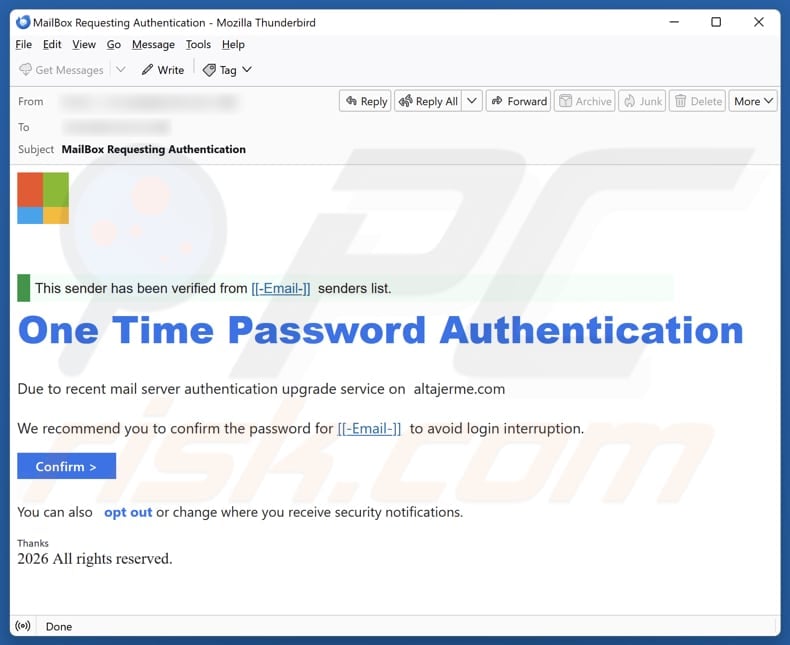
We have inspected the email and concluded that it is a phishing message posing as an authentication notice from the email provider. Its goal is to lure recipients into sharing personal data on a fraudulent website. Victims of this scam may encounter issues such as account hijacking and additional complications.
More about the "One Time Password Authentication" scam email
This scam email states that a recent mail server upgrade requires confirmation of the account password to avoid login interruptions. It presents a one-time password authentication and provides a link to "confirm" the password. The message also mentions options to opt out or change where security notifications are received to appear legitimate.
The website included in this phishing email was not active when we checked it. However, emails like this usually lead to fake login pages. In this case, the scammers were likely trying to trick users into entering their email addresses and passwords on a bogus login page.
Compromised login information can be sold or exploited to gain access to personal accounts, including email, social media, or gaming accounts. Once accessed, these accounts can be used to spread malware, carry out scams, make unauthorized purchases, or engage in other activities.
Falling for scams like this can result in money loss, stolen identities, damage to reputation, and other serious consequences. It is important to identify these emails and avoid interacting with them.
| Name | One Time Password Authentication Email Scam |
| Threat Type | Phishing, Scam, Social Engineering, Fraud |
| Fake Claim | The recipient has to authenticate their email account |
| Disguise | Message from the service provider |
| Symptoms | Unauthorized online purchases, changed online account passwords, identity theft, illegal access of the computer. |
| Distribution methods | Deceptive emails, rogue online pop-up ads, search engine poisoning techniques, misspelled domains. |
| Damage | Loss of sensitive private information, monetary loss, identity theft. |
| Malware Removal (Windows) |
To eliminate possible malware infections, scan your computer with legitimate antivirus software. Our security researchers recommend using Combo Cleaner. Download Combo CleanerTo use full-featured product, you have to purchase a license for Combo Cleaner. 7 days free trial available. Combo Cleaner is owned and operated by RCS LT, the parent company of PCRisk.com. |
Conclusion
This scam is designed to steal login credentials by posing as a legitimate account verification request. Users who provide their information risk having their accounts compromised and potentially misused for fraudulent activities. Recipients should recognize such emails and avoid engaging with them.
Examples of similar scams are "DHL - Shipment Address Is Missing Email Scam", "FINAL WARNING: Mailbox Upgrade Required Email Scam", and "Revalidate Multi-Factor Authentication Email Scam".
How do spam campaigns infect computers?
Cybercriminals can spread malware through email attachments. They usually send malicious Word, Excel, or PDF documents, as well as executables, script files, or ZIP (or RAR) files. When the recipient opens the file or performs additional steps, the system becomes infected with malware.
Threat actors can also use malicious links in emails. If a user clicks one of these links, it can lead to a fake website that either secretly downloads malware on the device or tricks the user into downloading and launching the harmful software manually.
How to avoid installation of malware?
Be cautious with any unexpected and irrelevant emails or messages, especially those that contain attachments or links. Avoid interacting with links, pop-ups, or advertisements, on suspicious websites, and never allow such sites to show browser notifications.
Download programs only from official websites or trusted app stores. Avoid pirated software, cracks, and unofficial activation tools. Make sure your operating system and applications are regularly updated, and use a reliable security solution to routinely check your device for malware and remove any detected risks.
Text presented in the "One Time Password Authentication" email letter:
Subject: MailBox Requesting Authentication
This sender has been verified from [[-Email-]] senders list.
One Time Password AuthenticationDue to recent mail server authentication upgrade service on altajerme.com
We recommend you to confirm the password for [[-Email-]] to avoid login interruption.
Confirm >You can also opt out or change where you receive security notifications.
Thanks
2026 All rights reserved.
Instant automatic malware removal:
Manual threat removal might be a lengthy and complicated process that requires advanced IT skills. Combo Cleaner is a professional automatic malware removal tool that is recommended to get rid of malware. Download it by clicking the button below:
DOWNLOAD Combo CleanerBy downloading any software listed on this website you agree to our Privacy Policy and Terms of Use. To use full-featured product, you have to purchase a license for Combo Cleaner. 7 days free trial available. Combo Cleaner is owned and operated by RCS LT, the parent company of PCRisk.com.
Quick menu:
- What is Fake One Time Password Authentication request?
- Types of malicious emails.
- How to spot a malicious email?
- What to do if you fell for an email scam?
Types of malicious emails:
 Phishing Emails
Most commonly, cybercriminals use deceptive emails to trick Internet users into giving away their sensitive private information, for example, login information for various online services, email accounts, or online banking information.
Such attacks are called phishing. In a phishing attack, cybercriminals usually send an email message with some popular service logo (for example, Microsoft, DHL, Amazon, Netflix), create urgency (wrong shipping address, expired password, etc.), and place a link which they hope their potential victims will click on.
After clicking the link presented in such email message, victims are redirected to a fake website that looks identical or extremely similar to the original one. Victims are then asked to enter their password, credit card details, or some other information that gets stolen by cybercriminals.
 Emails with Malicious Attachments
Another popular attack vector is email spam with malicious attachments that infect users' computers with malware. Malicious attachments usually carry trojans that are capable of stealing passwords, banking information, and other sensitive information.
In such attacks, cybercriminals' main goal is to trick their potential victims into opening an infected email attachment. To achieve this goal, email messages usually talk about recently received invoices, faxes, or voice messages.
If a potential victim falls for the lure and opens the attachment, their computers get infected, and cybercriminals can collect a lot of sensitive information.
While it's a more complicated method to steal personal information (spam filters and antivirus programs usually detect such attempts), if successful, cybercriminals can get a much wider array of data and can collect information for a long period of time.
 Sextortion Emails
This is a type of phishing. In this case, users receive an email claiming that a cybercriminal could access the webcam of the potential victim and has a video recording of one's masturbation.
To get rid of the video, victims are asked to pay a ransom (usually using Bitcoin or another cryptocurrency). Nevertheless, all of these claims are false - users who receive such emails should ignore and delete them.
How to spot a malicious email?
While cyber criminals try to make their lure emails look trustworthy, here are some things that you should look for when trying to spot a phishing email:
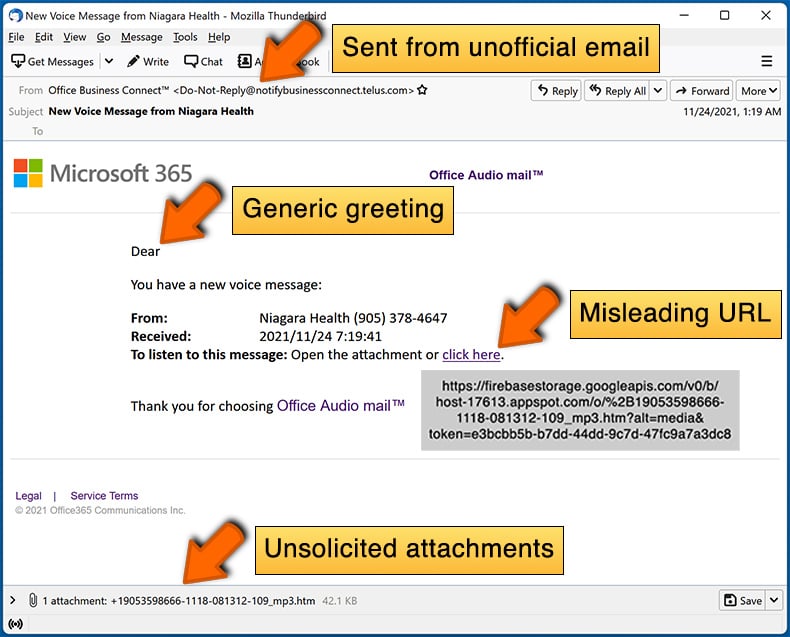
- Check the sender's ("from") email address: Hover your mouse over the "from" address and check if it's legitimate. For example, if you received an email from Microsoft, be sure to check if the email address is @microsoft.com and not something suspicious like @m1crosoft.com, @microsfot.com, @account-security-noreply.com, etc.
- Check for generic greetings: If the greeting in the email is "Dear user", "Dear @youremail.com", "Dear valued customer", this should raise suspiciousness. Most commonly, companies call you by your name. Lack of this information could signal a phishing attempt.
- Check the links in the email: Hover your mouse over the link presented in the email, if the link that appears seems suspicious, don't click it. For example, if you received an email from Microsoft and the link in the email shows that it will go to firebasestorage.googleapis.com/v0... you shouldn't trust it. It's best not to click any links in the emails but to visit the company website that sent you the email in the first place.
- Don't blindly trust email attachments: Most commonly, legitimate companies will ask you to log in to their website and to view any documents there; if you received an email with an attachment, it's a good idea to scan it with an antivirus application. Infected email attachments are a common attack vector used by cybercriminals.
To minimise the risk of opening phishing and malicious emails we recommend using Combo Cleaner Antivirus for Windows.
Example of a spam email:
What to do if you fell for an email scam?
- If you clicked on a link in a phishing email and entered your password - be sure to change your password as soon as possible. Usually, cybercriminals collect stolen credentials and then sell them to other groups that use them for malicious purposes. If you change your password in a timely manner, there's a chance that criminals won't have enough time to do any damage.
- If you entered your credit card information - contact your bank as soon as possible and explain the situation. There's a good chance that you will need to cancel your compromised credit card and get a new one.
- If you see any signs of identity theft - you should immediately contact the Federal Trade Commission. This institution will collect information about your situation and create a personal recovery plan.
- If you opened a malicious attachment - your computer is probably infected, you should scan it with a reputable antivirus application. For this purpose, we recommend using Combo Cleaner Antivirus for Windows.
- Help other Internet users - report phishing emails to Anti-Phishing Working Group, FBI’s Internet Crime Complaint Center, National Fraud Information Center and U.S. Department of Justice.
Frequently Asked Questions (FAQ)
Why did I receive this email?
These types of emails are usually distributed to large groups of recipients simultaneously. Attackers often collect email addresses from sources like data breaches, compromised websites, social media platforms, or other sources.
I have provided my personal information when tricked by this email, what should I do?
Change the passwords for any potentially affected accounts, and contact your bank and relevant authorities if any financial information may have been exposed.
I have downloaded and opened a malicious file attached to an email, is my computer infected?
The risk of infection varies based on the type of file and the user's actions. Executable files can infect a system immediately when opened, while documents and other formats usually need the user to take extra steps before malware is activated.
I have read the email but did not open the attachment, is my computer infected?
Simply opening an email is not risky. A device can only become infected if the user clicks on malicious links or opens infected attachments.
Will Combo Cleaner remove malware infections that were present in email attachment?
Combo Cleaner can identify and remove most known threats. Because sophisticated malware may be deeply embedded in the system, performing a full system scan is highly advisable to ensure complete removal.
Share:
 Facebook
 X.com
X.com
 LinkedIn
 Copy Link

Tomas Meskauskas
Expert security researcher, professional malware analyst
I am passionate about computer security and technology. I have an experience of over 10 years working in various companies related to computer technical issue solving and Internet security. I have been working as an author and editor for pcrisk.com since 2010. Follow me on Twitter and LinkedIn to stay informed about the latest online security threats.
PCrisk security portal is brought by a company RCS LT.
Joined forces of security researchers help educate computer users about the latest online security threats. More information about the company RCS LT.
Our malware removal guides are free. However, if you want to support us you can send us a donation.
DonatePCrisk security portal is brought by a company RCS LT.
Joined forces of security researchers help educate computer users about the latest online security threats. More information about the company RCS LT.
Our malware removal guides are free. However, if you want to support us you can send us a donation.
Donate
▼ Show Discussion