

Get free scan and check if your device is infected.
Remove it nowTo use full-featured product, you have to purchase a license for Combo Cleaner. Seven days free trial available. Combo Cleaner is owned and operated by RCS LT, the parent company of PCRisk.com.
What kind of malware is EKZ Stealer?
EKZ Stealer is an information stealer designed to silently extract saved passwords, cookies, autofill data, and payment card details from web browsers on infected Windows computers. According to research by Arctic Wolf, it was first observed in May 2026 as part of a campaign targeting organizations that use Fortinet's FortiClient EMS software.
To deliver the stealer, attackers disguised it as a legitimate Fortinet software update named FortiEndpoint_Patch.exe. The file was pushed to managed endpoints automatically through tampered VPN profile configurations, meaning victims typically had no idea the malware was being installed.
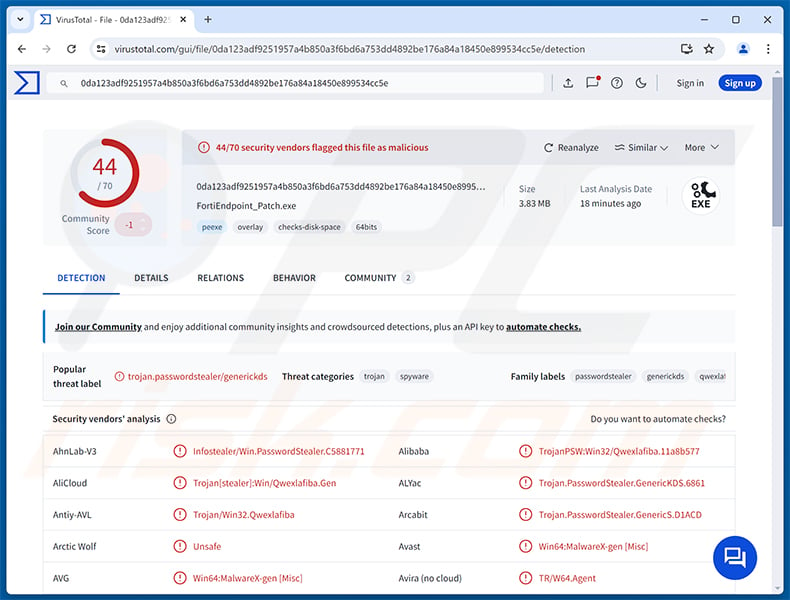
EKZ Stealer overview
The malware targets both Chromium-based browsers (such as Chrome and Edge) and Firefox-based browsers, including LibreWolf, Waterfox, Pale Moon, and Thunderbird. From these applications, it collects saved login credentials, session cookies, autofill data, and saved credit card numbers.
Once collection is complete, harvested data is written to a log file on the victim's machine and then sent to a server controlled by the attackers over an HTTP connection. The stealer supports repeated use across multiple hosts via a command-line interface, suggesting it is used in targeted, operator-driven operations.
The campaign Arctic Wolf documented exploited CVE-2026-35616, a vulnerability in FortiClient EMS that gave unauthenticated access to the server's management API. Attackers used that foothold to modify VPN profile configurations, injecting malicious PowerShell commands that were automatically executed on all managed endpoints when a VPN connection was made.
How EKZ Stealer steals browser data
Chromium-based browsers encrypt saved passwords using a protection tied to the Windows user account. EKZ Stealer bypasses this by copying itself into the browser's own application folder and relaunching from that location, which causes the browser to treat it as a trusted internal process.
From that position, it calls a privileged browser function to retrieve the AES-256 decryption key used to protect stored credentials. This allows the stealer to read every saved password in the browser without any warning to the user.
Defense evasion
EKZ Stealer takes steps to hinder analysis and remove traces of the infection. Its executable has a zeroed build timestamp, which removes the date marker normally used by researchers to determine when a program was compiled.
The malware was also delivered via Base64-encoded PowerShell scripts, which can bypass filters that scan for recognizable malicious commands. After exfiltration completes, the stealer deletes the payload file and cleans up related log entries, erasing evidence of the infection.
| Name | EKZ infostealer |
| Threat Type | Information Stealer, Trojan, Password-stealing virus |
| Detection Names | Avast (Win64:MalwareX-gen [Misc]), AVG (Win64:MalwareX-gen [Misc]), Combo Cleaner (Trojan.PasswordStealer.GenericKDS.6861), Kaspersky (Trojan-PSW.Win64.Agent.aea), Microsoft (Trojan:Win32/Qwexlafiba!rfn), Full List (VirusTotal) |
| Symptoms | Stealers are designed to stealthily infiltrate the victim's computer and remain silent, and thus no particular symptoms are clearly visible on an infected machine. |
| Distribution methods | Exploited software vulnerability (CVE-2026-35616), malicious PowerShell scripts, fake software update (disguised as a legitimate Fortinet patch). |
| Damage | Stolen passwords and banking information, identity theft, account hijacking, additional infections, monetary loss. |
| Malware Removal (Windows) |
To eliminate possible malware infections, scan your computer with legitimate antivirus software. Our security researchers recommend using Combo Cleaner. Download Combo CleanerTo use full-featured product, you have to purchase a license for Combo Cleaner. 7 days free trial available. Combo Cleaner is owned and operated by RCS LT, the parent company of PCRisk.com. |
Conclusion
Victims of EKZ Stealer can lose all credentials stored in their browsers, including account passwords, payment card data, and session cookies that may allow attackers to access accounts without needing the original password. Any accounts active in the browser at the time of infection should be considered potentially compromised.
The stealer's cleanup routine makes it difficult to confirm an infection after the fact, and organizations affected by the FortiClient EMS vulnerability may have had it deployed across many devices at once. EKZ Stealer should be removed from the system immediately.
More examples of stealers are DebugElevator, Evolution, and Needle.
How did EKZ Stealer infiltrate my computer?
According to Arctic Wolf, the EKZ Stealer campaign exploited CVE-2026-35616, a vulnerability in Fortinet's FortiClient EMS that allowed unauthenticated access to the server's management API. Attackers gained administrative control and modified VPN profile settings to inject malicious PowerShell scripts into the configuration.
These scripts were executed automatically on all managed endpoints whenever a VPN connection was established. The payload was named FortiEndpoint_Patch.exe, and to most users and administrators it would look like a routine Fortinet software update rather than malware.
Outside of this specific campaign, stealers commonly reach users through phishing emails, fake software download sites, pirated software, and software cracks.
How to avoid installation of malware?
Keep all software up to date, including network management tools and VPN clients. Vulnerabilities like CVE-2026-35616 are patched by vendors once discovered, but devices must actually receive and apply those patches to be protected. Only download software updates directly from official vendor websites.
Be cautious with unexpected emails that contain attachments or links, even when they appear to come from a trusted source. Use reputable antivirus software and scan regularly for threats. If you believe that your computer is already infected, we recommend running a scan with Combo Cleaner Antivirus for Windows to automatically eliminate infiltrated malware.
How to remove malware manually?
Most trojan infections can be removed by running a full system scan with Combo Cleaner. The full manual procedure below is for cases where automatic removal failed, where you want to verify a scan caught everything, or where the threat has multiple persistence points.
Disconnect from the network
Unplug your Ethernet cable and turn off Wi-Fi. If you're on a laptop, the airplane-mode key works fastest.
Many trojans exfiltrate data - saved browser passwords, banking sessions, screenshots - and accept remote commands. Cutting the network stops both immediately. Keep it disconnected until Phase 4.
Boot into Safe Mode with Networking
Safe Mode loads a minimal set of drivers and stops most malware from auto-running. "With Networking" lets you download tools - re-enable Wi-Fi only after you've booted in.
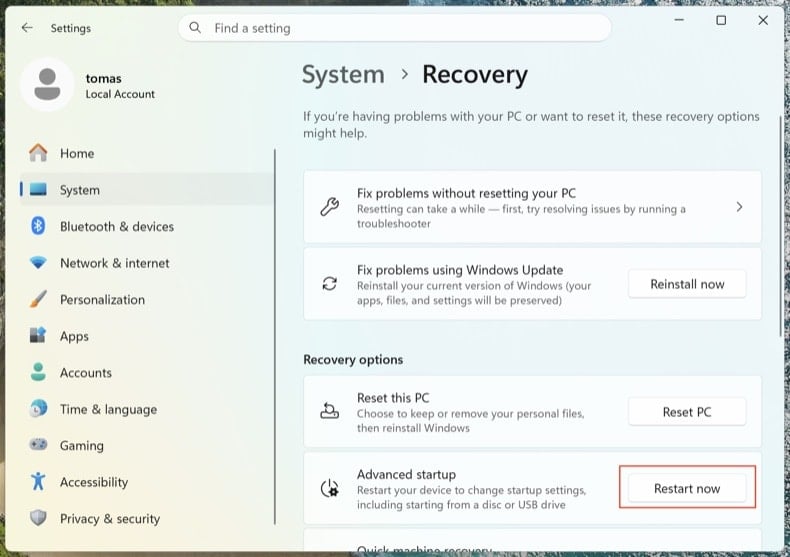
Open . Click Restart now next to Advanced startup.
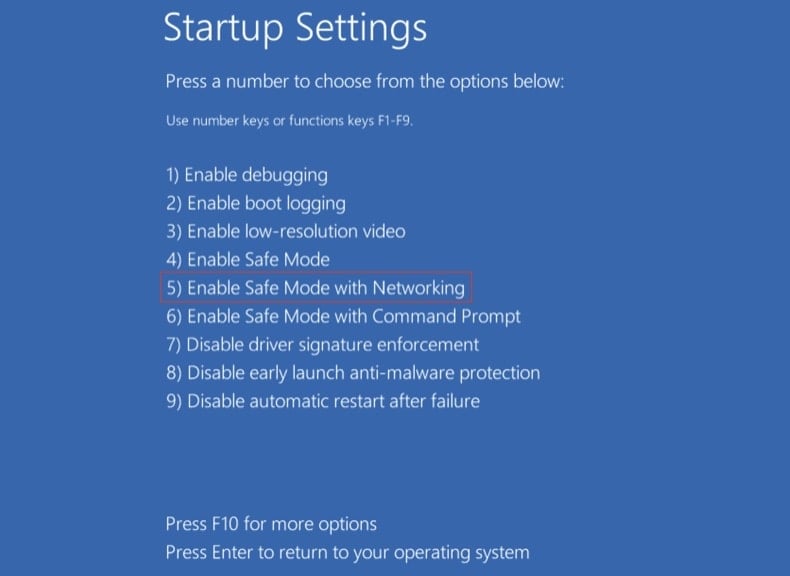
Your computer will restart into the "Choose an option" menu. Click . After the second reboot, press 5 or F5.
Click the Windows logo, hold Shift, click the Power icon and choose Restart. In the Choose an option screen, click . Press F5.
Windows 8
Go to the Start Screen, type Advanced, select Settings → Advanced startup options → Restart now → Troubleshoot → Advanced options → Startup settings → Restart → F5.
Note: Windows 8 reached end-of-life in January 2023 - running on it puts you at much higher risk of reinfection.
Windows 7
Click Start → Shut Down → Restart → OK. As the system boots, press F8 repeatedly until the Windows Advanced Options menu appears, then choose Safe Mode with Networking.
Note: Windows 7 reached end-of-life in January 2020 - running on it puts you at much higher risk of reinfection.
Inspect running processes with Process Explorer
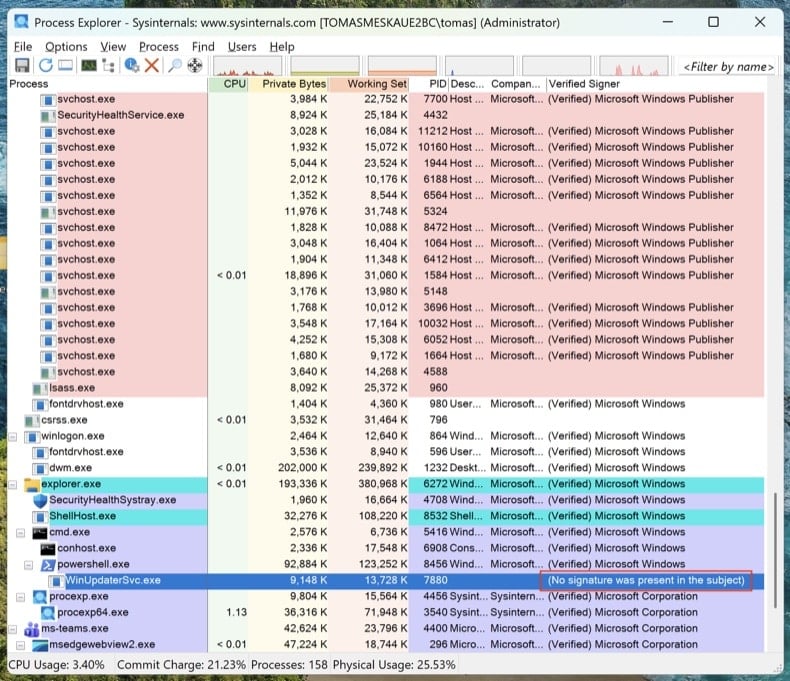
Download Process Explorer from Microsoft Sysinternals. Run it as Administrator. Click and .
Sort by "Verified Signer." Anything unsigned running from %AppData%, %LocalAppData%, %Temp%, or %ProgramData% is suspicious. Right-click → Properties to see the full image path. Right-click → "Search Online" to look up unfamiliar process names.
Task Manager hides full file paths, doesn't show digital signatures, and groups processes in ways that make malware easy to miss. Process Explorer is the same tool Microsoft engineers use.
Map every persistence point with Autoruns
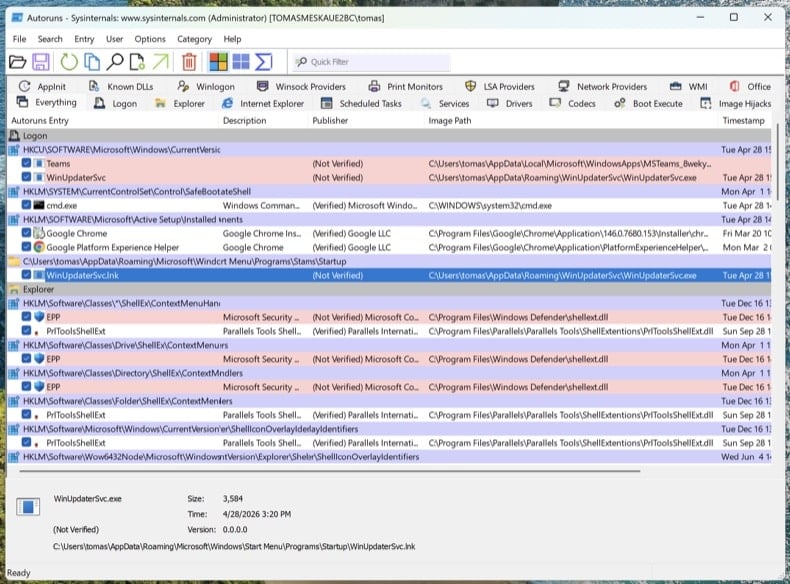
Download Autoruns. Right-click Autoruns.exe and choose Run as administrator - without elevation, Autoruns can't inspect protected registry hives.
In the menu, open and , then click Refresh.
Modern trojans don't just live in startup. Walk through these tabs and look for unsigned or unfamiliar entries:
- Logon - classic Run/RunOnce keys
- Scheduled Tasks - frequent hiding spot, especially tasks with PowerShell, MSHTA, or rundll32 actions
- Services - unsigned services in non-Microsoft folders
- WMI - Event Subscriptions are a stealthy persistence mechanism (MITRE T1546.003)
- Image Hijacks - Image File Execution Options "Debugger" abuse
- AppInit - DLLs loaded into every GUI process
- Browser plug-ins - unsigned add-ons across all installed browsers
Right-click any suspicious entry → "Jump to Image" to see the actual file. Right-click → "Search Online" opens VirusTotal for the file hash. Don't delete yet - just write down the file paths and entry names. We'll remove them after the scans.
Check the hosts file and DNS settings
Trojans often redirect bank, antivirus, and update domains to attacker-controlled servers by editing the hosts file or DNS settings.
Hosts file: Open Notepad as Administrator and open C:\Windows\System32\drivers\etc\hosts. Legitimate entries are commented with #. Any uncommented IP-to-domain mapping is suspicious - especially redirects for microsoft.com, windowsupdate, or your bank.
DNS settings: Open Command Prompt as Administrator and run ipconfig /all. Confirm your DNS servers point to your ISP, your router, or a known public resolver (Cloudflare 1.1.1.1, Google 8.8.8.8). Then open and verify both DNS and DNS over HTTPS (DoH) settings haven't been hijacked.
A clean PC with hijacked DNS is still a compromised PC. You'll think you're at chase.com and you'll be at the attacker's clone.
No single antivirus catches everything. The order below is intentional: offline scan first (catches rootkits before Windows fully loads), then on-demand scanners on the running system, then manual cleanup of anything they missed.
Run Microsoft Defender Offline
Reboot to normal Windows. Open . Select Microsoft Defender Antivirus (offline scan) and click Scan now. Your computer will restart into a stripped-down environment and scan before the full operating system loads.
Rootkits and bootkits hide from any scanner running on the same Windows session that's already infected. A pre-boot offline scan sees the disk before the malware can hide itself.
VB100 certified. Includes anti-trojan, registry/persistence scanning, anti-spyware in one pass. The 7-day free trial is available.
Download Combo CleanerRun Combo Cleaner full system scan
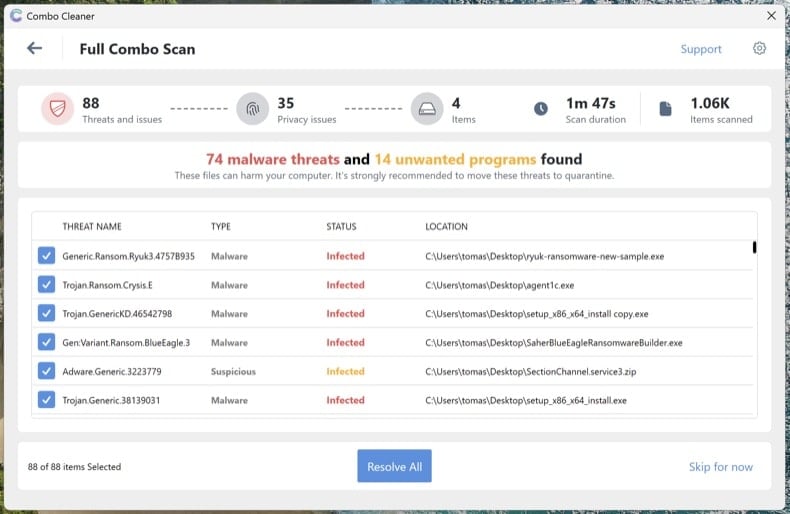
Install Combo Cleaner and run a full system scan (not the quick scan). Let it complete fully, review the detected threats, and apply the recommended actions. Combo Cleaner will quarantine known trojans and registry persistence.
Run Microsoft Safety Scanner as a second-opinion scan
Download Microsoft Safety Scanner (MSERT.exe), Microsoft's free on-demand tool. The binary expires every 10 days, which means every download has the latest signatures. Run a full scan after Combo Cleaner to catch anything one engine alone might miss.
Different scanning engines catch different threats. Running an additional Microsoft scan after Combo Cleaner is the single most underused verification step in malware removal.
Manually remove anything still listed in Autoruns
Reopen Autoruns. Anything you flagged in Step 4 that's still present hasn't been caught by the automated scans. For each remaining suspicious entry: right-click → Delete in Autoruns (this removes the persistence registration), then navigate to the file path and delete the actual file. Empty the Recycle Bin.
Some malware files reappear after deletion because something else on the system recreates them. If you delete a file and it returns within minutes, you have a remaining persistence point that Autoruns didn't show - usually a service or scheduled task running under SYSTEM. Re-run the scans from Steps 6-8 or proceed to a clean install (see end of guide).
Reset browsers and clear notification permissions
Trojans and adware frequently hijack browsers - change the default search engine, install rogue extensions, or grant themselves notification permissions to keep displaying scam pop-ups even after the malware is gone.
- Chrome: visit
chrome://settings/resetand click "Restore settings to their original defaults." Then visitchrome://settings/content/notificationsand remove any unfamiliar sites. - Edge: visit
edge://settings/reset. Then checkedge://settings/content/notifications. - Firefox: open
about:supportand click Refresh Firefox (Firefox uses "Refresh," not "Reset"). Then check Settings → Privacy & Security → Permissions → Notifications.
Review installed extensions in each browser and remove anything you don't recognize, especially extensions you didn't install yourself.
Re-enable Defender, Tamper Protection, and update everything
Many trojans disable security software. Open and confirm Real-time protection, Cloud-delivered protection, and Tamper Protection are all turned on. Tamper Protection prevents malware from disabling Defender silently.
Then run Windows Update () and update your browsers and applications. The infection vector that let the trojan in originally usually involves outdated software.
Change passwords from a clean device
If the trojan was an info-stealer (Lumma, RedLine, Vidar, and similar are extremely common), assume every password saved in your browser is compromised. Change them from a different, known-clean device - your phone is fine if it's not infected.
Recommended order:
- Primary email first - it's the recovery hub for everything else
- Banking and financial accounts
- Password manager master password (if you use one)
- Social media, shopping, and remaining accounts
Where available, enable phishing-resistant multi-factor authentication (passkeys / FIDO2 hardware keys / authenticator apps) - SMS-based MFA is bypassable by sophisticated attackers.
Verify the clean and monitor for 7 days
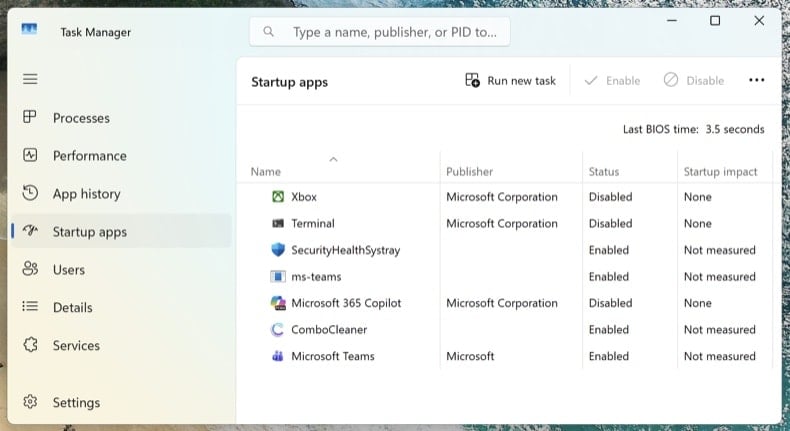
Reconnect to the network and run one final full scan with Combo Cleaner. Open Task Manager (Ctrl + Shift + Esc) and switch to the Startup apps tab - confirm nothing suspicious has reappeared.
Over the next 7 days, watch for symptom recurrence: unexpected high CPU usage, unknown processes returning, browser redirects, or pop-ups. If anything returns, you missed a persistence point and the procedure needs to be repeated - or you may have a deeper compromise that requires a clean install.
When to clean install Windows instead
Manual removal isn't always the right answer. Reinstalling Windows from scratch is the only way to be 100% certain when:
- The malware reappears after every removal attempt
- A bootkit or UEFI rootkit was detected (this class of threat sits below the operating system and survives a normal Windows reinstall)
- A confirmed credential-theft trojan ran with administrator privileges (Lumma, RedLine, Vidar) - the system likely has multiple unknown payloads
- The PC is used for online banking, business email, or anything where partial doubt isn't acceptable
A clean install is a 30-60 minute process: Windows 11 reinstall via . Back up documents to external storage first, scan the backup with Combo Cleaner before restoring it, and reinstall applications fresh - never restore them from a backup of the infected system.
Important: Manual removal requires advanced computer skills. If you're not confident identifying system files from malicious files, run an automated scan with Combo Cleaner and Windows Defender and stop there - that path catches the vast majority of consumer trojans without the risk of breaking Windows by deleting the wrong file.
Frequently Asked Questions (FAQ)
My computer is infected with EKZ Stealer malware, should I format my storage device to get rid of it?
Formatting removes EKZ Stealer but also erases all data on the drive. Running a reputable security tool like Combo Cleaner is the recommended first step; formatting should only be considered as a last resort.
What are the biggest issues that EKZ Stealer malware can cause?
EKZ Stealer can result in the theft of all saved browser passwords, session cookies, and payment card data. This can lead to account takeover, identity theft, and financial fraud, especially if stolen credentials include banking or email accounts.
What is the purpose of EKZ Stealer malware?
The purpose of EKZ Stealer is to harvest saved credentials and sensitive data from web browsers, including passwords, cookies, autofill data, and payment card details, and send that information to the attackers for exploitation.
How did EKZ Stealer malware infiltrate my computer?
EKZ Stealer was observed spreading through a campaign that exploited CVE-2026-35616, a FortiClient EMS vulnerability. Attackers injected malicious PowerShell scripts into VPN configurations, causing the stealer to execute automatically on managed endpoints without any user action.
Will Combo Cleaner protect me from malware?
Yes. Combo Cleaner can detect and remove most known malware, including information stealers. Running a full system scan is recommended to ensure that no threats are missed and the system is thoroughly clean.
Share:
 Facebook
 X.com
X.com
 LinkedIn
 Copy Link

Tomas Meskauskas
Expert security researcher, professional malware analyst
I am passionate about computer security and technology. I have an experience of over 10 years working in various companies related to computer technical issue solving and Internet security. I have been working as an author and editor for pcrisk.com since 2010. Follow me on Twitter and LinkedIn to stay informed about the latest online security threats.
PCrisk security portal is brought by a company RCS LT.
Joined forces of security researchers help educate computer users about the latest online security threats. More information about the company RCS LT.
Our malware removal guides are free. However, if you want to support us you can send us a donation.
DonatePCrisk security portal is brought by a company RCS LT.
Joined forces of security researchers help educate computer users about the latest online security threats. More information about the company RCS LT.
Our malware removal guides are free. However, if you want to support us you can send us a donation.
Donate
▼ Show Discussion