
What is the "FIFA 2026 World Cup Scams" phishing campaign
Phishing/ScamAlso Known As: FIFA 2026 World Cup phishing scams

Get free scan and check if your device is infected.
Remove it nowTo use full-featured product, you have to purchase a license for Combo Cleaner. Seven days free trial available. Combo Cleaner is owned and operated by RCS LT, the parent company of PCRisk.com.
What is the "FIFA 2026 World Cup Scams" scam?
The "FIFA 2026 World Cup Scams" refers to a coordinated wave of fraudulent websites that impersonate FIFA and its official partners to defraud football fans. The FBI and the Internet Crime Complaint Center (IC3) have warned the public about this campaign, which exploits the global excitement surrounding the upcoming tournament.
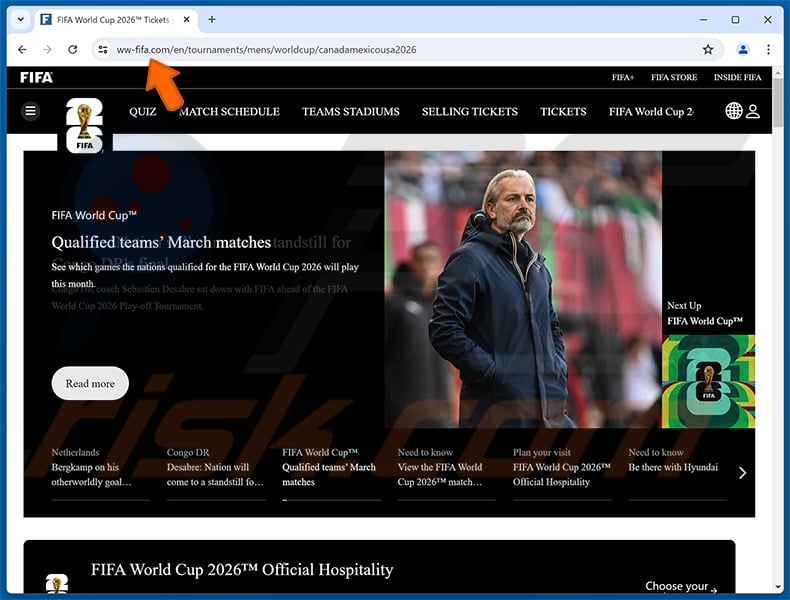
![FIFA 2026 World Cup Scams full-page spoof at ww-fifa[.]com](/images/stories/screenshots202606/fifa-2026-world-cup-scams-main.jpg)
"FIFA 2026 World Cup Scams" in detail
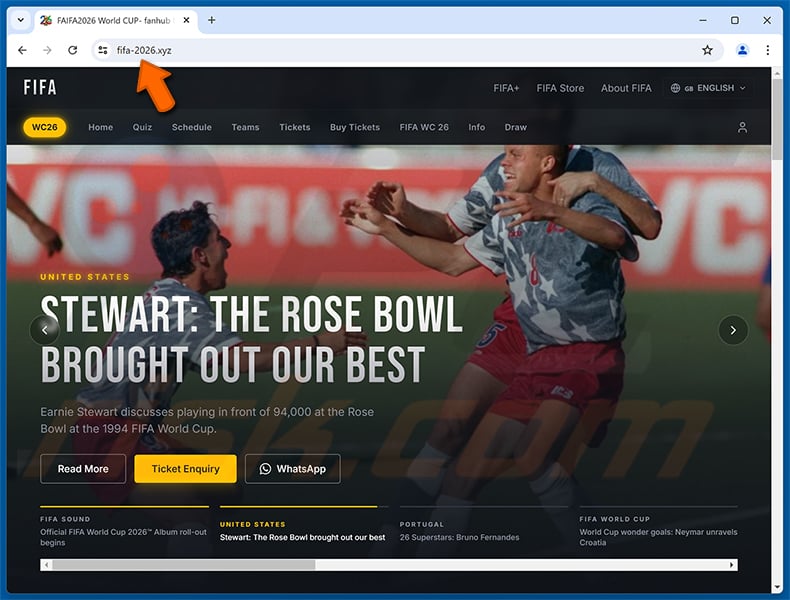
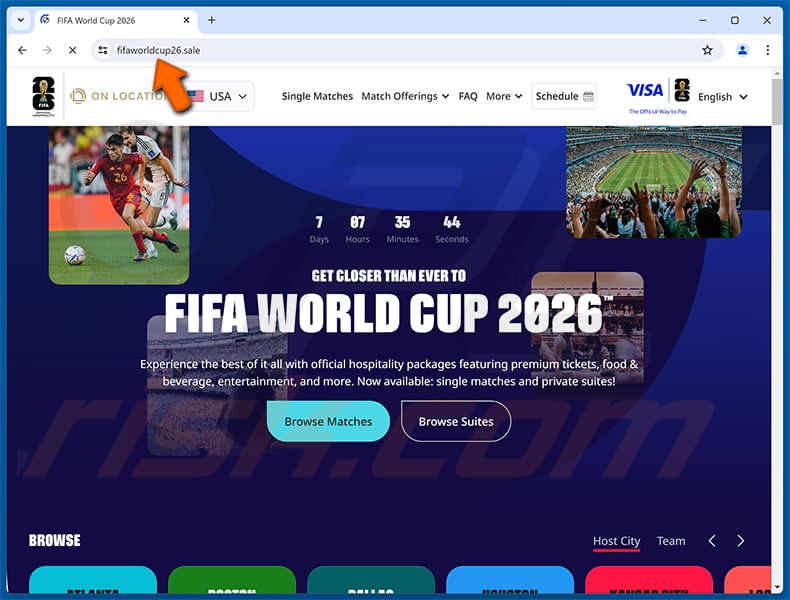
According to advisories from the FBI and IC3, cybercriminals have registered hundreds of FIFA-themed domains to impersonate the official tournament website, ticket platforms, hospitality providers, and merchandise stores. Many of these pages copy FIFA's branding so closely that casual visitors cannot easily tell them apart from the real thing.
It must be emphasized that FIFA is the international governing body of association football and has no connection to these websites. The logos, official imagery, and partner branding shown on the spoofed pages are reused without authorization to give visitors a false sense of legitimacy.
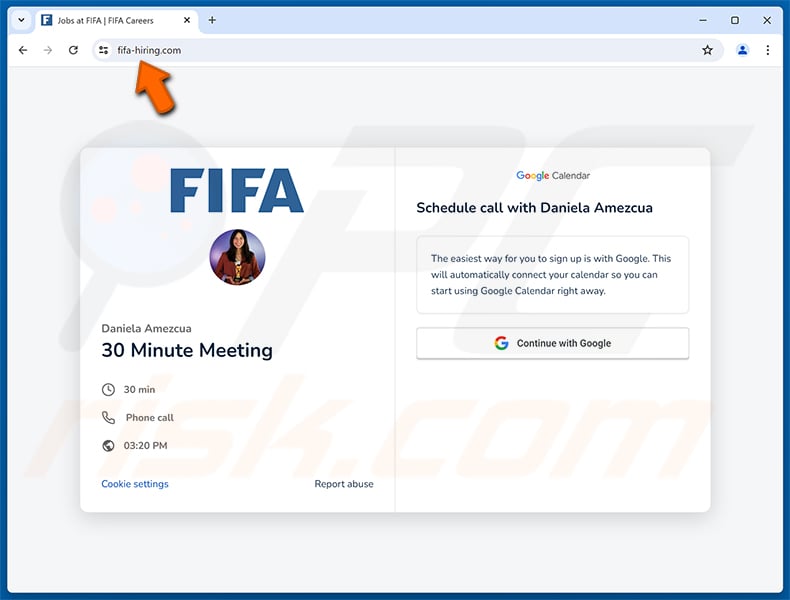
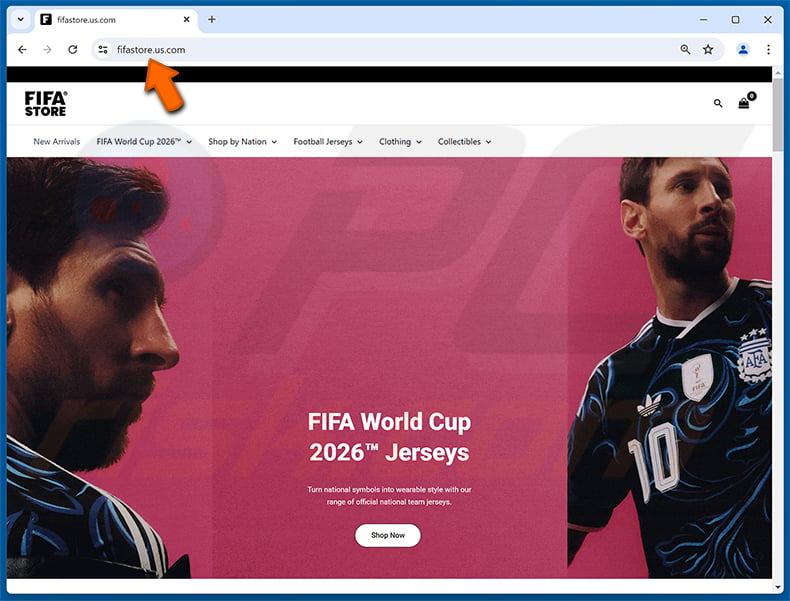
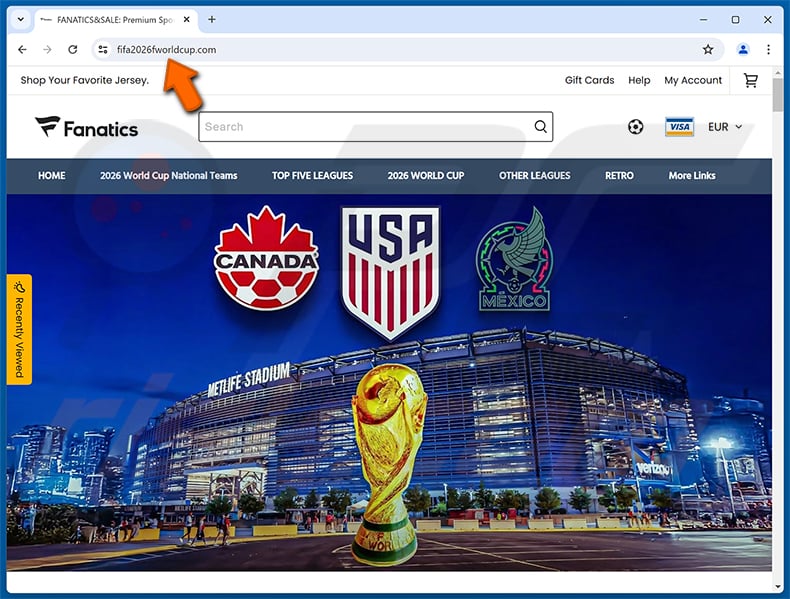
The campaign spans several different angles. Some pages sell counterfeit match tickets at apparent discounts. Others promote premium hospitality packages that do not actually exist. A number of sites pose as the official FIFA Store and take payment for jerseys and collectibles that are never shipped, while others mimic FIFA careers portals to collect personal data from people who think they are applying for a job.
Visitors who buy through these sites typically lose the money they spent and never receive the items they paid for. The data entered during checkout, including names, home addresses, phone numbers, email addresses, and payment card details, is harvested by the operators and reused for follow-up fraud, unauthorized charges, and identity theft.
Several of the domains rely on typosquatting, rearranging or adding letters around "fifa" or "worldcup" so the address looks plausible at a glance. Researchers also reported these sites being promoted through sponsored search results, Facebook advertisements, and links shared on Telegram and WhatsApp.
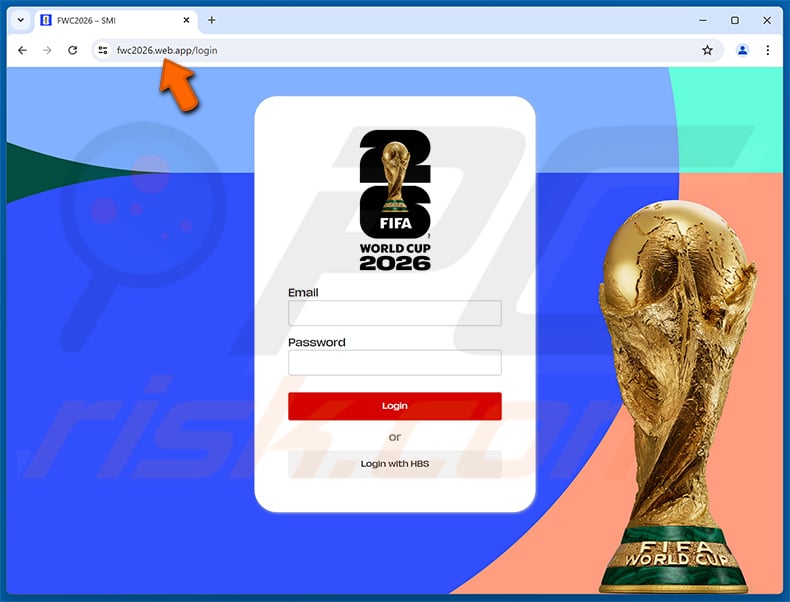
At least one variant goes a step further and presents a fake login screen that asks for an email and password. Anyone who submits credentials there hands account access directly to the scammers, who can then reuse the same email and password combination on unrelated services in credential stuffing attacks.
The safest way to buy World Cup tickets, hospitality, or merchandise is to type the official FIFA address into the browser directly rather than reach it through a search engine or a social media link. Any page offering guaranteed premium seats or steep discounts on official goods should be treated as fraudulent.
| Name | FIFA 2026 World Cup phishing scams |
| Threat Type | Phishing, Scam, Social Engineering, Fraud |
| Fake Claim | Official FIFA World Cup 2026 tickets, hospitality packages, merchandise, and employment opportunities |
| Disguise | Legitimate FIFA websites and authorized FIFA partners |
| Related Domains | fifa[.]cab; fifa[.]pink; fifa[.]blue; fifa[.]pub; fifa[.]city; fifa[.]bio; fifa[.]beer; fifa[.]click; fifa[.]cam; fifa[.]ceo; fifa[.]help; filfa[.]org; fifa-online[.]com; fifa-2026[.]xyz; jobs-fifa[.]com; fifa-hr[.]com; fifa-careerhub[.]com; fifaworldcup-careers[.]com; fifa-hiring[.]com; fifahiring[.]com; fifa-ticket[.]live; fifastore.us[.]com; fifaworldcup26[.]sale; fifaworldcup26.xcover-staging[.]com; worldcup2026-tickets.com[.]mx; worldcup26ticket[.]com; 2026fifaworldcuptickets[.]online; fwc2026[.]net; fwc2026.web[.]app; fifa2026p[.]com; fifa2026fworldcup[.]com; wvvw-fifa[.]com; ww-fifa[.]com; fifa-com[.]com; fifa-com[.]services; quiniela-fifa-2026.pages[.]dev |
| Symptoms | Fake error messages, fake system warnings, pop-up errors, hoax computer scan. |
| Distribution methods | Compromised websites, rogue online pop-up ads, potentially unwanted applications. |
| Damage | Loss of sensitive private information, monetary loss, identity theft, possible malware infections. |
| Malware Removal (Windows) |
To eliminate possible malware infections, scan your computer with legitimate antivirus software. Our security researchers recommend using Combo Cleaner. Download Combo CleanerTo use full-featured product, you have to purchase a license for Combo Cleaner. 7 days free trial available. Combo Cleaner is owned and operated by RCS LT, the parent company of PCRisk.com. |
Similar scams in general
Scams of this type rely on the credibility of well-known brands and high-profile events to manipulate visitors into acting before they think it through. The goal is always the same: extract payment, personal data, or account credentials from people who believe they are dealing with a legitimate organization.
Some examples of similar scams are "2026 FIFA World Cup Lottery" and "Emirates First Class Subscription".
How did I open a scam website?
Pages like these are rarely visited on purpose. Most users arrive after clicking sponsored advertisements that appear at the top of search results or paid promotions on social networks. Posts and direct messages shared on Facebook, Telegram, and WhatsApp are another common route, especially when they promise hard-to-find tickets or large discounts on official merchandise.
Other visitors land on these sites after mistyping the official FIFA address and ending up on a typosquatted domain. In some cases, adware already installed on the device generates the redirects automatically, and phishing emails containing links to fake ticket or hospitality offers can lead users to the same pages.
How to avoid visiting scam pages?
Treat unsolicited offers around major sporting events with extra caution. Avoid clicking sponsored search results, advertisements, or social media promotions for tickets, hospitality, or merchandise, even when the prices look attractive. Reach the official FIFA website by typing the address directly into the browser, and check that the URL uses a familiar top-level domain rather than an unusual one like .sale, .xyz, or .live.
Do not enter personal or payment details into a site you reached through a paid advertisement or an unknown link, and avoid opening links sent in unexpected emails from senders you do not recognize. Keep the operating system, browser, and security tools up to date. If your computer is already infected with unwanted apps, we recommend running a scan with Combo Cleaner Antivirus for Windows to automatically eliminate them.
Other examples of FIFA 2026 World Up-themed scam websites:
Instant automatic malware removal:
Manual threat removal might be a lengthy and complicated process that requires advanced IT skills. Combo Cleaner is a professional automatic malware removal tool that is recommended to get rid of malware. Download it by clicking the button below:
DOWNLOAD Combo CleanerBy downloading any software listed on this website you agree to our Privacy Policy and Terms of Use. To use full-featured product, you have to purchase a license for Combo Cleaner. 7 days free trial available. Combo Cleaner is owned and operated by RCS LT, the parent company of PCRisk.com.
Quick menu:
- What is FIFA 2026 World Cup phishing scams?
- How to identify a pop-up scam?
- How do pop-up scams work?
- How to remove fake pop-ups?
- How to prevent fake pop-ups?
- What to do if you fell for a pop-up scam?
How to identify a pop-up scam?
Pop-up windows with various fake messages are a common type of lures cybercriminals use. They collect sensitive personal data, trick Internet users into calling fake tech support numbers, subscribe to useless online services, invest in shady cryptocurrency schemes, etc.
While in the majority of cases these pop-ups don't infect users' devices with malware, they can cause direct monetary loss or could result in identity theft.
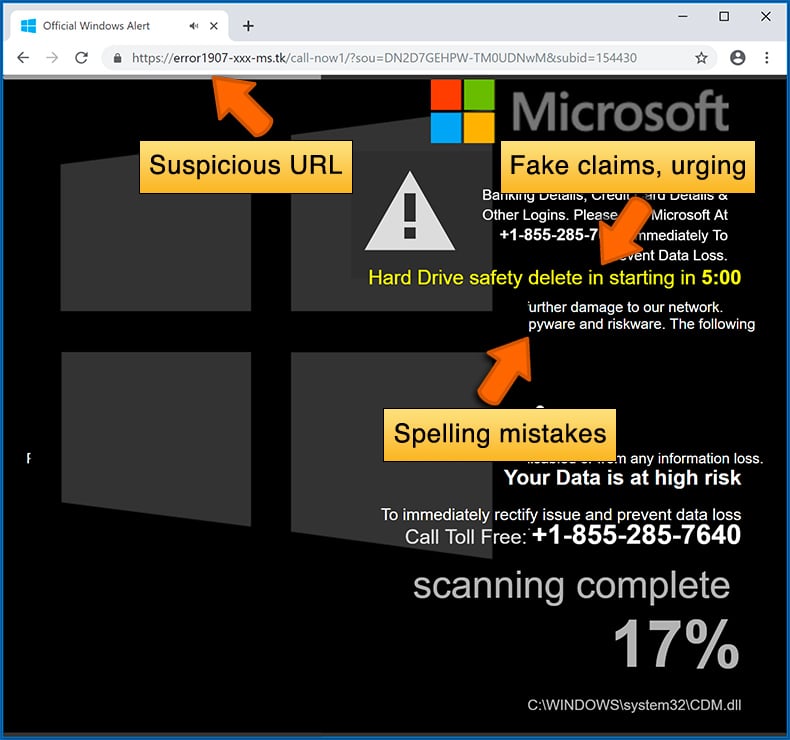
Cybercriminals strive to create their rogue pop-up windows to look trustworthy, however, scams typically have the following characteristics:
- Spelling mistakes and non-professional images - Closely inspect the information displayed in a pop-up. Spelling mistakes and unprofessional images could be a sign of a scam.
- Sense of urgency - Countdown timer with a couple of minutes on it, asking you to enter your personal information or subscribe to some online service.
- Statements that you won something - If you haven't participated in a lottery, online competition, etc., and you see a pop-up window stating that you won.
- Computer or mobile device scan - A pop-up window that scans your device and informs of detected issues - is undoubtedly a scam; webpages cannot perform such actions.
- Exclusivity - Pop-up windows stating that only you are given secret access to a financial scheme that can quickly make you rich.
Example of a pop-up scam:
How do pop-up scams work?
Cybercriminals and deceptive marketers usually use various advertising networks, search engine poisoning techniques, and shady websites to generate traffic to their pop-ups. Users land on their online lures after clicking on fake download buttons, using a torrent website, or simply clicking on an Internet search engine result.
Based on users' location and device information, they are presented with a scam pop-up. Lures presented in such pop-ups range from get-rich-quick schemes to fake virus scans.
How to remove fake pop-ups?
In most cases, pop-up scams do not infect users' devices with malware. If you encountered a scam pop-up, simply closing it should be enough. In some cases scam, pop-ups may be hard to close; in such cases - close your Internet browser and restart it.
In extremely rare cases, you might need to reset your Internet browser. For this, use our instructions explaining how to reset Internet browser settings.
How to prevent fake pop-ups?
To prevent seeing pop-up scams, you should visit only reputable websites. Torrent, Crack, free online movie streaming, YouTube video download, and other websites of similar reputation commonly redirect Internet users to pop-up scams.
To minimize the risk of encountering pop-up scams, you should keep your Internet browsers up-to-date and use reputable anti-malware application. For this purpose, we recommend Combo Cleaner Antivirus for Windows.
What to do if you fell for a pop-up scam?
This depends on the type of scam that you fell for. Most commonly, pop-up scams try to trick users into sending money, giving away personal information, or giving access to one's device.
- If you sent money to scammers: You should contact your financial institution and explain that you were scammed. If informed promptly, there's a chance to get your money back.
- If you gave away your personal information: You should change your passwords and enable two-factor authentication in all online services that you use. Visit Federal Trade Commission to report identity theft and get personalized recovery steps.
- If you let scammers connect to your device: You should scan your computer with reputable anti-malware (we recommend Combo Cleaner Antivirus for Windows) - cyber criminals could have planted trojans, keyloggers, and other malware, don't use your computer until removing possible threats.
- Help other Internet users: report Internet scams to Federal Trade Commission.
Frequently Asked Questions (FAQ)
What is a pop-up scam?
A pop-up scam is a deceptive message or website designed to trick visitors into taking a harmful action, whether that is handing over personal information, paying for something that does not exist, or installing dangerous software. The "FIFA 2026 World Cup Scams" belong to the broader website-spoofing variant of this category.
What is the purpose of a pop-up scam?
The purpose is financial gain for the operators. In this campaign that means selling fake tickets, hospitality packages, and merchandise, harvesting personal and payment data for resale or identity theft, and in some cases stealing login credentials that can be reused on other accounts.
Why do I encounter fake pop-ups?
Most encounters happen through sponsored search advertisements, social media posts, and direct messages on Telegram or WhatsApp. Typosquatted domains, malicious ads, and adware already present on a device can also send visitors to fake pages without any warning.
Will Combo Cleaner protect me from pop-up scams?
Yes. Combo Cleaner scans visited websites and recognizes domains used for phishing, ticket fraud, and other forms of online deception. When such a page is detected, it blocks access before the visitor can submit data or complete a payment.
Share:
 Facebook
 X.com
X.com
 LinkedIn
 Copy Link

Tomas Meskauskas
Expert security researcher, professional malware analyst
I am passionate about computer security and technology. I have an experience of over 10 years working in various companies related to computer technical issue solving and Internet security. I have been working as an author and editor for pcrisk.com since 2010. Follow me on Twitter and LinkedIn to stay informed about the latest online security threats.
PCrisk security portal is brought by a company RCS LT.
Joined forces of security researchers help educate computer users about the latest online security threats. More information about the company RCS LT.
Our malware removal guides are free. However, if you want to support us you can send us a donation.
DonatePCrisk security portal is brought by a company RCS LT.
Joined forces of security researchers help educate computer users about the latest online security threats. More information about the company RCS LT.
Our malware removal guides are free. However, if you want to support us you can send us a donation.
Donate
▼ Show Discussion