
What sort of scam is the fake "Ethereum Genesis Airdrop Scam"?
Phishing/ScamAlso Known As: Ethereum Genesis Airdrop phishing scam

Get free scan and check if your device is infected.
Remove it nowTo use full-featured product, you have to purchase a license for Combo Cleaner. Seven days free trial available. Combo Cleaner is owned and operated by RCS LT, the parent company of PCRisk.com.
What is the fake "Ethereum Genesis Airdrop Scam"?
During our investigation of genesispool[.]org, we found that this site promotes a fake Ethereum token airdrop. The page falsely claims to distribute 12.5 million tokens to early community members. In reality, it is a fraudulent website designed to steal cryptocurrency by harvesting wallet recovery phrases from visitors.
![Ethereum Genesis Airdrop Scam (genesispool[.]org)](/images/stories/screenshots202606/ethereum-genesis-airdrop-scam-main.jpg)
IMPORTANT NOTE: We do not review crypto projects, please do your own research when investing money.
Federal Trade Commission (FTC) states that since the start of 2021, more than 46,000 people have reported losing over $1 billion in crypto to scams – that's about one out of every four dollars reported lost, more than any other payment method.
"Ethereum Genesis Airdrop Scam" in detail
Ethereum (ethereum.org) is a decentralized, open-source blockchain platform that supports smart contracts and powers thousands of decentralized applications. The Ethereum Foundation does not run airdrops or token distributions through third-party websites.
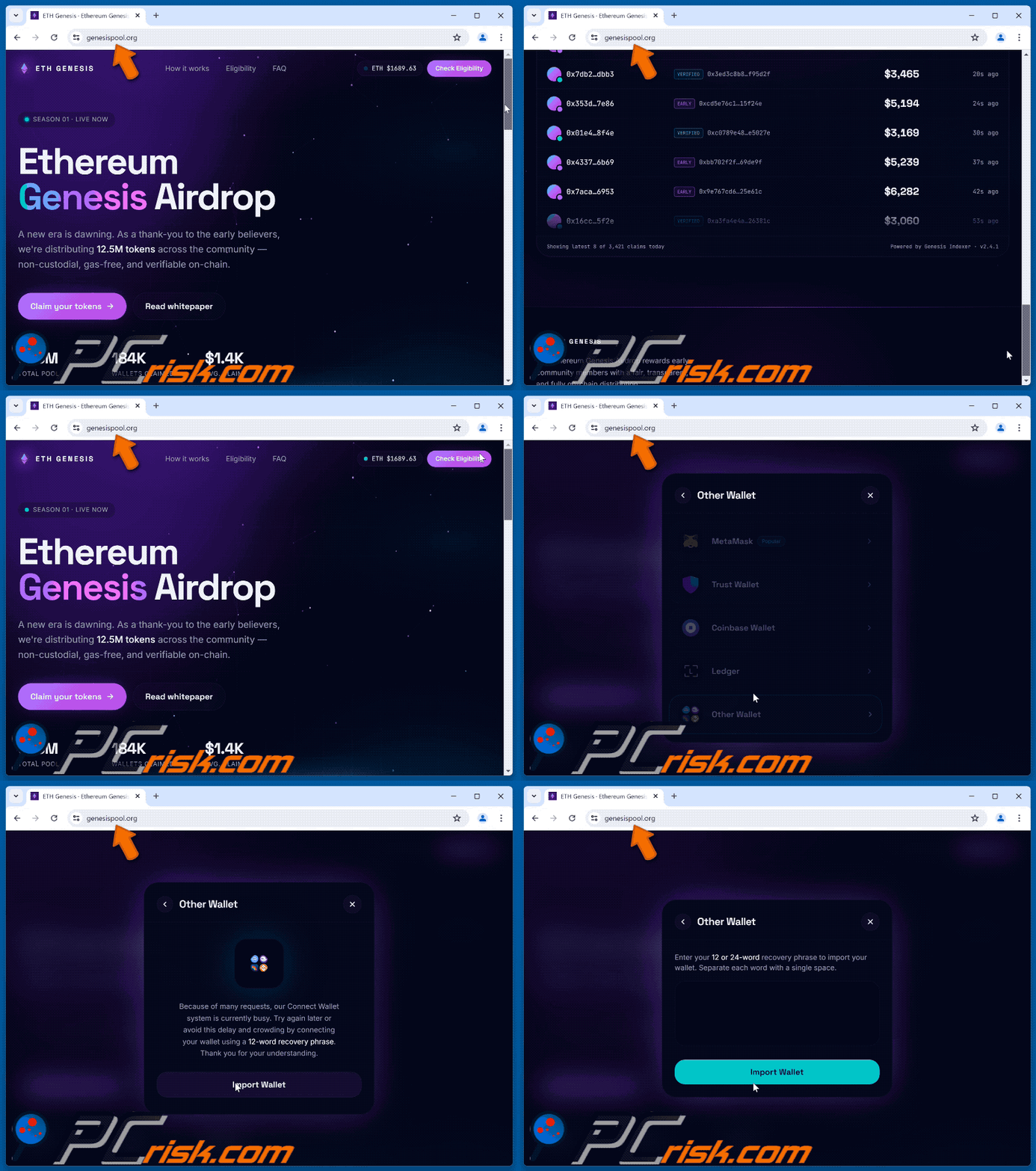
The genesispool[.]org site presents itself as "ETH Genesis," advertising a "Season 01 · Live Now" promotion. It claims a $25 million total token pool, 184,000 participating wallets, and an average claim of $1,400 per user. These statistics are entirely fabricated to create an appearance of legitimacy and urgency.
When a visitor clicks "Claim your tokens," a wallet connection dialog appears, offering MetaMask, Trust Wallet, Coinbase Wallet, and Ledger options, along with a generic "Other Wallet" choice. Selecting "Other Wallet" triggers a brief loading screen before the site claims its connection system is too busy to proceed.
At that point, users are invited to bypass the wait by entering their wallet recovery phrase directly into the site. Submitting a recovery phrase gives scammers complete, permanent access to every asset in the associated cryptocurrency wallet. Funds can be emptied at any time, without further action from the victim.
Since blockchain transactions are irreversible, stolen cryptocurrency cannot be recovered. There is no chargeback mechanism or governing authority that can reverse an on-chain transfer. Users should never enter a recovery phrase on any website and should always verify a platform is official before providing any sensitive information.
| Name | Ethereum Genesis Airdrop phishing scam |
| Threat Type | Phishing, Scam, Social Engineering, Fraud |
| Fake Claim | Participants can receive free Ethereum tokens (12.5 million tokens from a $25 million community pool) |
| Disguise | Legitimate Ethereum airdrop/token distribution event |
| Related Domain(s) | genesispool[.]org |
| Threat Status (genesispool[.]org) | PCrisk Website Scanner Results |
| Symptoms | Unofficial domain, lack of official verification, unrealistic claims, too good-to-be-true promises |
| Distribution methods | Fake social media accounts, deceptive websites, rogue online advertisements |
| Damage | Loss of sensitive private information (wallet recovery phrases), monetary loss, identity theft |
| Malware Removal (Windows) |
To eliminate possible malware infections, scan your computer with legitimate antivirus software. Our security researchers recommend using Combo Cleaner. Download Combo CleanerTo use full-featured product, you have to purchase a license for Combo Cleaner. 7 days free trial available. Combo Cleaner is owned and operated by RCS LT, the parent company of PCRisk.com. |
Cryptocurrency drainer scam examples
Genesispool[.]org is a fraudulent page that exploits the Ethereum brand to trick visitors into handing over their wallet recovery phrases. Once a phrase is submitted, scammers gain unrestricted access to the linked wallet and can transfer all funds without further interaction from the victim. The sole purpose of this site is cryptocurrency theft.
Some examples of similar scams are "PowerGacha ($GACHA) Airdrop", "Grass Vote Rewards", and "$ETHFI Vote Rewards".
How did I open a scam website?
Fake cryptocurrency pages like genesispool[.]org are most often promoted through stolen or fabricated social media accounts on platforms such as X and Facebook. Scammers frequently use accounts belonging to celebrities, well-known companies, or crypto influencers to lend their links a false sense of credibility.
Users may also encounter these pages by clicking misleading ads or links while browsing unreliable websites, interacting with adware-generated pop-ups, opening links in phishing emails, or following notifications from untrustworthy websites they previously allowed.
How to avoid visiting scam pages?
Keep your operating system and all installed applications updated at all times. Download software only from official websites or developer-verified sources. Treat unexpected emails containing links or attachments with caution, as phishing is one of the most common ways fraudulent pages reach new victims.
Avoid clicking pop-ups, banners, or links while browsing unfamiliar or suspicious websites. Do not grant notification permissions to sites you cannot verify as trustworthy. If your computer is already infected with unwanted apps, we recommend running a scan with Combo Cleaner Antivirus for Windows to automatically eliminate them.
The appearance of "Ethereum Genesis Airdrop Scam" (GIF):
The official Ethereum website (ethereum.org):

Instant automatic malware removal:
Manual threat removal might be a lengthy and complicated process that requires advanced IT skills. Combo Cleaner is a professional automatic malware removal tool that is recommended to get rid of malware. Download it by clicking the button below:
DOWNLOAD Combo CleanerBy downloading any software listed on this website you agree to our Privacy Policy and Terms of Use. To use full-featured product, you have to purchase a license for Combo Cleaner. 7 days free trial available. Combo Cleaner is owned and operated by RCS LT, the parent company of PCRisk.com.
Quick menu:
- What is Ethereum Genesis Airdrop phishing scam?
- How to identify a pop-up scam?
- How do pop-up scams work?
- How to remove fake pop-ups?
- How to prevent fake pop-ups?
- What to do if you fell for a pop-up scam?
How to identify a pop-up scam?
Pop-up windows with various fake messages are a common type of lures cybercriminals use. They collect sensitive personal data, trick Internet users into calling fake tech support numbers, subscribe to useless online services, invest in shady cryptocurrency schemes, etc.
While in the majority of cases these pop-ups don't infect users' devices with malware, they can cause direct monetary loss or could result in identity theft.
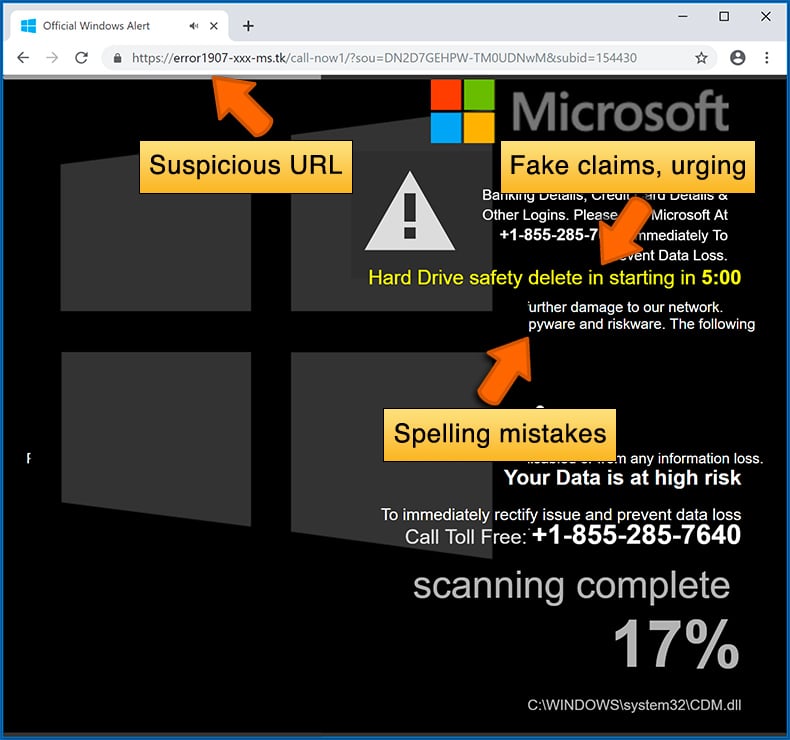
Cybercriminals strive to create their rogue pop-up windows to look trustworthy, however, scams typically have the following characteristics:
- Spelling mistakes and non-professional images - Closely inspect the information displayed in a pop-up. Spelling mistakes and unprofessional images could be a sign of a scam.
- Sense of urgency - Countdown timer with a couple of minutes on it, asking you to enter your personal information or subscribe to some online service.
- Statements that you won something - If you haven't participated in a lottery, online competition, etc., and you see a pop-up window stating that you won.
- Computer or mobile device scan - A pop-up window that scans your device and informs of detected issues - is undoubtedly a scam; webpages cannot perform such actions.
- Exclusivity - Pop-up windows stating that only you are given secret access to a financial scheme that can quickly make you rich.
Example of a pop-up scam:
How do pop-up scams work?
Cybercriminals and deceptive marketers usually use various advertising networks, search engine poisoning techniques, and shady websites to generate traffic to their pop-ups. Users land on their online lures after clicking on fake download buttons, using a torrent website, or simply clicking on an Internet search engine result.
Based on users' location and device information, they are presented with a scam pop-up. Lures presented in such pop-ups range from get-rich-quick schemes to fake virus scans.
How to remove fake pop-ups?
In most cases, pop-up scams do not infect users' devices with malware. If you encountered a scam pop-up, simply closing it should be enough. In some cases scam, pop-ups may be hard to close; in such cases - close your Internet browser and restart it.
In extremely rare cases, you might need to reset your Internet browser. For this, use our instructions explaining how to reset Internet browser settings.
How to prevent fake pop-ups?
To prevent seeing pop-up scams, you should visit only reputable websites. Torrent, Crack, free online movie streaming, YouTube video download, and other websites of similar reputation commonly redirect Internet users to pop-up scams.
To minimize the risk of encountering pop-up scams, you should keep your Internet browsers up-to-date and use reputable anti-malware application. For this purpose, we recommend Combo Cleaner Antivirus for Windows.
What to do if you fell for a pop-up scam?
This depends on the type of scam that you fell for. Most commonly, pop-up scams try to trick users into sending money, giving away personal information, or giving access to one's device.
- If you sent money to scammers: You should contact your financial institution and explain that you were scammed. If informed promptly, there's a chance to get your money back.
- If you gave away your personal information: You should change your passwords and enable two-factor authentication in all online services that you use. Visit Federal Trade Commission to report identity theft and get personalized recovery steps.
- If you let scammers connect to your device: You should scan your computer with reputable anti-malware (we recommend Combo Cleaner Antivirus for Windows) - cyber criminals could have planted trojans, keyloggers, and other malware, don't use your computer until removing possible threats.
- Help other Internet users: report Internet scams to Federal Trade Commission.
Frequently Asked Questions (FAQ)
What is a fake crypto airdrop?
A fake crypto airdrop is a fraudulent promotion that claims to give away free tokens or cryptocurrency. These pages are designed to look like legitimate distribution events to persuade visitors into connecting their wallets or revealing sensitive account details.
What is the purpose of a crypto scam?
The purpose is to steal cryptocurrency. Scammers achieve this by collecting wallet recovery phrases, deploying drainer tools after a wallet is connected, or tricking victims into sending funds directly to addresses controlled by the fraudsters.
Why do I encounter fake websites?
Fraudulent pages are promoted through compromised social media accounts, phishing emails, rogue advertising networks, and deceptive pop-ups or links on unsafe websites. Adware on a device can also redirect users to scam pages or display ads promoting them.
Will Combo Cleaner protect me from scams?
Combo Cleaner can scan websites you visit and identify suspicious or malicious pages, including those hosting cryptocurrency scams. When a threat is detected, Combo Cleaner warns you and restricts access to help prevent financial loss.
Share:
 Facebook
 X.com
X.com
 LinkedIn
 Copy Link

Tomas Meskauskas
Expert security researcher, professional malware analyst
I am passionate about computer security and technology. I have an experience of over 10 years working in various companies related to computer technical issue solving and Internet security. I have been working as an author and editor for pcrisk.com since 2010. Follow me on Twitter and LinkedIn to stay informed about the latest online security threats.
PCrisk security portal is brought by a company RCS LT.
Joined forces of security researchers help educate computer users about the latest online security threats. More information about the company RCS LT.
Our malware removal guides are free. However, if you want to support us you can send us a donation.
DonatePCrisk security portal is brought by a company RCS LT.
Joined forces of security researchers help educate computer users about the latest online security threats. More information about the company RCS LT.
Our malware removal guides are free. However, if you want to support us you can send us a donation.
Donate
▼ Show Discussion