
How to remove TONResolver RAT from the operating system
TrojanAlso Known As: TONResolver remote access trojan

Get free scan and check if your device is infected.
Remove it nowTo use full-featured product, you have to purchase a license for Combo Cleaner. Seven days free trial available. Combo Cleaner is owned and operated by RCS LT, the parent company of PCRisk.com.
What kind of malware is TONResolver RAT?
TONResolver is a Remote Access Trojan (RAT) written in JavaScript and run through the legitimate Node.js runtime. Once active, it opens a persistent encrypted connection to an attacker-controlled server and waits for instructions, giving operators the ability to execute code, retrieve files, and deploy additional payloads on the victim's machine.
According to research published by Trend Micro, the campaign was active from at least February to June 2026 and focused on employees of Japanese accommodation companies that partner with Booking.com. Attackers sent phishing emails posing as urgent guest complaints to trick hotel staff into downloading and running the malware.
What distinguishes TONResolver from most RATs is its use of The Open Network (TON) blockchain as a dead drop resolver. Instead of hardcoding a server address, the malware reads its active command-and-control (C&C) destination from a TON smart contract. If that server is blocked or taken down, the attacker simply updates the contract with a new address, and the infected machine connects there instead.
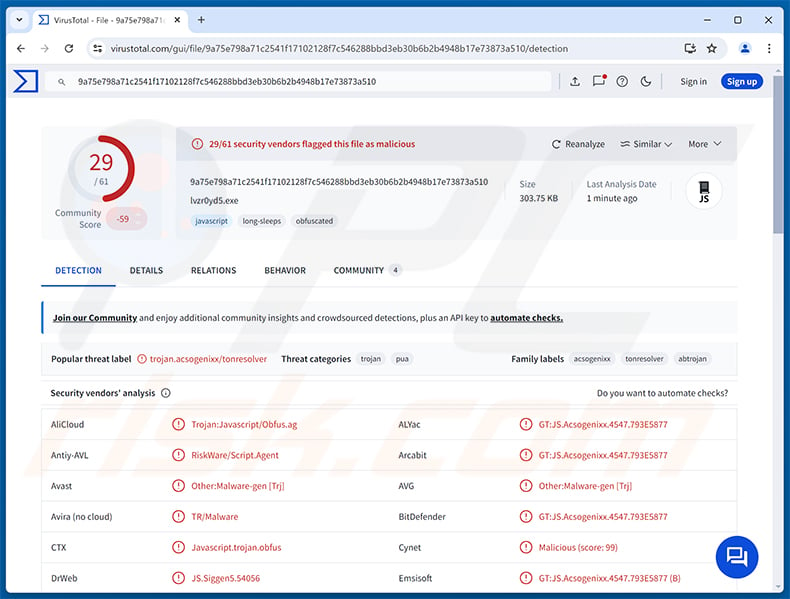
TONResolver RAT overview
After execution, TONResolver is loaded into a legitimate Node.js process. A custom VM-based obfuscation layer converts the malware's logic into a virtual instruction set processed by a built-in interpreter. This design makes the code extremely difficult to analyze through static inspection alone.
The malware's first runtime task is locating its C&C server. It queries a TON smart contract through the public tonapi.io API, calling the contract's "get_domain" method. The C&C server domain embedded in that contract is returned in the response, and the malware connects to it.
Once connected over an encrypted WebSocket, TONResolver transmits basic details about the victim's machine: username, hostname, OS version, CPU core count, available memory, and hardware MAC address. A keepalive ping runs every 20 seconds to hold the connection open and confirm to the attacker that the endpoint is still reachable.
TONResolver RAT features
All traffic between the infected machine and the C&C server is encrypted using ECDH secp256k1 key exchange, HKDF-SHA256 key derivation, and AES-256-CBC encryption. Because the WebSocket stream is fully opaque to packet inspection, detection through proxy analysis or network security monitoring is extremely difficult.
The RAT supports four main command types: running arbitrary JavaScript strings on the victim's machine, executing PowerShell commands, and retrieving and executing additional files sent by the attacker. This makes TONResolver an adaptable initial-access foothold that can be directed toward almost any follow-on objective.
Trend Micro's MDR team observed a follow-on executable deployed from a temporary folder after TONResolver established access. That executable targeted Chrome and Edge "User Data" directories, which store saved passwords, cookies, browsing history, and autofill data. TONResolver itself does not steal credentials - it provides the remote-access channel that lets the attacker deliver and run tools that do.
Persistence and defense evasion
To survive reboots, TONResolver adds a startup entry to the Windows Registry Run key (HKCU\Software\Microsoft\Windows\CurrentVersion\Run), causing the malware to relaunch automatically each time the user logs in. A Mutex check also prevents multiple copies from running at the same time.
The malware runs entirely inside Node.js, a widely used and trusted runtime. The Node.js binary is fetched from the official nodejs.org website during the infection chain, so no suspicious or unsigned executable needs to be bundled in the initial payload. This helps the malware blend into normal software activity on the endpoint.
The PowerShell loader also applies a server-side filter: it only serves the next-stage payload when the HTTP request's User-Agent string contains "Powershell." Requests from browsers, automated crawlers, or analysis sandboxes that do not match receive a 404 error, keeping the payload away from automated inspection.
| Name | TONResolver remote access trojan |
| Threat Type | Remote Access Trojan (RAT) |
| Detection Names | Avast (Other:Malware-gen [Trj]), Combo Cleaner (GT:JS.Acsogenixx.4547.793E5877), ESET-NOD32 (JS/Agent.ULF Trojan), Kaspersky (Trojan.Script.Obfus.ay), Full List (VirusTotal) |
| Symptoms | Remote Access Trojans are designed to stealthily infiltrate the victim's computer and remain silent, and thus no particular symptoms are clearly visible on an infected machine. |
| Distribution methods | Phishing emails (impersonating Booking.com guest-complaint notifications), malicious LNK shortcut files, malicious websites. |
| Damage | Stolen passwords and banking information, identity theft, the victim's computer added to a botnet, additional infections, credential theft, loss of account access. |
| Malware Removal (Windows) |
To eliminate possible malware infections, scan your computer with legitimate antivirus software. Our security researchers recommend using Combo Cleaner. Download Combo CleanerTo use full-featured product, you have to purchase a license for Combo Cleaner. 7 days free trial available. Combo Cleaner is owned and operated by RCS LT, the parent company of PCRisk.com. |
Conclusion
TONResolver gives attackers persistent, encrypted remote access to infected systems and the ability to run arbitrary code, retrieve files, and install further payloads. Its use of the TON blockchain to conceal the C&C server address makes it significantly harder to disrupt through conventional takedown methods.
Victims face the risk of credential theft from browsers, account hijacking, identity theft, and potentially much deeper system compromise. TONResolver should be removed from any infected system immediately.
More examples of RATs are QuimaRAT, msaRAT, and Dolphin X.
How did TONResolver RAT infiltrate my computer?
According to Trend Micro, TONResolver was spread through phishing emails targeting Japanese accommodation companies that partner with Booking.com. Messages posed as urgent guest complaints about issues such as bed bug infestations and included fake reservation details along with a link labeled "Download Photos and Videos."
A second distribution method observed in this campaign was a "conversational attack" carried out through Gmail. Attackers first sent an ordinary inquiry email and waited for a reply. After receiving a response, they followed up with a message containing the malicious link - a two-step approach that builds initial trust and is harder to recognize as a threat than a cold unsolicited message with an attachment.
Clicking the link downloaded a zip archive containing an LNK shortcut file disguised as a photo. Running the shortcut triggered a chain of PowerShell commands that fetched and executed a script, which then downloaded Node.js and the TONResolver JavaScript payload. More broadly, malware of this kind also reaches victims through software cracks, unofficial download sites, malicious email attachments, and social engineering through other messaging platforms.
How to avoid installation of malware?
Be cautious with unexpected emails, especially those urging you to click a link or open an attachment. Attackers increasingly disguise messages as legitimate business communications - complaints, invoices, or notifications from known services. Always verify the sender's actual email domain before interacting with any link or file, and download software only from official sources.
Keep your operating system and installed applications updated, as patches close vulnerabilities attackers depend on. Use a reputable security tool with real-time protection and run regular scans. If you believe that your computer is already infected, we recommend running a scan with Combo Cleaner Antivirus for Windows to automatically eliminate infiltrated malware.
Instant automatic malware removal:
Manual threat removal might be a lengthy and complicated process that requires advanced IT skills. Combo Cleaner is a professional automatic malware removal tool that is recommended to get rid of malware. Download it by clicking the button below:
DOWNLOAD Combo CleanerBy downloading any software listed on this website you agree to our Privacy Policy and Terms of Use. To use full-featured product, you have to purchase a license for Combo Cleaner. 7 days free trial available. Combo Cleaner is owned and operated by RCS LT, the parent company of PCRisk.com.
Quick menu:
- What is TONResolver RAT?
- STEP 1. Manual removal of TONResolver RAT malware.
- STEP 2. Check if your computer is clean.
How to remove malware manually?
Manual malware removal is a complicated task - usually it is best to allow antivirus or anti-malware programs to do this automatically. To remove this malware we recommend using Combo Cleaner Antivirus for Windows.
If you wish to remove malware manually, the first step is to identify the name of the malware that you are trying to remove. Here is an example of a suspicious program running on a user's computer:
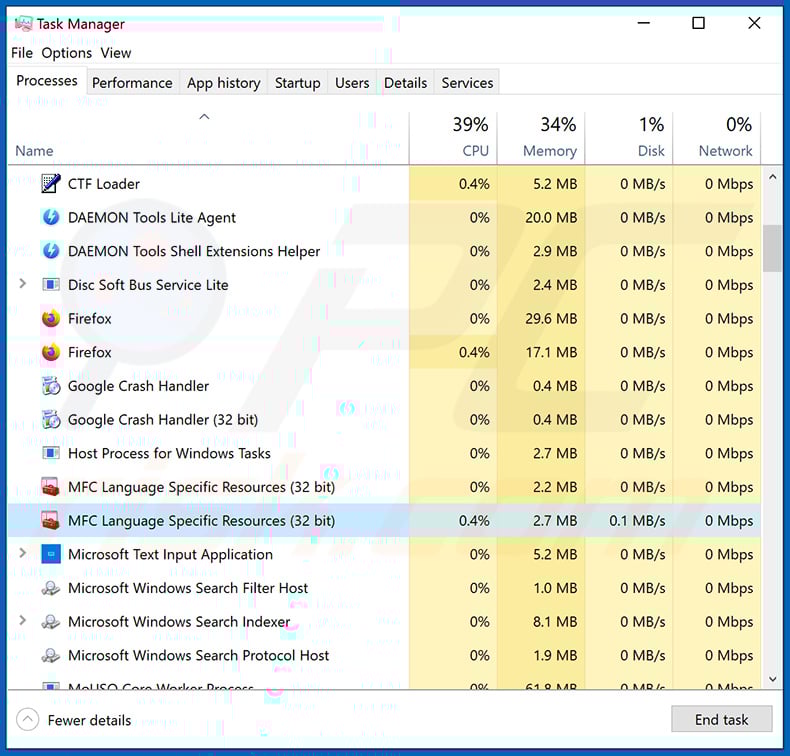
If you checked the list of programs running on your computer, for example, using task manager, and identified a program that looks suspicious, you should continue with these steps:
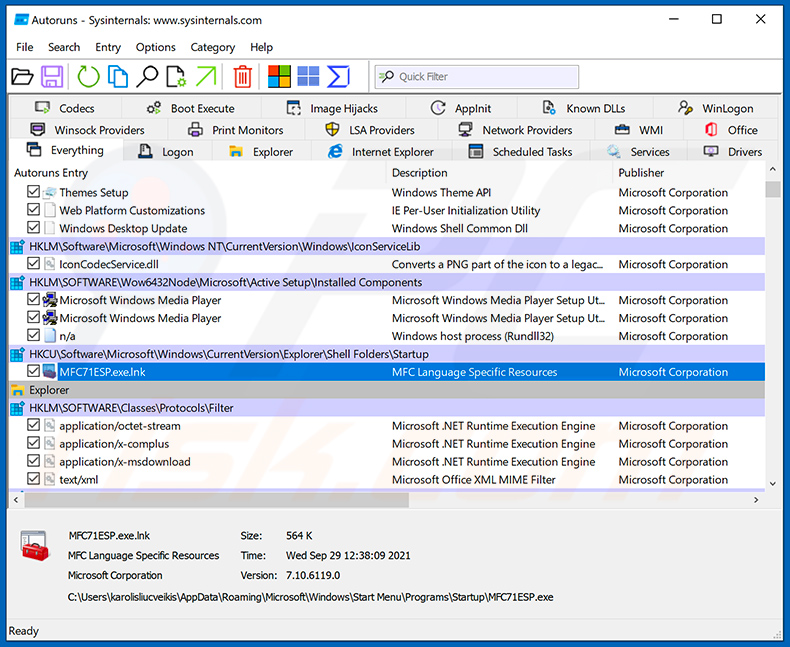
 Download a program called Autoruns. This program shows auto-start applications, Registry, and file system locations:
 Restart your computer into Safe Mode:
Windows XP and Windows 7 users: Start your computer in Safe Mode. Click Start, click Shut Down, click Restart, click OK. During your computer start process, press the F8 key on your keyboard multiple times until you see the Windows Advanced Option menu, and then select Safe Mode with Networking from the list.
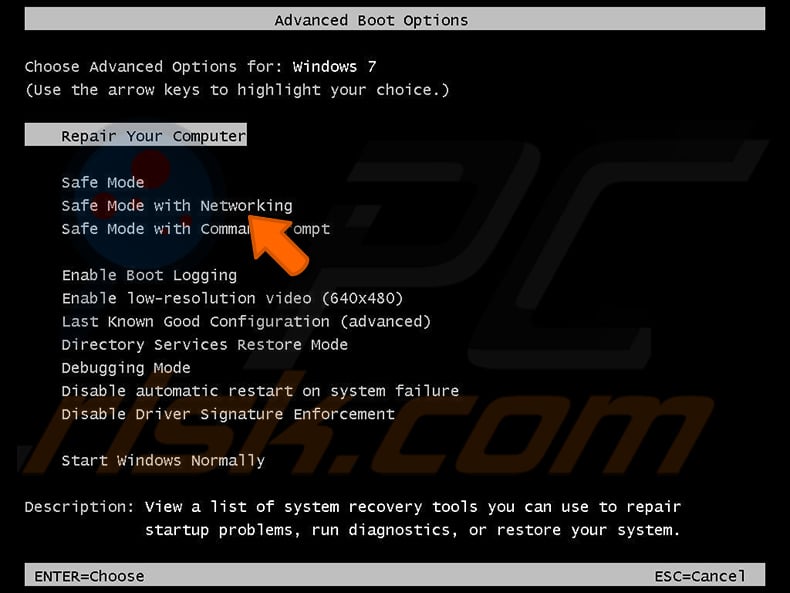
Video showing how to start Windows 7 in "Safe Mode with Networking":
Windows 8 users: Start Windows 8 is Safe Mode with Networking - Go to Windows 8 Start Screen, type Advanced, in the search results select Settings. Click Advanced startup options, in the opened "General PC Settings" window, select Advanced startup.
Click the "Restart now" button. Your computer will now restart into the "Advanced Startup options menu". Click the "Troubleshoot" button, and then click the "Advanced options" button. In the advanced option screen, click "Startup settings".
Click the "Restart" button. Your PC will restart into the Startup Settings screen. Press F5 to boot in Safe Mode with Networking.
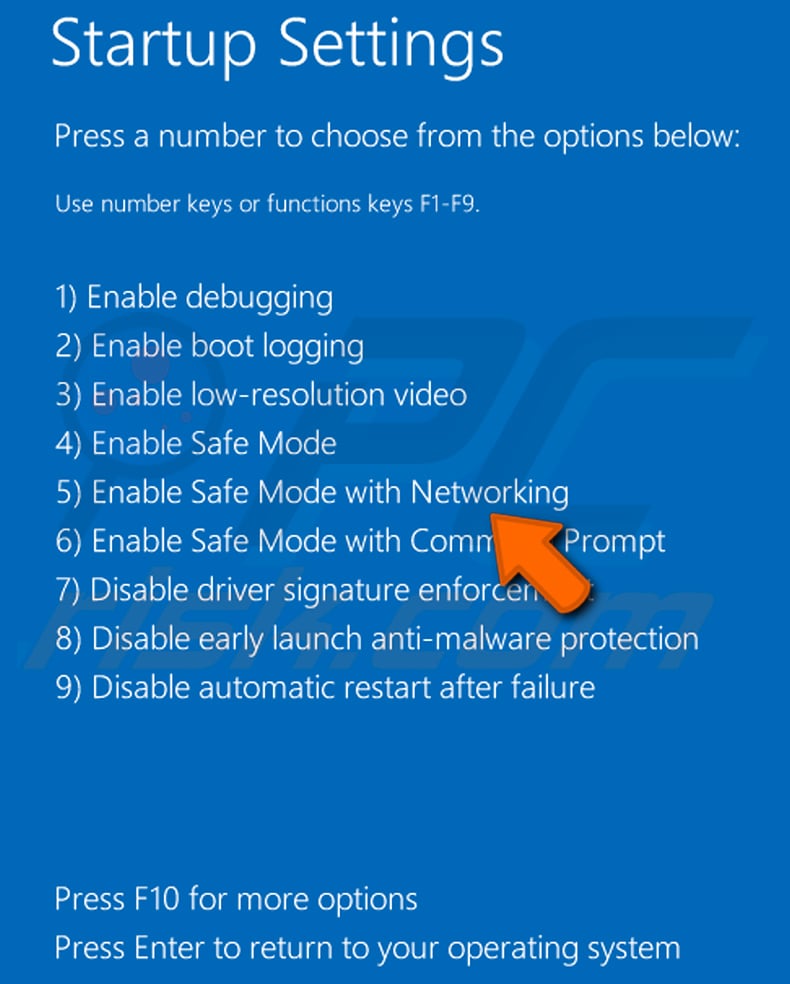
Video showing how to start Windows 8 in "Safe Mode with Networking":
Windows 10 users: Click the Windows logo and select the Power icon. In the opened menu click "Restart" while holding "Shift" button on your keyboard. In the "choose an option" window click on the "Troubleshoot", next select "Advanced options".
In the advanced options menu select "Startup Settings" and click on the "Restart" button. In the following window you should click the "F5" button on your keyboard. This will restart your operating system in safe mode with networking.
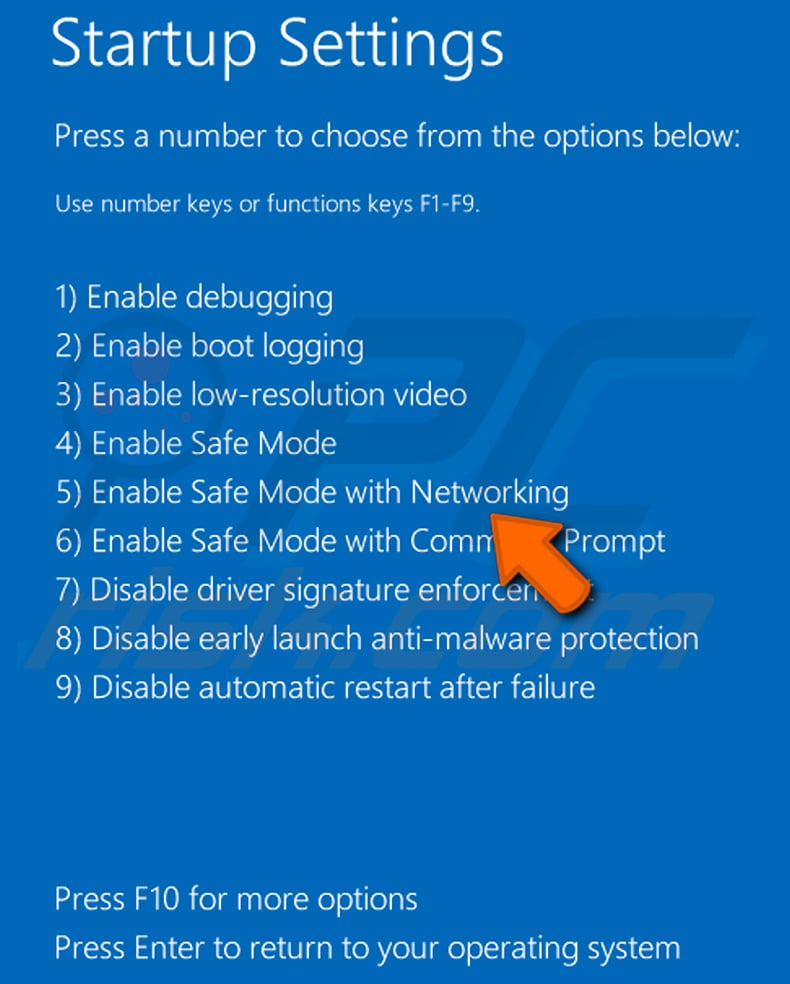
Video showing how to start Windows 10 in "Safe Mode with Networking":
 Extract the downloaded archive and run the Autoruns.exe file.
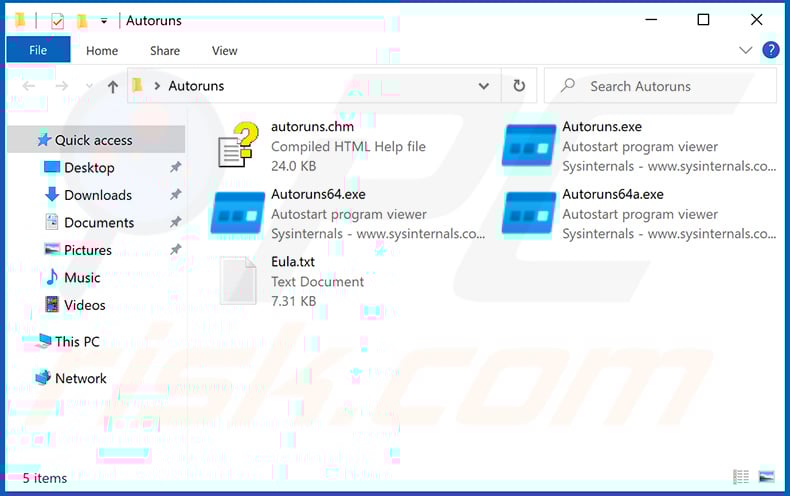
 In the Autoruns application, click "Options" at the top and uncheck "Hide Empty Locations" and "Hide Windows Entries" options. After this procedure, click the "Refresh" icon.
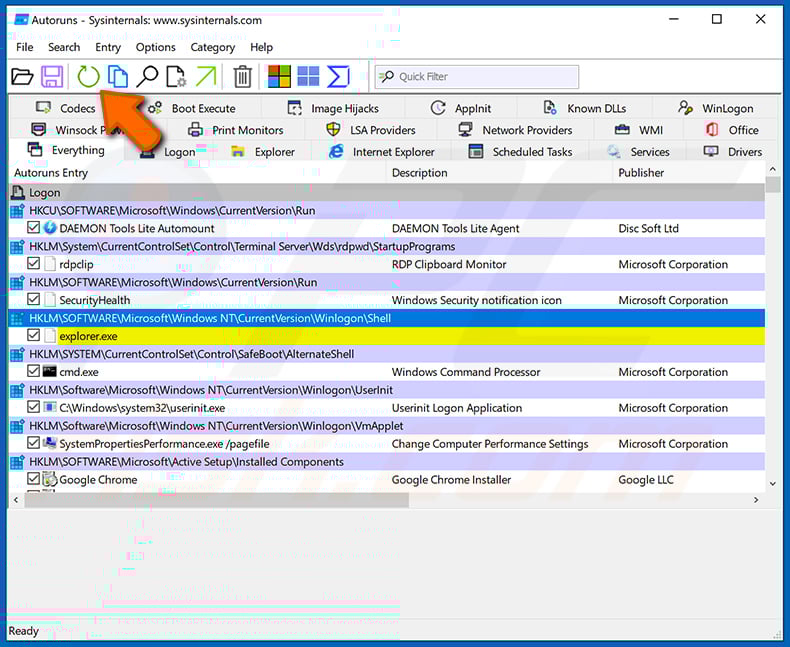
 Check the list provided by the Autoruns application and locate the malware file that you want to eliminate.
You should write down its full path and name. Note that some malware hides process names under legitimate Windows process names. At this stage, it is very important to avoid removing system files. After you locate the suspicious program you wish to remove, right click your mouse over its name and choose "Delete".
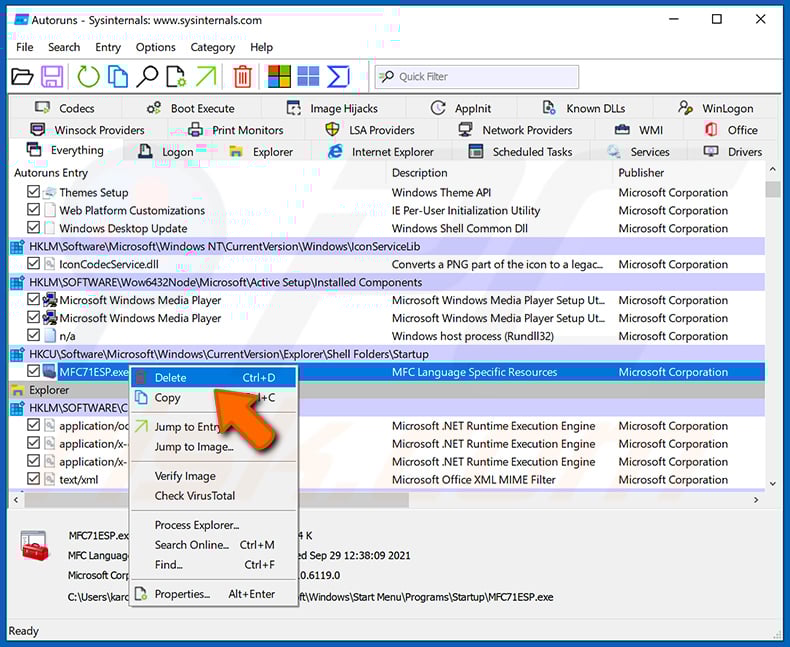
After removing the malware through the Autoruns application (this ensures that the malware will not run automatically on the next system startup), you should search for the malware name on your computer. Be sure to enable hidden files and folders before proceeding. If you find the filename of the malware, be sure to remove it.
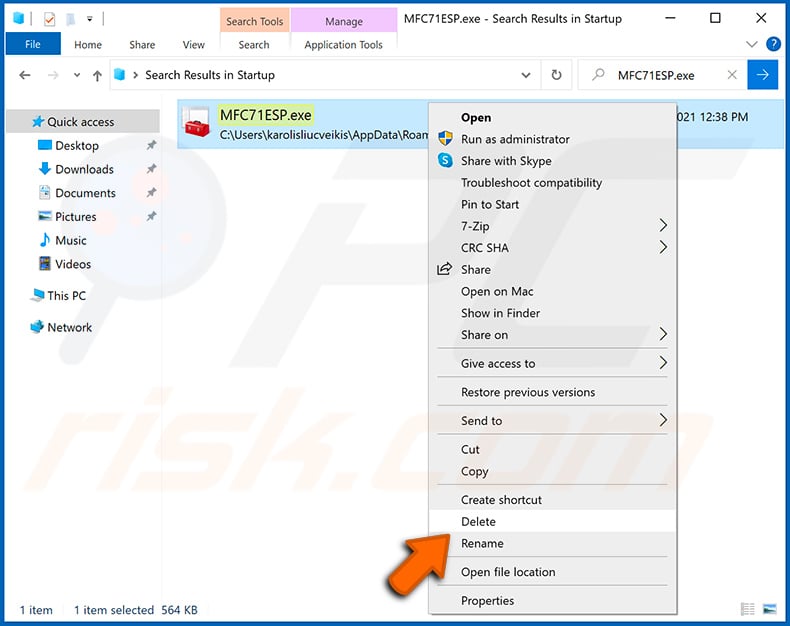
Reboot your computer in normal mode. Following these steps should remove any malware from your computer. Note that manual threat removal requires advanced computer skills. If you do not have these skills, leave malware removal to antivirus and anti-malware programs.
These steps might not work with advanced malware infections. As always it is best to prevent infection than try to remove malware later. To keep your computer safe, install the latest operating system updates and use antivirus software. To be sure your computer is free of malware infections, we recommend scanning it with Combo Cleaner Antivirus for Windows.
Frequently Asked Questions (FAQ)
My computer is infected with TONResolver RAT malware, should I format my storage device to get rid of it?
Formatting removes the infection but also erases every file on the drive. Running a reputable security tool such as Combo Cleaner is the safer first step in most cases - formatting should be treated as a last resort.
What are the biggest issues that TONResolver RAT malware can cause?
TONResolver gives attackers remote access to the infected system and lets them deploy credential-stealing tools, execute arbitrary commands, and install further malware. This can lead to stolen passwords, account hijacking, identity theft, and financial loss.
What is the purpose of TONResolver RAT malware?
TONResolver is designed to give attackers a persistent, encrypted remote-access foothold on infected machines. Operators can use it to execute commands, retrieve and run files, and stage follow-on attacks such as credential theft or additional malware deployment.
How did TONResolver RAT malware infiltrate my computer?
TONResolver has been observed spreading through phishing emails that impersonate Booking.com guest-complaint notifications, targeting Japanese hotel staff. Clicking the link in the email downloaded a zip archive, and running the shortcut file inside triggered the malware installation chain via PowerShell and Node.js.
Will Combo Cleaner protect me from malware?
Yes. Combo Cleaner can detect and remove most known malware infections. Because sophisticated threats can hide deep in the system, running a full system scan is recommended to ensure nothing is missed.
Share:
 Facebook
 X.com
X.com
 LinkedIn
 Copy Link

Tomas Meskauskas
Expert security researcher, professional malware analyst
I am passionate about computer security and technology. I have an experience of over 10 years working in various companies related to computer technical issue solving and Internet security. I have been working as an author and editor for pcrisk.com since 2010. Follow me on Twitter and LinkedIn to stay informed about the latest online security threats.
PCrisk security portal is brought by a company RCS LT.
Joined forces of security researchers help educate computer users about the latest online security threats. More information about the company RCS LT.
Our malware removal guides are free. However, if you want to support us you can send us a donation.
DonatePCrisk security portal is brought by a company RCS LT.
Joined forces of security researchers help educate computer users about the latest online security threats. More information about the company RCS LT.
Our malware removal guides are free. However, if you want to support us you can send us a donation.
Donate
▼ Show Discussion