
We may earn commissions from products we recommend. Learn more.
How to opt out of USPhoneBook in 2026 | Easy guide

How to opt out of USPhoneBook in 2026
Most people first hear about USPhoneBook when they discover their information is already online. If you search your phone number, name, or address, you might find a public profile that connects these details with past addresses, relatives, and other personal information you never shared. This happens often. The Federal Trade Commission says people-search sites create reports by buying data from other brokers, collecting from public social media, and compiling federal, state, and local public records. In 2026, USPhoneBook still gathers data from public records and third-party databases to build profiles that anyone can view.
From a cybersecurity perspective, the main problem is not just that your information is public somewhere. The bigger concern is that USPhoneBook collects scattered data into one place, making it easier for scammers, phishers, identity thieves, stalkers, and doxxers to find what they want. California's privacy regulator points out that data brokers can collect and sell sensitive details like exact locations and browsing history. The new DROP system lets California residents send one deletion request to over 500 registered brokers. Still, removing your information from each site by hand is important because it is often the fastest way to take down an exposed listing while you work on the rest.
At PCRisk, we view USPhoneBook as another service that exposes your personal data. Even if the site operates legally, it still increases the chance your information could be misused. The good news is you can opt out. The catch is that you need to be careful and have realistic expectations. Opting out can remove your current public profile, but it will not erase the public records behind the listing, and your information might appear again if the broker rebuilds your profile.
Opt out of USPhoneBook with Incogni
Table of Contents:
- Introduction
- What Is USPhoneBook?
- How to manually remove your information from USPhoneBook
- How to remove your information from USPhoneBook automatically
- What are personal data removal services?
- How to prevent data brokers from getting your data
- Wrapping up
- Frequently asked questions (FAQs)
What Is USPhoneBook?
USPhoneBook is a people-search and reverse phone lookup website. This means you can search by phone number, name, or address, and the site will show a profile that may link the person to other details, such as past addresses and family members. California's Data Broker Registry says a data broker collects personal information from various sources and sells it to other companies, even if the person never interacted with the broker. The registry also lists USPhoneBook.com, which matters because in 2026, California's centralized broker deletion system becomes available to consumers.
USPhoneBook does not create the information it displays. According to the FTC, people-search sites like this buy data from other brokers, gather information from public social media, and collect details from public records such as property records, voter registrations, court cases, and more. So, USPhoneBook acts as an aggregator, pulling information from multiple sources and combining it into a single report for users.
What does USPhoneBook.com collect? Our privacy policy review indicates that the site collects personal identifiers, customer records, protected characteristics permitted by law, internet activity, and location data. In reality, people-search reports often show your age or birth date, current and past addresses, phone numbers, previous names, marital status, property history, education or work history, and family members' names and addresses. You might even see relatives, contact details, address history, workplaces, and sometimes social profiles. Not every profile has all this information, but even a partial listing can give scammers a lot to work with.
Many people overlook an important fact when opting out of a broker. Removing your information from USPhoneBook does not delete the original public records. The FTC makes it clear that opting out of people-search sites does not remove your data from public records. This means someone could still find your information through government websites or other brokers who copied it earlier. That is why taking your data off one site helps, but it is not enough on its own.
How to manually remove your information from USPhoneBook
If you want the fastest free route, the manual opt-out is the place to start. The FTC says self-service opt-outs are possible, but they can be time-consuming and often require you to provide identifying information to verify that the request is yours. Current 2026 USPhoneBook-specific guides are fairly consistent in their flow and point to the same basic pattern: start from the privacy link in the footer, verify an email address, locate the matching record, open the full profile, and confirm the removal request.
1. Start from the USPhoneBook privacy link. Current guides say you should scroll to the site's footer and open the "Do Not Sell My Personal Information" or direct opt-out page. This is the starting point for the site's removal workflow.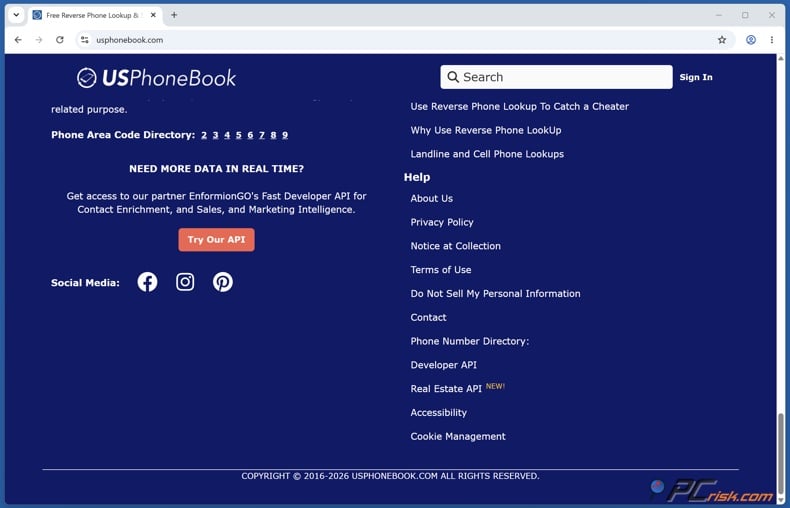
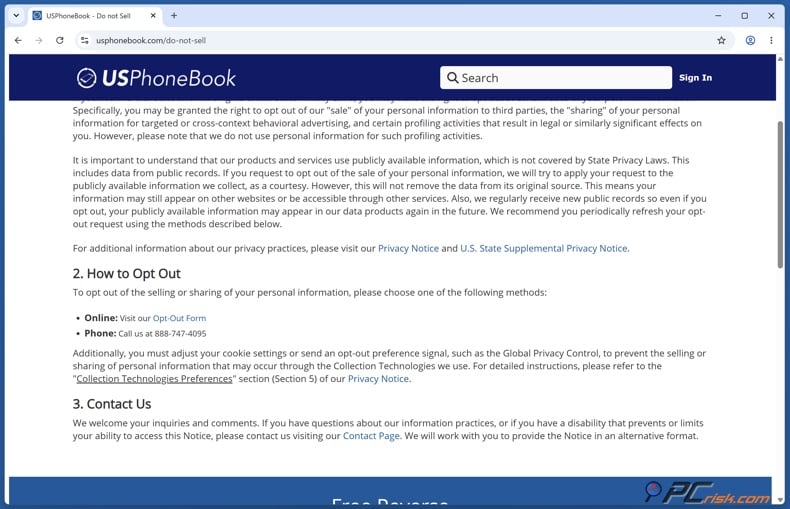
2. Click on the online Opt-Out Form, read the page, check the required boxes, and submit an email address you control. USPhoneBook may ask you to agree to the terms and privacy materials, complete a CAPTCHA, and begin the removal request with an email address. If you prefer to compartmentalize privacy requests, using an email alias or secondary inbox that you still control is a sensible move.
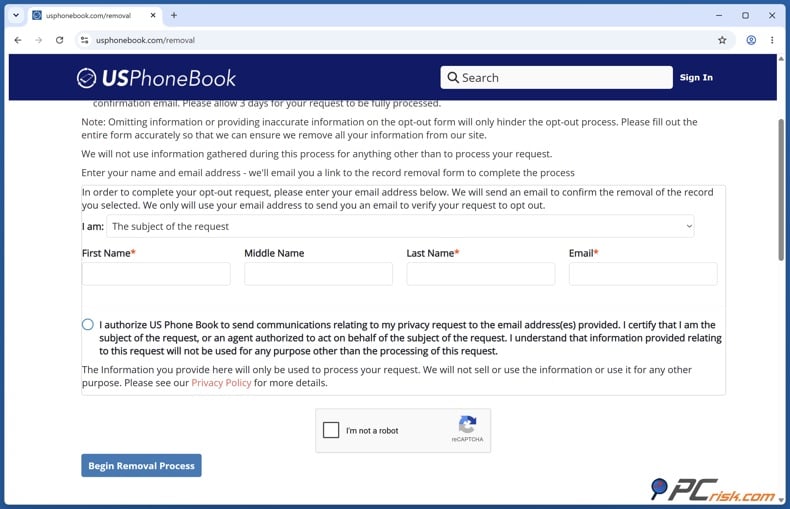
3. Once you are on the detailed record page, look for the "Begin Removal Process" button and submit the removal request for your profile. This is the step that matters most. The removal control is generally attached to the detailed listing page, not just the search result.
4. Watch your inbox and confirm quickly. USPhoneBook sends a confirmation email, and the continuation link is valid for 24 hours. If you miss that window, you may need to restart the process. Save the confirmation email afterward so you have a timestamped record of the request.
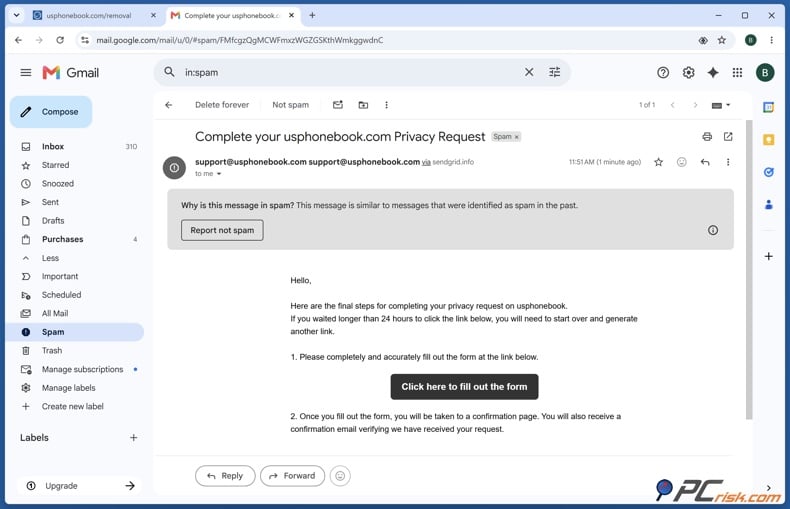
5. Recheck the listing after submission. USPhoneBook states removals may take up to 72 hours, and we see the process complete within that window, sometimes faster. Give it the full period before assuming the request failed. Then search again using the same identifier that originally found the record.
6. If the source page disappears but Google still shows it, handle Google separately. Google's help pages make clear that Google can remove results from Google Search, but that does not remove the underlying source page, and the reverse is also true: the source page can disappear before Google's index updates. If the broker page is gone but the search result persists, use Google's "Results about you" workflow or the personal content removal form to remove it.
Common issues with removing information from USPhoneBook manually. The most common problem is simple interface confusion. If the page tells you to click one label but you only see "GET DETAILS FOR," trust the live interface, not the stale wording. Another frequent problem is an expired or missing verification email. The practical fix is to check the spam and junk folders, then restart the process if the 24-hour window has passed. A third issue is duplicate or near-duplicate listings. If you find more than one profile tied to your name, phone number, or former addresses, remove each one individually, as the site may treat them as separate records. Finally, if the record remains visible after 72 hours, current guides recommend trying again, clearing your cache, and then escalating through the site's alternate contact methods.
Alternative ways to opt out of USPhoneBook. If the standard opt-out page fails, try three fallback routes: the contact form, a phone request, and written mail. The contact form route generally asks for your name, email address, the listing URL, and a message explaining that you are making a privacy or opt-out request. There’s also an opt-out phone line at (888) 747-4095 and an alternate number at (469) 983-2441, and we found (469) 983-2441 as a support contact. There is also a mailing address of PO Box 660675, Dallas, TX 75266-0675 for written requests. If you use one of these fallback methods, include your full name, current and former addresses, relevant phone numbers, the profile URL if available, and a clear statement that you want your USPhoneBook record removed.
There is also a new California-specific alternative worth knowing in 2026. The CPPA says California residents can use the state-run DROP platform to submit one deletion request to more than 500 registered data brokers, and the registry dataset includes an entry for USPhoneBook.com. DROP launched for consumer submissions on January 1, 2026, and data brokers must begin processing those requests on August 1, 2026, deleting the data within 90 days of the start of processing. If you are a Californian, this does not replace the manual USPhoneBook opt-out if you want the site cleaned up immediately, but it is an important second layer because it reaches a much wider group of brokers in one move.
How to remove your information from USPhoneBook automatically
USPhoneBook is usually not the only broker with your data. If one people-search site has a profile on you, it is likely that others do too. That is why automated removal services exist. Incogni's official support materials specifically include USPhoneBook among its covered brokers, and we recommend considering Incogni if you want broad broker coverage, recurring scans, and a hands-off process instead of making many individual requests.
Opt out of USPhoneBook with Incogni
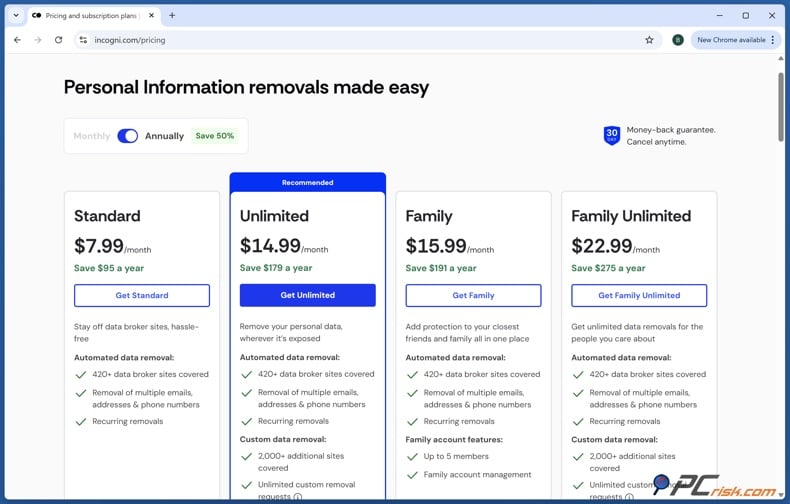
1. The first step is to create an Incogni account and complete setup properly. Incogni's official getting-started guide says the service offers Standard, Family, and Unlimited plans. After purchase, you must verify your email address, create a password, and then enter the minimum personal information required to begin data removal, including your name, date of birth, and home address. If you enter a U.S. address, Incogni says you will also be required to provide a phone number.
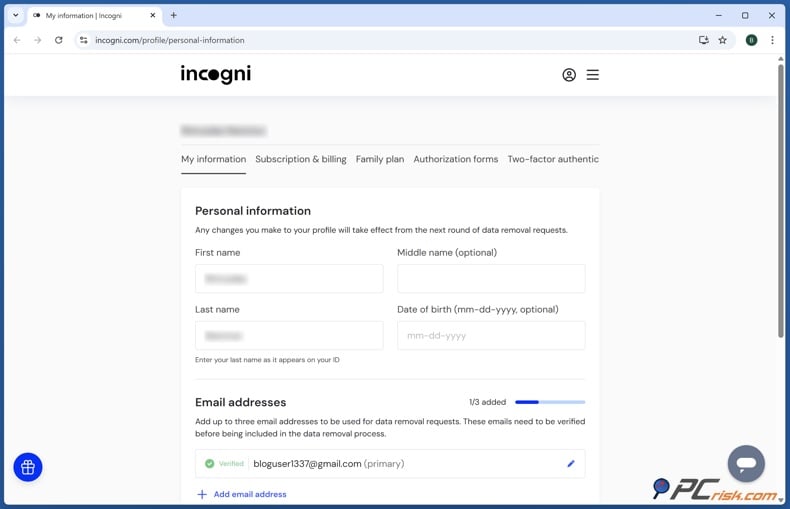
2. The second step is to make your profile as useful as possible. Incogni says you can add more current and past addresses and phone numbers to extend the search, and its account documentation says you can add up to three email addresses or home addresses for data removal. This matters because brokers like USPhoneBook often hold historical information, and an incomplete profile reduces the chance of matching every exposed record.
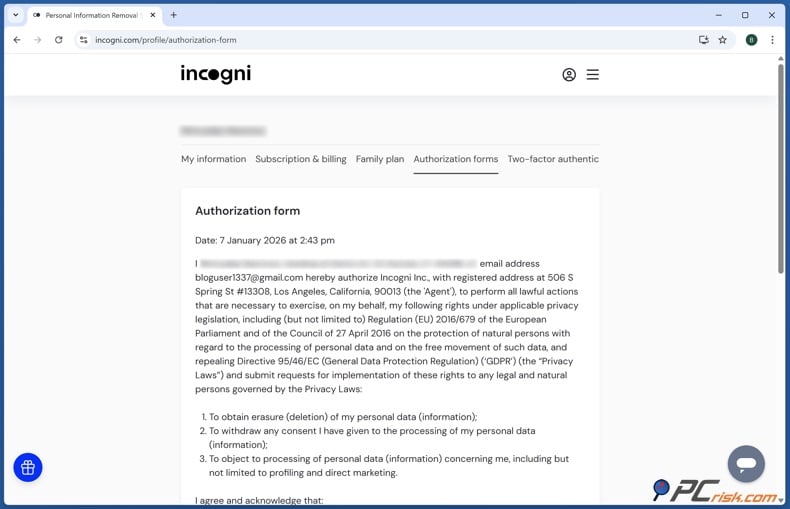
3. The third step is to sign the authorization form. This is not a cosmetic checkbox. Incogni's support materials say the authorization form is the document that allows the company to act on your behalf with brokers. In our Incogni review, we make the same point: the authorization step is critical because most brokers require proof that the person making the request is either the individual or an authorized representative. Without this step, the automated removals do not really begin.
4. The fourth step is to start the removal process and let the system work. Incogni says it contacts brokers on your behalf and automates requests across a growing list of 420-plus data brokers. USPhoneBook appears on Incogni's official coverage list, which is the key fact for this section. In other words, if your goal is to remove data from USPhoneBook automatically rather than manually repeating a site-specific opt-out, Incogni is explicitly built to do that.
5. The fifth step is to check your progress in the dashboard instead of expecting instant results. Incogni's dashboard clearly shows statuses such as removals in progress, removed, and awaiting response, and the official site says users receive regular privacy reports. Our in-house testing also found that quick early wins happen, but many broker removals still take several weeks because the brokers themselves respond on different legal and operational timelines.
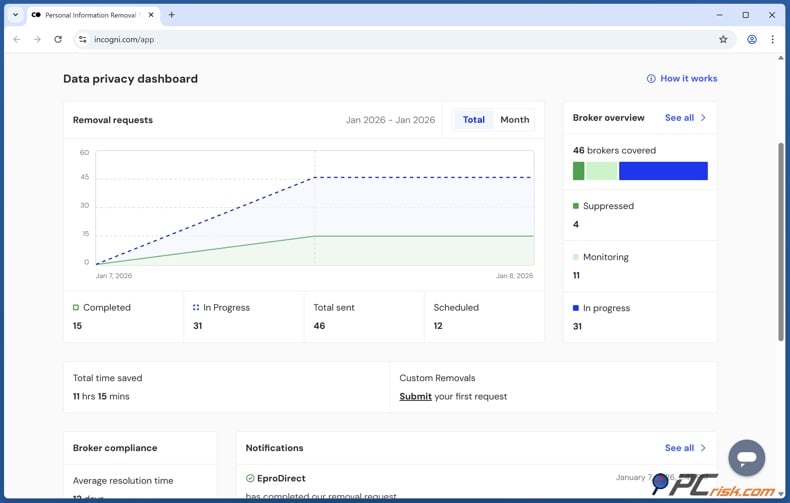
6. The sixth step is to respond when a broker match is ambiguous. Incogni's support article on "action required" emails explains that some brokers hold profiles similar to yours but lack enough detail for a confident automated match. When that happens, you may be asked to verify that a specific profile is really yours. This is still far easier than manually opting out of the entire USPhoneBook, but it is important to understand that "automatic" does not always mean "zero interaction."
7. The seventh step is to keep monitoring turned on if possible. We want to stress the importance of recurring scans and new waves of requests. This matters because the FTC warns that people-search data can come back when public records change, and we point out that the real value of a removal service is in repeated detection and removal across many brokers, not just a one-time fix.
What are personal data removal services?
Personal data removal services are privacy tools that search broker databases and people-search sites for your information, then submit deletion or opt-out requests on your behalf. The FTC describes the basic consumer choice very simply: you can opt out of people-search sites yourself, one by one, or you can pay a service to handle those steps for you. Our 2026 review of the sector goes further, describing these services as an essential layer of privacy protection because they repeatedly scan broker sites, identify where your data appears, and push for its removal at scale.
Check our top personal data removal services
The main benefit is saving time. Manual opt-outs are free, but they are slow and repetitive. The FTC warns that there are many people-search sites and users should check them regularly because information can show up again. Paid services are usually more thorough and convenient because they cover hundreds of sites automatically and keep monitoring for relisting. That ongoing work is what sets them apart. A one-time manual opt-out is just a single step. A data removal service is an ongoing process.
The second benefit is visibility. Incogni's public site says users receive regular privacy reports, and we can appreciate the dashboard's clarity and status tracking. For non-technical users, that matters more than it sounds. The hardest part of broker cleanup is often not sending the first request. It is keeping track of what was removed, what is still pending, what needs more verification, and what came back later. Good removal services make that legible.
The third benefit is broader coverage. In our 2026 round-up, Incogni scanned and removed data across about 420 standard data sources, with more than 2,000 additional sites within the custom-removal scope of its higher tier, while Incogni's own site makes the same coverage claim. That kind of breadth is difficult to replicate manually unless you are willing to spend a lot of time on privacy maintenance each month.
There are limits, and they are important. Note that removal services do not erase all your data from the internet. They usually do not remove your social media content, news articles, court records, or government databases, and the FTC says opting out of people-search sites does not delete public records. That is why these services should be seen as tools to reduce broker data, not as magic solutions for the whole internet.
At PCrisk, our 2026 Incogni review summarizes the tradeoff well. We liked the service's broad broker coverage, effortless setup, and flexible targeting through the Unlimited plan, but we also noted the downsides: there is no free version, meaningful results can take weeks, and broker removal is only one part of personal privacy. For people who only care about a single urgent broker profile, manual removal can be enough. For people who want continuous reduction across brokers, a paid service is usually the better long-term answer.
How to prevent data brokers from getting your data
The hard truth is that prevention is never perfect. The FTC says people-search sites collect information from public social media, public records, and other brokers, so some exposure happens before you even know about sites like USPhoneBook. Still, good privacy habits can make it harder for brokers to rebuild your profile and keep it less visible.
The first useful step is to reduce unnecessary public exposure. Review your social media bios, old forum accounts, public resumes, marketplace listings, wedding sites, alumni pages, and neighborhood apps for any combination of home address, mobile number, full birth date, or family names. The FTC explicitly notes that public or viewable social profiles can feed people-search reports. If a detail does not need to be public, make it private or delete it.
The second step is to turn on Global Privacy Control where possible. The California Attorney General's office describes GPC as a "stop selling or sharing my data switch" available in some browsers and extensions, including Mozilla Firefox, DuckDuckGo, Brave, and Privacy Badger. The same office says that, under California law, covered businesses must honor a valid user-enabled GPC signal as a request to stop the sale or sharing of personal information. It is not a complete solution for broker cleanup, but it is one of the rare privacy controls that can automatically communicate your preference across sites instead of forcing you to click separate opt-out links everywhere.
The third step is to reduce search-engine exposure alongside source-site exposure. Google's support documentation says you can use "Results about you" to monitor Google Search for your home address, phone number, email address, and other personal data, request removal of qualifying results, and receive notifications when new results appear. Google also makes clear that removing a result from Search does not remove the source page from the web, which is why this should complement a USPhoneBook opt-out rather than replace it. But as a visibility-reduction measure, it is extremely useful, especially when broker pages rank well in search results.
The fourth step is to use state tools if you are eligible. California's DROP platform is the most important 2026 development in this area. The CPPA says California residents can submit one request to more than 500 registered data brokers, and starting August 1, 2026, those brokers must delete the consumer's data within 90 days and continue processing the system's deletion cycles every 45 days. For Californians, that makes privacy maintenance much more scalable than the old one-broker-at-a-time approach.
The fifth step is to stay consistent. The FTC warns that your information can show up again if public records change. Incogni makes the same point: ongoing scans and repeated requests are key to keeping your exposure low over time. Whether you do this manually with reminders or use a service, the main idea is the same. Privacy cleanup is not a one-time job.
Wrapping up
Why should you remove your information from USPhoneBook? Because being listed on a people-search site is not harmless. The FTC says even a single detail, like your name or phone number, can let someone buy a report that reveals much more about you, such as your age, past addresses, marital status, property history, and relatives. EPIC warns that brokers make phishing and fraud easier because accurate personal details make scam messages more convincing, and this kind of data can put domestic violence survivors and public officials at risk by making them easier to find. From a cybersecurity perspective, that is reason enough to take action.
If you have just one exposed listing, manual removal is still the best first step. It is free, straightforward, and usually quick if the form works as expected. We recommend doing the same: verify your email, remove the exact record, and wait up to 72 hours for the listing to be taken down. That is a manageable job for one site.
Check our top personal data removal services
The problem comes when people think one successful opt-out fixes everything. It does not. The FTC says your information can still show up in reports about relatives, neighbors, or associates, and it can come back if public records change. That is why we suggest a layered approach. First, remove the urgent USPhoneBook profile. Next, clean up your Google search results. Then, add browser privacy signals like GPC if you can. If you are in California, use DROP. If you keep finding your data on different brokers, a monitored removal service is much easier to justify.
At PCrisk, our advice for 2026 is straightforward. If you find your information on USPhoneBook today, start the manual opt-out right away. Save the confirmation email. Check the listing again after the processing window. Then decide if your wider broker exposure means you need an automated service. That second choice is personal, but the first one is clear. If your information is public on USPhoneBook, there is almost no reason to leave it there.
Frequently asked questions (FAQs)
Is USPhoneBook legal?
USPhoneBook is generally described as a legitimate people-search or reverse lookup service, even though many users strongly object to the privacy impact. California also regulates the broader data broker category through registration and deletion rules, and the public registry surfaces an entry for USPhoneBook.com in the broker dataset. Legal operation does not mean good privacy practice for consumers.
Is USPhoneBook free?
USPhoneBook is a free reverse phone lookup service. That is one reason the site is so concerning from a privacy standpoint. It lowers the barrier to looking people up because users often do not need to pay to see basic identifying information.
How long does the USPhoneBook opt-out process usually take?
The current 2026 USPhoneBook guides state that the site's processing window is typically up to 72 hours after you confirm the request, but we have seen removals happen faster than that in practice. The confirmation email stage is time-sensitive, though, because the continuation link is reported to expire within 24 hours.
Why can't I find the button the instructions tell me to click?
Because the interface appears to have changed, while some site wording lagged behind. Users may be told to click "VIEW FULL ADDRESS & PHONE," but the tested interface actually showed "GET DETAILS FOR." If you are stuck, open the detailed record using the real button, then look for "Remove Record" on the profile page.
Will my information come back after I opt out?
It can. The FTC says people-search information may reappear if your public records change, and current USPhoneBook guides also warn that the site may rebuild a profile later from updated source data. That is why periodic rechecks, Google monitoring, or a recurring removal service are worth considering after the first opt-out succeeds.
Does opting out of USPhoneBook delete the original public records?
No. The FTC is explicit that opting out of a people-search site does not delete the underlying public records. It removes or suppresses the broker's listing, but the source material may still exist in government records or in copies held by other brokers.
Can I remove someone else's information from USPhoneBook?
As a general rule, no. The site only allows individuals to remove their own records for privacy and verification purposes. The main exception is California's DROP system, where the state says certain people, such as a parent acting for a child or a family member helping an elderly relative, may, in some cases, submit requests on behalf of another California resident.
What should I do if the normal USPhoneBook opt-out form fails?
Use the fallback channels. You can try the site's contact form, call the opt-out or support numbers, or send a written request by mail. Include your full name, the listing URL (if available), current and past addresses, phone numbers associated with the record, and a clear request for removal so the site can identify the correct profile.
Is there a one-request option for Californians in 2026?
Yes. California's DROP system launched consumer submissions on January 1, 2026, and the CPPA says it allows California residents to submit one request to more than 500 registered data brokers. Brokers must begin processing those requests on August 1, 2026, and delete consumer data within 90 days after that processing starts.
Does Incogni cover USPhoneBook?
Yes. Incogni's official help materials list USPhoneBook among the brokers in its covered library, and in our 2026 testing of personal data removal services, we describe Incogni as a strong fit for users who want automated removals, dashboard tracking, and recurring scans instead of repeating manual opt-outs broker by broker.
Will removing a result from Google also remove the page from USPhoneBook?
No. Google's support pages say Google can remove qualifying results from Google Search, but that does not remove the source page from the website that hosts it. If you want the information gone at the source, you still need the USPhoneBook opt-out or another direct deletion route, then use Google cleanup only for search visibility.
Share:
 Facebook
 X.com
X.com
 LinkedIn
 Copy Link

Rimvydas Iliavicius
Researcher, author
Rimvydas is a researcher with over four years of experience in the cybersecurity industry. He attended Kaunas University of Technology and graduated with a Master's degree in Translation and Localization of Technical texts. His interests in computers and technology led him to become a versatile author in the IT industry. At PCrisk, he's responsible for writing in-depth how-to articles for Microsoft Windows.
▼ Show Discussion