
Avoid getting scammed by fake "Iforgot.apple.com" emails
Phishing/ScamAlso Known As: Iforgot.apple.com spam

Get free scan and check if your device is infected.
Remove it nowTo use full-featured product, you have to purchase a license for Combo Cleaner. Seven days free trial available. Combo Cleaner is owned and operated by RCS LT, the parent company of PCRisk.com.
What is "iforgot.apple.com"?
The "Iforgot.apple.com" scam is used by cyber criminals to steal logins and passwords (AppleID accounts). They send this email to many people hoping that at least some will click the link and provide the requested details. We strongly recommend that you ignore this email, since it has nothing to do with the Apple company.
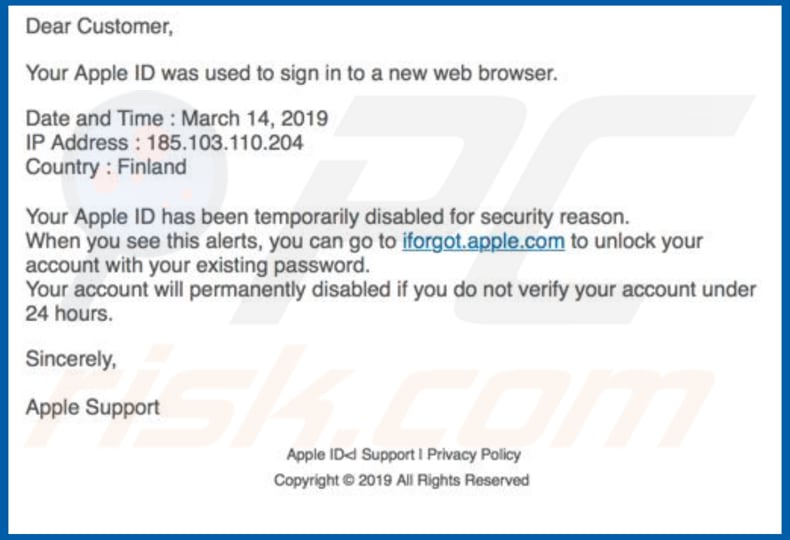
"Iforgot.apple.com" email scam overview
The message informs recipients that their Apple ID was used to sign in on a new browser - potentially implying that another device was used to sign in with the ID. In any case, the scam states that the user's Apple ID has been temporarily disabled for security reasons.
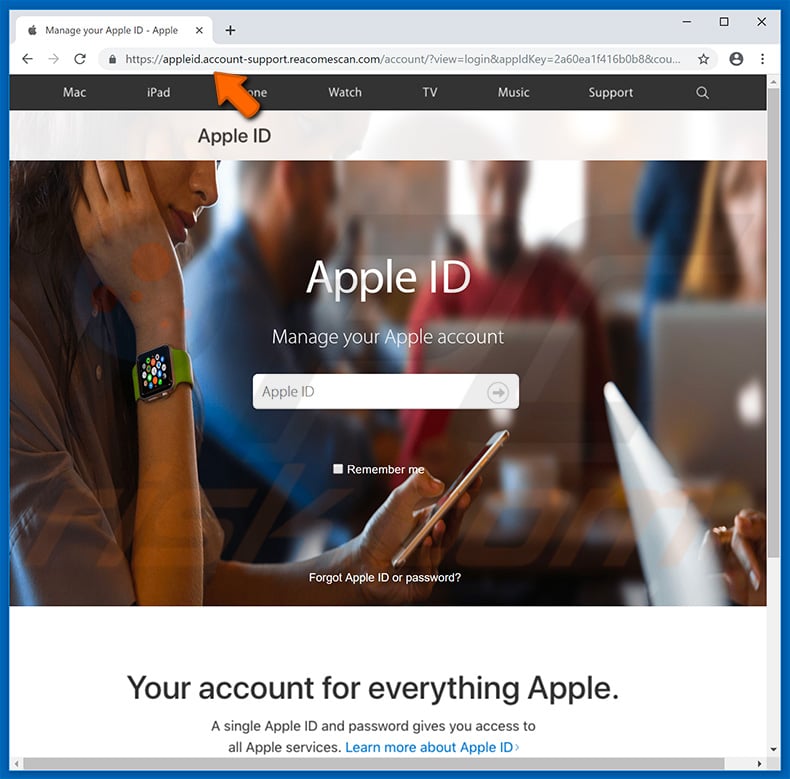
To re-enable it, people are encouraged to sign in to their Apple accounts using their Apple IDs and passwords via a deceptive website. Note that the email contains the iforgot.apple.com URL, which is a legitimate Apple website, however, this actually a hyperlink.
Thus, "iforgot.apple.com" is simply text pointing to a URL of a fake Apple ID management website used to steal account credentials. People are urged to sign in within 24 hours, otherwise their accounts will be disabled permanently. These scammers pose as Apple Support team members.
We strongly advise that you do not sign in through the presented website, since this is used to steal Apple ID accounts (and credentials).
If they succeed, cyber criminals can use these accounts to access App Store (make purchases), iMessage (manage messages), iCloud (gain access to files stored on it), and so on. In summary, using this deceptive website to sign into Apple ID can result in privacy issues or even financial loss. This scam should not be trusted. We recommend that you delete this email and never trust any similar emails in future.
| Name | Iforgot.apple.com spam |
| Threat Type | Mac malware, Mac virus |
| Symptoms | Your Mac became slower than normal, you see unwanted pop-up ads, you get redirected to shady websites. |
| Distribution methods | Deceptive pop-up ads, free software installers (bundling), fake flash player installers, torrent file downloads. |
| Damage | Internet browsing tracking (potential privacy issues), displaying of unwanted ads, redirects to shady websites, loss of private information. |
| Malware Removal (Windows) |
To eliminate possible malware infections, scan your computer with legitimate antivirus software. Our security researchers recommend using Combo Cleaner. Download Combo CleanerTo use full-featured product, you have to purchase a license for Combo Cleaner. 7 days free trial available. Combo Cleaner is owned and operated by RCS LT, the parent company of PCRisk.com. |
Spam campaigns in general
Typically, scammers use similar spam campaigns to extort money from people. Trusting these emails often leads to financial loss. Some examples of other similar rogue emails are "You Certainly Do Not Know Me", "Hey. It's me! Your Future Friend Or Enemy", and "I Have A Forum In The Darkweb".
Nevertheless, some spam campaigns are used to cause computer infections. Cyber criminals send emails that contain malicious attachments (or web links that lead to them) and, if opened, they cause installation of high-risk viruses such as LokiBot, TrickBot, Emotet, AZORult, Adwind, and so on.
These emails usually contain Microsoft Office documents (Word, Excel and others), JavaScript files, PDF documents, archives (ZIP, RAR, etc.), executables and other files.
If opened, they download and install malicious programs that proliferate other infections, steal personal details (passwords, logins), etc. These programs usually cause problems relating to privacy, browsing safety, financial loss, and various other serious issues.
How do spam campaigns infect computers?
Spam campaigns that cause computer infections can do so only if the attachments and links that lead to them are opened. For example, if an attached file is an MS Office document, once opened, it will demand permission to enable macros commands.
In effect, this is to disable "Protected View" mode, which protects users from installation of malware caused by malicious/infected documents. The same applies to other files. Whatever the file type, it must first be opened. The best way to avoid computer infections is to leave these files unopened.
How to avoid installation of malware?
To avoid computer infections and damage that can be done by them, handle emails that are received from unknown or suspicious addresses with care. Especially if these emails contain links or attachments. Most are presented as official and legitimate, however, they usually have no relevance to the recipients at all.
Therefore, download software from official websites and using direct links. Do not use dubious software download channels such as Peer-to-Peer networks (torrent clients, eMule etc.), unofficial/dubious websites, third party downloaders, etc. to download software.
Software should be updated using tools provided by official software developers only and not third party tools. Do not use software "cracking" tools to avoid paying for official software. Cracking tools are often used by cyber criminals to proliferate malware.
Besides, it is illegal to use these tools. Additionally, have reputable anti-virus or anti-spyware software installed and keep it enabled at all times. If you have already opened malicious attachments, we recommend running a scan with Combo Cleaner Antivirus for Windows to automatically eliminate infiltrated malware.
Text presented in the "iforgot.apple.com" email message:
Dear Customer,
Your Apple ID was used to sign in to a new web browser.
Date and Time:
IP Address:
Country:
Your Apple ID has been temporarily disabled for security reason. When you see this alerts, you can go to iforgot.apple.com to unlock your account with your existing password. Your account will permanently disabled if you not verify your account under 24 hours.
Sincerely,
Apple Support
Screenshot of a fake Apple ID management website:
Another variant of iforgot.apple.com email scam:
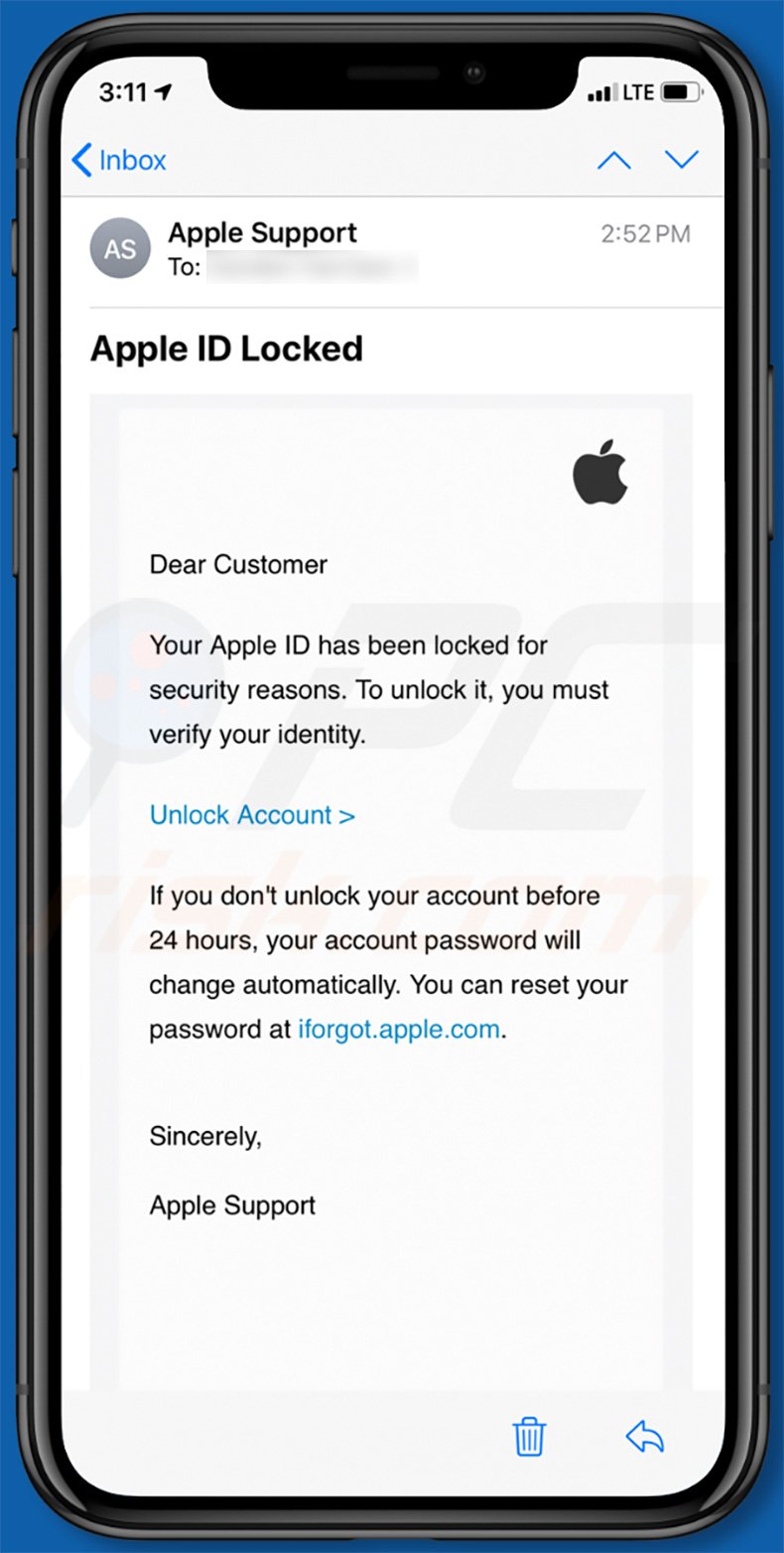
Text presented within this email:
Subject: Apple Support
Apple ID Locked
Dear Customer
Your Apple ID has been locked for security reasons. To unlock it, you must verify your identity.
Unlock Account >
If you don't unlock your account before 24 hours, your account password will change automatically. You can reset your password at iforgot.apple.com.
Sincerely,
Apple Support
Instant automatic malware removal:
Manual threat removal might be a lengthy and complicated process that requires advanced IT skills. Combo Cleaner is a professional automatic malware removal tool that is recommended to get rid of malware. Download it by clicking the button below:
DOWNLOAD Combo CleanerBy downloading any software listed on this website you agree to our Privacy Policy and Terms of Use. To use full-featured product, you have to purchase a license for Combo Cleaner. 7 days free trial available. Combo Cleaner is owned and operated by RCS LT, the parent company of PCRisk.com.
Quick menu:
- What is Iforgot.apple.com spam?
- Types of malicious emails.
- How to spot a malicious email?
- What to do if you fell for an email scam?
Types of malicious emails:
 Phishing Emails
Most commonly, cybercriminals use deceptive emails to trick Internet users into giving away their sensitive private information, for example, login information for various online services, email accounts, or online banking information.
Such attacks are called phishing. In a phishing attack, cybercriminals usually send an email message with some popular service logo (for example, Microsoft, DHL, Amazon, Netflix), create urgency (wrong shipping address, expired password, etc.), and place a link which they hope their potential victims will click on.
After clicking the link presented in such email message, victims are redirected to a fake website that looks identical or extremely similar to the original one. Victims are then asked to enter their password, credit card details, or some other information that gets stolen by cybercriminals.
 Emails with Malicious Attachments
Another popular attack vector is email spam with malicious attachments that infect users' computers with malware. Malicious attachments usually carry trojans that are capable of stealing passwords, banking information, and other sensitive information.
In such attacks, cybercriminals' main goal is to trick their potential victims into opening an infected email attachment. To achieve this goal, email messages usually talk about recently received invoices, faxes, or voice messages.
If a potential victim falls for the lure and opens the attachment, their computers get infected, and cybercriminals can collect a lot of sensitive information.
While it's a more complicated method to steal personal information (spam filters and antivirus programs usually detect such attempts), if successful, cybercriminals can get a much wider array of data and can collect information for a long period of time.
 Sextortion Emails
This is a type of phishing. In this case, users receive an email claiming that a cybercriminal could access the webcam of the potential victim and has a video recording of one's masturbation.
To get rid of the video, victims are asked to pay a ransom (usually using Bitcoin or another cryptocurrency). Nevertheless, all of these claims are false - users who receive such emails should ignore and delete them.
How to spot a malicious email?
While cyber criminals try to make their lure emails look trustworthy, here are some things that you should look for when trying to spot a phishing email:
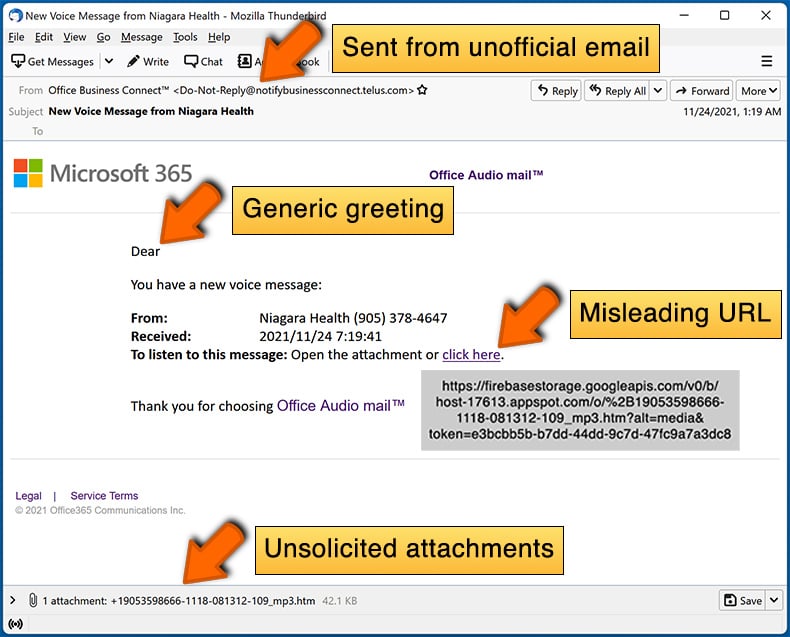
- Check the sender's ("from") email address: Hover your mouse over the "from" address and check if it's legitimate. For example, if you received an email from Microsoft, be sure to check if the email address is @microsoft.com and not something suspicious like @m1crosoft.com, @microsfot.com, @account-security-noreply.com, etc.
- Check for generic greetings: If the greeting in the email is "Dear user", "Dear @youremail.com", "Dear valued customer", this should raise suspiciousness. Most commonly, companies call you by your name. Lack of this information could signal a phishing attempt.
- Check the links in the email: Hover your mouse over the link presented in the email, if the link that appears seems suspicious, don't click it. For example, if you received an email from Microsoft and the link in the email shows that it will go to firebasestorage.googleapis.com/v0... you shouldn't trust it. It's best not to click any links in the emails but to visit the company website that sent you the email in the first place.
- Don't blindly trust email attachments: Most commonly, legitimate companies will ask you to log in to their website and to view any documents there; if you received an email with an attachment, it's a good idea to scan it with an antivirus application. Infected email attachments are a common attack vector used by cybercriminals.
To minimise the risk of opening phishing and malicious emails we recommend using Combo Cleaner Antivirus for Windows.
Example of a spam email:
What to do if you fell for an email scam?
- If you clicked on a link in a phishing email and entered your password - be sure to change your password as soon as possible. Usually, cybercriminals collect stolen credentials and then sell them to other groups that use them for malicious purposes. If you change your password in a timely manner, there's a chance that criminals won't have enough time to do any damage.
- If you entered your credit card information - contact your bank as soon as possible and explain the situation. There's a good chance that you will need to cancel your compromised credit card and get a new one.
- If you see any signs of identity theft - you should immediately contact the Federal Trade Commission. This institution will collect information about your situation and create a personal recovery plan.
- If you opened a malicious attachment - your computer is probably infected, you should scan it with a reputable antivirus application. For this purpose, we recommend using Combo Cleaner Antivirus for Windows.
- Help other Internet users - report phishing emails to Anti-Phishing Working Group, FBI’s Internet Crime Complaint Center, National Fraud Information Center and U.S. Department of Justice.
Frequently Asked Questions (FAQ)
Why did I receive this email?
Spam emails are not personal. Cyber criminals distribute this mail in massive campaigns with the hopes that at least some recipients will fall for their scams.
I have provided my personal information when tricked by this spam email, what should I do?
If you have disclosed your log-in credentials - change the passwords of all potentially compromised accounts and inform their official support without delay. And if other private information has been exposed (e.g., ID card details, credit card numbers, etc.) - immediately contact the appropriate authorities.
I have read a spam email but didn't open the attachment, is my computer infected?
No, just reading an email will not result in a system infection. Malware download/installation chains are triggered when malicious attachments/links found in spam mail are opened/clicked.
I have downloaded and opened a file attached to a spam email, is my computer infected?
If the opened file was an executable (.exe, .run, etc.) - most likely, yes - your system was infected. However, document formats (.doc, .xls, etc.) may need additional user interaction (e.g., enabling macro commands) to start downloading/installing malware.
Will Combo Cleaner remove malware infections present in email attachments?
Yes, Combo Cleaner is capable of detecting and eliminating most of the known malware infections. However, it must be emphasized that running a full system scan is essential - since sophisticated malicious programs tend to hide deep within systems.
Share:
 Facebook
 X.com
X.com
 LinkedIn
 Copy Link

Tomas Meskauskas
Expert security researcher, professional malware analyst
I am passionate about computer security and technology. I have an experience of over 10 years working in various companies related to computer technical issue solving and Internet security. I have been working as an author and editor for pcrisk.com since 2010. Follow me on Twitter and LinkedIn to stay informed about the latest online security threats.
PCrisk security portal is brought by a company RCS LT.
Joined forces of security researchers help educate computer users about the latest online security threats. More information about the company RCS LT.
Our malware removal guides are free. However, if you want to support us you can send us a donation.
DonatePCrisk security portal is brought by a company RCS LT.
Joined forces of security researchers help educate computer users about the latest online security threats. More information about the company RCS LT.
Our malware removal guides are free. However, if you want to support us you can send us a donation.
Donate
▼ Show Discussion