
We may earn commissions from products we recommend. Learn more.
How to Unblock Pornhub in Australia With a VPN in 2026

How to Unblock Pornhub in Australia in 2026
In March 2026, Australian internet users saw significant changes in how they accessed adult content online. While many called it a "porn ban," it was not a total ban for adults. Instead, stricter age checks were introduced for online services with age-restricted material. For many, it felt like a ban because major sites changed what Australians could view, blocked features, stopped new sign-ups, or limited access unless users could prove they were adults under the new rules.
Pornhub became the main focus because it is the most well-known adult site. However, the issue is bigger than one website. The 2026 rules in Australia affect how many platforms, including app stores, social media, messaging services, and search engines, handle age-restricted content. For adults, the main questions now are not just about why Pornhub is blocked, but also how age verification works, what data is collected, how private the process is, and how to best protect personal information online.
Disclaimer: PCrisk.com does not promote, encourage, or endorse bypassing legal age-verification requirements, platform restrictions, or local laws. This article is provided for educational and privacy-awareness purposes only. It is intended to explain what changed in Australia in 2026, how online age verification typically works, and how users can better protect their data and online privacy. It is not intended for minors, and anyone under 18 should not attempt to access adult material.
Watch Pornhub in Australia with NordVPNSpecial deal30-day money-back guarantee→
Table of Contents:
- Introduction
- Why Is Pornhub Blocked in Australia?
- How Age Verification Works for Adult Content in Australia
- Why Pornhub and Other Sites May Restrict Access Instead of Verifying
- Unblock Pornhub in Australia With a VPN 2026
- Best VPNs for Unblocking Pornhub in Australia in 2026
- Can I Access Other Porn Sites in Australia?
- Common Issues and Solutions When Using a VPN for Privacy
- Guide on How to Verify Your Age on Adult Websites in Australia
- Is It Safe to Upload Your ID to Pornhub for Age Verification?
- Is Using a VPN Legal in Australia?
- Can I Use a Free VPN in Australia?
- Conclusion
- Frequently Asked Questions (FAQs)
Why Is Pornhub Blocked in Australia?
Pornhub became controversial in Australia not because adult content was made illegal, but because the country started enforcing age-restricted content rules more strictly. When these rules took effect, platforms serving Australians had to decide whether to implement proper age checks, change how they displayed content, or limit access.
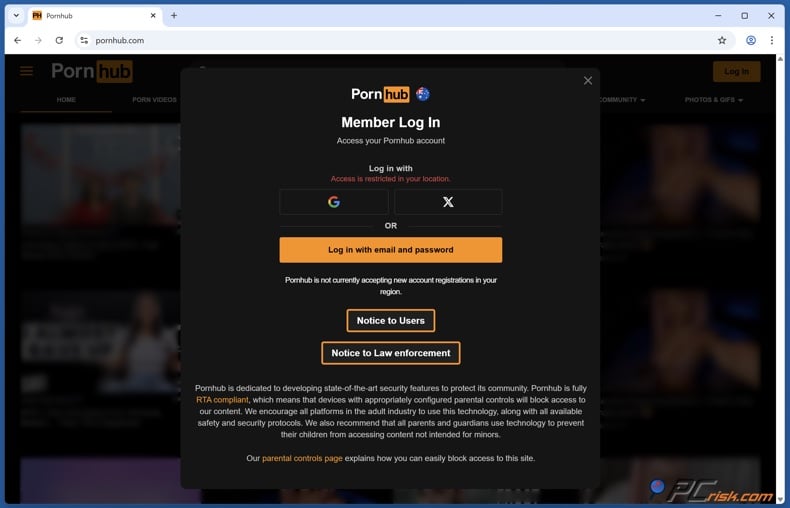
This is why many Australians noticed a big change in March 2026. Some adult sites stopped allowing new accounts. Others hid explicit content from users who were not verified or logged in. Some sites announced they would start age checks, while others limited access. As a result, Australians saw everything from safe-for-work homepages to account restrictions and full content blocks.
On March 9, 2026, a new phase of Australia's Age-Restricted Material Codes began. These rules, created under the Online Safety bill, were designed to reduce minors' exposure to things like pornography, extreme violence, self-harm, and other content not suitable for children. The changes did not just target porn sites - they applied to many parts of the online world.
Here are the key points to understand:
- The Australian framework is national, not a different porn law for each state.
- The rules focus on keeping under-18s away from age-restricted material, not on criminalising adults for viewing lawful adult content.
- A simple "Yes, I am over 18" button is no longer considered sufficient on its own.
- Platforms are expected to use stronger age-assurance methods and to do so in ways that also respect privacy law.
- Sites that do not want to operate those systems, or that object to them, may limit content, block new registrations, or otherwise restrict access for Australian users.
When people say Pornhub is "blocked" in Australia, they usually mean that Australians no longer have the same open access they did before March 2026. How each platform responds can vary, but the main reason is compliance with age-restricted content rules.
What Actually Changed on March 9, 2026?
March 9 was important because it marked the start date of a new set of age-restricted content rules that covered a wider range of online services. Some rules were already in place, but after March 9, the changes became more noticeable for everyday users.
The new rules did not just affect traditional adult websites. They also included some social media features, certain online services, equipment providers, and app stores, though some app-store rules started later. This created a more visible and connected set of regulations for adult content.
That date was also important because it changed how platforms made decisions. Before the rules started, companies could cite technical issues or privacy concerns, or wait to see how things would play out. After March 9, they had to make choices about how to handle Australian users.
For companies in the adult-content space, there were three broad choices.
- The first option was to implement age assurance directly or via a third party. That could mean asking users to prove they are over 18 using a document, a digital ID system, a facial age estimation tool, a payment-linked method, or another approved approach.
- The second option was to limit content exposure unless the platform was confident the user was an adult. This can result in blurred content, safe-for-work landing pages, disabled previews, or a requirement to log in.
- The third option was to narrow or restrict access for Australian users altogether. In some cases, that means blocking explicit material for free users, refusing new account registrations, or treating the Australian market differently from other countries.
This is why there was not just one outcome on March 9. Instead, different platforms responded in their own ways, all because of the same new rules.
Our top recommendation for streaming and privacy. NordVPN consistently leads our tests with fast speeds, reliable geo-unblocking, and a strict no-logs policy.
- ✔ Unblocks geo-restricted streaming services reliably
- ✔ 202+ locations across 111 countries
- ✔ 30-day money-back guarantee · Special deal available
How Age Verification Works for Adult Content in Australia
A common misunderstanding is that Australia now requires everyone to upload a passport to every adult website. That is not the case. The rules do not force every service to use the same method. Instead, they expect platforms to use strong enough age checks for the level of risk.
In practice, age verification and age assurance can take several forms.
The most obvious method is photo ID matching. A user uploads a government-issued identity document, such as a passport or driver's licence, and the verification system checks whether the person is old enough. Often, this is handled by a specialist third-party provider rather than by the adult website itself.
Another method is facial age estimation. Instead of proving identity, the user submits a selfie or a short live scan. Software estimates whether the person is likely above or below the threshold age. This method is often marketed as more privacy-preserving because it can verify adulthood without necessarily proving exactly who the person is.
Credit-card checks are another possible method. The logic is simple: if the card can be issued only to an adult, the payment instrument serves as a proxy for age. The problem is that this approach is imperfect. Not every adult has a qualifying card, and not every card-based check reveals more than payment validity.
Digital identity wallets and government-backed digital ID systems may also be used. In that model, the website or verifier receives an "over 18" signal rather than the full identity record. This can be more privacy-friendly if designed properly.
There are also other models, including third-party age tokens, reusable age credentials, or age signals already generated elsewhere in the digital ecosystem.
The key thing for users to know is that age verification does not always mean full identity verification. Some systems only check if someone is over 18, without sharing their full identity with the site. This difference is important for privacy.
It is also important to know what no longer works. The old method of just clicking a checkbox or selecting "Enter if over 18" is no longer sufficient for high-risk sites.
Why Pornhub and Other Sites May Restrict Access Instead of Verifying
Many users are confused and wonder: if age checks are allowed, why not just let people verify and move on?
The reason is that websites do not all agree on the best way to conduct age checks, what the privacy risks are, how much it costs, or whether it could cause legal or reputational problems. For big adult sites, age checks are not just a technical issue - they also involve decisions about data, trust, and business.
Big adult sites have often said that strict age checks can drive users to smaller, less safe, or less regulated sites. They also warn that requiring millions of adults to submit sensitive data can pose a significant privacy risk if the system is poorly designed or hacked.
These concerns are real for users. Browsing adult sites is very private, and even if a site says it will not keep your documents, people still worry about leaks, misuse, or changes in policy. That is why some adult sites have chosen to limit access instead of making age checks easy for everyone.
This is also why free and paid services can feel different. A company might check the age of subscribers or verified users, but limit what anonymous or casual visitors can see. For many, this still feels like being blocked, even if the legal reasons are more complex.
Unblock Pornhub in Australia With a VPN 2026
NordVPN is PCrisk's top-rated VPN for 2026, making it a good example for adults in Australia who want to set up a privacy-focused VPN. The steps below show how to set up your VPN securely and browse legally, not how to bypass age checks.
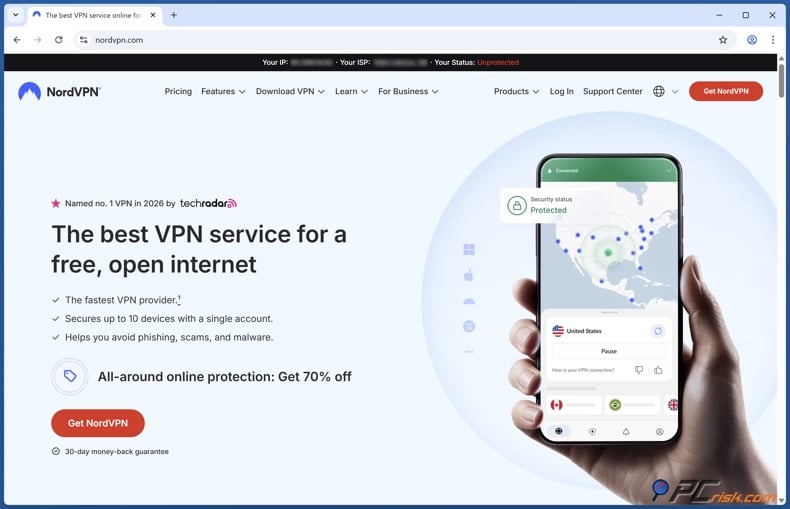
1. Sign up for NordVPN. Choose a subscription on the official website or app store. For most people, the Standard plan is enough because it includes the main VPN service, encryption, and access to all main servers. If you want features like password management or cloud storage, you can look at the higher plans later.
2. Install the app on your device. Download NordVPN for Windows, macOS, Android, iPhone, iPad, or any other supported device. Install it like any other security app. During setup, your device may ask for permission to create VPN settings. Allow this so the app can connect securely.
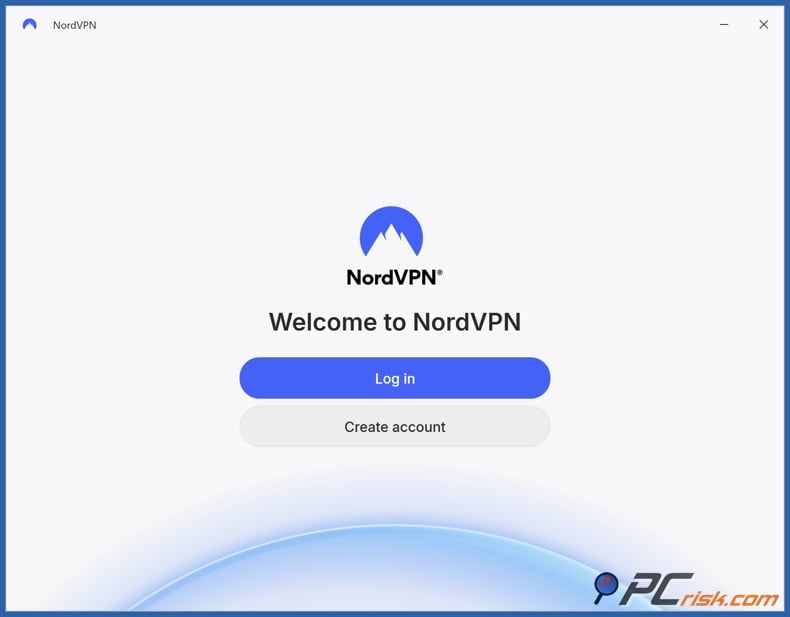
3. Log in and turn on basic protections. After you sign in, go to settings and turn on the Kill Switch. This feature stops your internet traffic if the VPN disconnects, keeping your real IP address hidden. If your plan includes it, also turn on Threat Protection or basic site filtering.
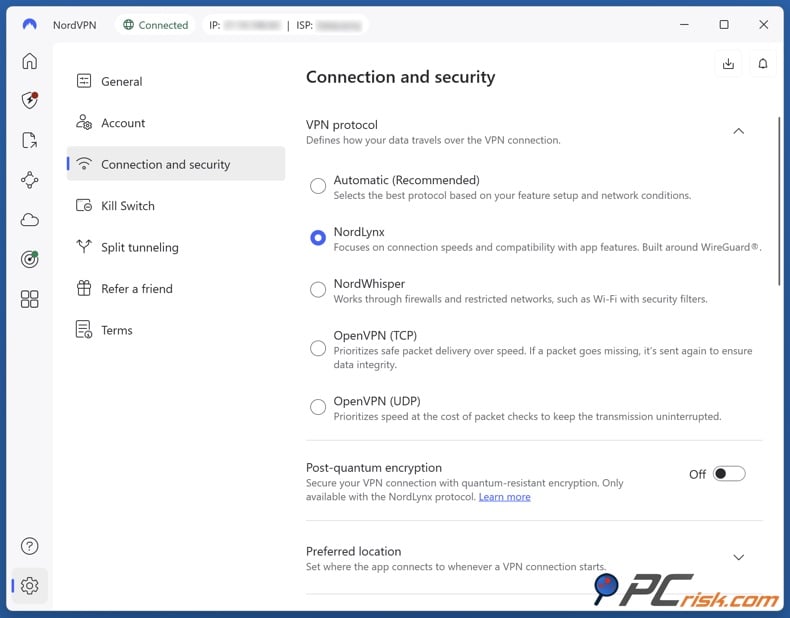
4. Choose the right protocol. For most users, NordLynx is the best choice. It is usually the fastest in NordVPN's app and works well for video sites. If a network blocks it, try OpenVPN or NordVPN's obfuscated options, but most people should start with NordLynx for the best speed and stability.
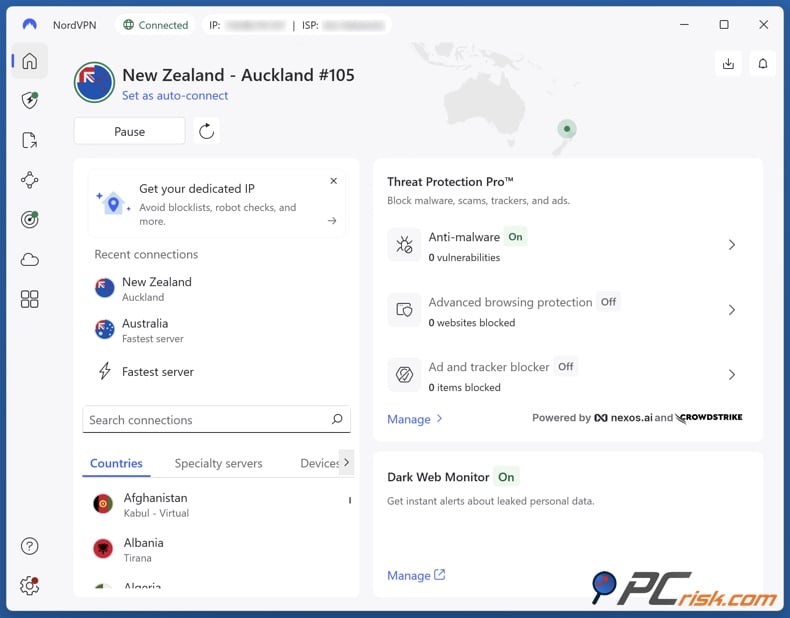
5. Connect and check that the VPN is working. Use Quick Connect or choose a server from the list. Once connected, make sure the app shows you are protected. For extra safety, visit an IP-checking website to confirm your IP address has changed. Also, check that DNS leak protection is on so your requests stay private.
6. Start with a fresh browser session. If a site still recognizes you as an Australian visitor after connecting, it is often due to old cookies, cached data, location permissions, or saved sessions. Open a private window, clear cookies, block location access, and try again. On mobile, you may need to close the browser or clear the app cache.
7. Browse as usual and follow any legal age checks. This is the most important step. If a site asks for age verification, complete it legally or stop there. A VPN does not replace proof of age. It only protects your connection and changes your network route. Use it for security, not to bypass rules. a workaround.
8. Disconnect when finished if you want. After you are done, you can keep the VPN on or turn it off if you only use it for private browsing. Many people leave it on all the time because it also helps protect privacy when searching, streaming, banking on public Wi-Fi, and during other daily browsing.
For adults who value privacy, this setup offers real benefits. NordVPN hides your home IP from websites, encrypts your traffic on shared networks, and limits what your ISP can learn about your browsing. These are real advantages in 2026. However, you still need to comply with any age checks when a service asks for them.
Best VPNs for Unblocking Pornhub in Australia in 2026
A VPN will not remove legal or site rules about age checks, and it cannot fix poor privacy choices. What it does is improve your general online privacy by encrypting your traffic, hiding your browsing from your ISP, and protecting you on public Wi-Fi. For people who care about privacy and security, a good VPN is still useful.
Based on PCrisk's current VPN reviews and 2026 rankings, these are the five strongest options to consider for privacy and security.
1. NordVPN - NordVPN remains the most rounded choice in PCrisk's rankings. It combines a very large network with fast performance, polished apps, and a strong privacy feature set. For people who want one product that is easy to use but still offers power-user tools, it is the most complete package in the group.
NordVPN operates more than 9,100 servers across 167 countries. That level of country coverage matters because it gives users a lot of flexibility when they need stable connections, low congestion, or region diversity for travel and general browsing.
Its strongest points are speed, streaming reliability, and extras such as Double VPN, Onion over VPN, Threat Protection, and obfuscated servers. The apps are mature and beginner-friendly, and one account covers up to 10 devices.
- Pros: Excellent balance of speed, privacy, and ease of use. Very large server network and broad country coverage. Strong feature set, including obfuscation and advanced privacy tools.
- Cons: Shorter plans are relatively expensive. No permanent free tier. Some platform differences remain, especially around split tunneling on iOS and macOS.
NordVPN is the easiest recommendation for users who want the broadest mix of privacy, usability, and everyday performance.
2. Surfshark - Surfshark is the value pick for people with many devices. It allows unlimited simultaneous connections, making it particularly attractive for households with laptops, phones, tablets, smart TVs, and spare devices competing for coverage.
Surfshark runs more than 4,500 servers in 100 countries. While the total server count is smaller than NordVPN's, the country coverage is still strong, and the provider performs especially well on modern WireGuard-based connections.
Its major strengths are price-to-feature value, unlimited device support, and a surprisingly rich feature set for the money. MultiHop, CleanWeb, split tunneling, and Everlink all add practical value.
- Pros: Excellent value on long-term plans. Unlimited devices on one subscription. Fast performance and strong feature depth.
- Cons: Renewal pricing rises sharply after the initial term. No free version. Some features are missing or reduced on certain platforms.
Surfshark is a smart option for budget-conscious users who still want a premium VPN experience.
3. Proton VPN - Proton VPN stands out for transparency and privacy culture. Developed by the team behind Proton's privacy ecosystem, it has a strong reputation among users who care about jurisdiction, open-source software, and independently audited apps.
Proton VPN's network is huge: more than 18,700 servers in over 134 countries. That makes it one of the broadest networks in the current market. The provider also offers Secure Core multi-hop routing, NetShield filtering, and a strong free tier.
The free version is one of its biggest selling points. Unlike most free VPNs, it does not impose a hard data cap. That said, the free tier is limited in the countries it supports and is not designed for premium streaming or P2P use.
- Pros: Strong privacy reputation and Swiss base. Open-source apps and an audited no-logs approach. Excellent free plan for basic privacy use.
- Cons: Paid tiers cost more than some rivals. Speed is good, but not always class-leading. Support and billing response times can be slower than the top mainstream brands.
Proton VPN is ideal for users who prioritize transparency and privacy architecture over aggressive discount pricing.
4. Mullvad - Mullvad is the specialist's choice. It is not the most feature-rich consumer VPN, nor the best streaming option, but it is arguably the purest privacy-first service in the group.
Mullvad operates around 580 servers in 50-plus countries. That is a much smaller footprint than most of the others on this list, but the service makes up for it with anonymous sign-up, open-source apps, simple flat pricing, and an unusually strong reputation among privacy enthusiasts.
Instead of asking for an email address, Mullvad can assign an account number. It also supports unusual payment methods, which are rare in a market full of identity-linked subscriptions.
- Pros: Excellent privacy posture and anonymous sign-up model. Open-source, audited apps. Stable, honest product with straightforward pricing.
- Cons: Smallest network of the five. Weakest choice for unblocking mainstream streaming services. Lacks some mainstream convenience features, such as live chat or dedicated IP products.
Mullvad is best for users who want a privacy tool first and a lifestyle subscription second.
5. ExpressVPN - ExpressVPN is still one of the most user-friendly premium VPNs available. Its interface is simple, the performance is dependable, and its security model remains strong, particularly with RAM-only server infrastructure and an audited no-logs policy.
ExpressVPN operates in more than 105 countries with over 3,000 servers worldwide. That gives it solid global flexibility, even if it trails NordVPN and Proton VPN on raw scale.
Its Lightway protocol is a key strength, helping deliver quick connections and stable performance. The apps are polished across desktop and mobile, and router support remains better than average.
- Pros: Very easy to use. Strong privacy design and RAM-only servers. Reliable performance across many regions.
- Cons: More expensive than most direct rivals. Lacks some advanced extras found elsewhere. Long-term deals are less aggressive than those of some competitors.
ExpressVPN is a good premium choice for users who prioritise simplicity, reliability, and clean cross-platform support.
Can I Access Other Porn Sites in Australia?
Users often assume that if one site changes its policy, another site will provide the old experience. In reality, that is not a safe assumption in Australia after March 2026.
The new framework is not aimed only at one brand. It is aimed at age-restricted material as a category. That means other adult platforms may react differently, but they face the same broad regulatory climate if they serve Australian users. Some may choose document-based age checks. Some may use facial age tools. Some may restrict previews or anonymous browsing. Others may reduce access, disable specific sections, or change account creation rules.
This matters for two reasons.
- First, users should not expect a stable loophole ecosystem. A site that is more open today may tighten tomorrow if it reassesses its compliance risk.
- Second, not every site that remains easy to access is necessarily safer. In fact, one of the major privacy concerns raised in every jurisdiction with adult-site age verification is that users may drift toward smaller, less compliant, or less trustworthy sites. Those sites may have worse moderation, weaker data protection, more trackers, more malware-laced advertising, or fewer safeguards around illegal content.
From a cybersecurity perspective, that is a serious concern. If a user refuses one site's identity request and then lands on a far less reputable alternative, they may have traded one privacy problem for a much worse overall security problem.
Visiting some alternative sites or download pages can put you at risk for malicious ads, phishing, and hidden malware before you even notice. Combo Cleaner protects your device with real-time anti-malware scanning and web protection that blocks scams, phishing, unsafe websites, and harmful downloads.
A VPN encrypts your traffic — but your device still needs protection against malware and ransomware. Combo Cleaner adds the missing layer of defense.
Download Combo CleanerAntivirusDetect & remove malware threats→Common Issues and Solutions When Using a VPN for Privacy
Even when a VPN is used for general privacy rather than to bypass site restrictions, users regularly encounter similar technical problems. Most of them are easy to understand once you know where the leak or friction point is.
The website still seems to know your region. This is not always about the VPN failing. Websites can infer location from cookies, saved sessions, browser language, time zone, GPS permissions, account history, or DNS requests. A user may think "the VPN didn't work" when the browser itself is handing over enough information to create a strong regional signal.
The fix is usually basic hygiene: log out and back in, clear the site's cookies, disable unnecessary location permissions, and make sure the VPN is also handling DNS securely.
The VPN connection is slow. Speed drops usually come from one of four causes: an overloaded server, long physical distance to the selected server, protocol mismatch, or a weak local connection. In many cases, switching to a nearby server or changing to a different protocol solves the problem immediately.
Certain sites reject VPN traffic. This is common, especially with known VPN exit IP ranges. Many sites challenge or throttle traffic that looks automated, abusive, or highly shared. Some premium VPNs offer obfuscated or specialty servers that can improve reliability on restrictive networks, but results will vary.
Video or media quality drops. Streaming and large downloads are sensitive to latency and packet loss. If media buffers constantly, the simplest solution is to use a closer server, reduce congestion by switching nodes, or test another protocol. A poor free VPN is often the underlying problem.
The VPN disconnects unexpectedly. This is where kill-switch behavior matters. A proper kill switch stops traffic from leaking out onto the regular connection if the VPN fails. Without it, users can unknowingly switch back to their normal IP address in the middle of a session.
Guide on How to Verify Your Age on Adult Websites in Australia
As of 2026, the exact age-verification path depends on the site, the provider it uses, and whether the service has decided to verify, restrict, or limit access in the Australian market. Even so, the overall process tends to follow a recognisable pattern.
The first step is usually to reach an age gate or a restricted-content barrier. Instead of a simple "I'm over 18" checkbox, the site may now require stronger proof.
The second step is choosing a verification method, if the site offers more than one. This can include photo ID, a digital identity app or wallet, a facial age-estimation scan, or in some cases a card-based or account-based method.
The third step is passing that information to a verification provider. In well-designed systems, the adult website does not necessarily receive the raw document itself. Instead, a third party performs the check and returns a result such as "verified over 18."
The fourth step is the access decision. If the system confirms the user is an adult, the site can unlock adult content or mark the user or session as verified. If the system cannot confirm adulthood, access may be denied or limited.
Is It Safe to Upload Your ID to Pornhub for Age Verification?
There is no one-word answer here. "Safe" depends on the site, the verification vendor, the privacy policy, the retention period, the jurisdiction, and the user's own threat model.
In the best-case scenario, the site uses a reputable third-party verifier, collects only what is necessary, stores as little as possible, and receives only a yes-or-no age result rather than the full identity record. That can be reasonably privacy-conscious.
In the worst-case scenario, a user is dealing with a poorly secured platform, unclear data handling, aggressive trackers, or vague retention language. That is where the risk becomes uncomfortable.
The main risks are straightforward:
- Sensitive documents may be stored longer than users expect
- Identity data may be shared with more parties than users realise
- A breach could expose highly sensitive behavioural context
- Verification data may later be linked with account data, device data, or payment records
- Users may not have a clean, simple way to delete the verification footprint
A VPN does not solve those risks. A VPN can hide browsing traffic from the local network or ISP, but it does not protect the ID document once the user voluntarily submits it to a verifier.
If you are going to complete an age check on any adult platform, reduce your risk as much as you can. Read the privacy policy. Confirm whether a third party is doing the verification. Use a strong, unique password. Turn on two-factor authentication if the account supports it. Avoid storing screenshots of your ID in your photo library. Keep your browser and device updated. And be wary of any service that explains the process badly or seems more interested in data collection than simple age confirmation.
Is Using a VPN Legal in Australia?
In general, using a VPN in Australia is legal. VPNs are mainstream privacy and security tools used by businesses, remote workers, travelers, and ordinary consumers every day. They are not inherently suspicious technologies.
That said, the tool's legality is not the same as the legality of every use of the tool. A VPN does not make unlawful activity lawful. It does not override the platform's terms of service. It does not erase age restrictions that apply to minors. And it does not remove the possibility that a service may still block or limit you under its own policies.
For adults, the safest way to think about a VPN is this: it is a privacy product, not a legal exemption. It can encrypt your traffic, reduce ISP visibility, and secure you on untrusted networks. What it cannot do is change the website you are visiting's underlying compliance obligations or the legal status of content for minors.
Can I Use a Free VPN in Australia?
You can use a free VPN, but it is not always a good idea.
Top VPN ReviewsExclusive dealsExpert-tested · hands-on reviews→
The main problem with most free VPNs is not just slow speed - it is trust. Running a VPN costs money. If a provider is not charging you, they might make money in other ways, like showing ads, pushing upgrades, using low-quality servers, or handling your data in ways that are not very private.
Common free-VPN problems include:
- Tiny server networks
- Overloaded connections
- Limited country choice
- Daily or monthly data caps
- Weak support
- Poor app quality
- Heavy tracking or vague privacy policies
There are exceptions, but not many. Proton VPN's free plan is one of the better examples because it offers unlimited data and comes from a provider with a strong privacy reputation. Even then, the free tier is still limited compared with the paid service. It is better for basic privacy and casual browsing than for sustained high-bandwidth use.
If you want real privacy, a trusted paid VPN is usually the best long-term choice.
Why PCrisk Does Not Recommend Open Proxies or Tor as Simple "Alternatives"
When people look for alternatives to VPNs, they often mention open proxies and Tor. These are very different tools, and neither one is a simple replacement for a trusted VPN in this situation.
Open proxies are usually the worst choice. Many are unreliable, some keep logs, some add ads, and some vanish quickly. They are hard to trust and easy to misuse. If you care about privacy, open proxies are not a good option.
Tor is a stronger privacy tool, but it is meant for different situations. It sends your traffic through several relays and is good for people who need strong anonymity. However, it is slower, many sites block Tor, and it does not remove legal or site rules. For most people who just want safer browsing and less ISP tracking, a good VPN is usually easier to use.
Most importantly, neither open proxies nor Tor are a safe way to get around age verification laws. They are just tools, not permissions. The best advice is to focus on security, clear privacy policies, up-to-date software, and trusted providers instead of risky shortcuts.
Conclusion
The changes in Australia in March 2026 did not make adult content simply legal or illegal. Instead, they created stricter rules for access and age checks, forcing platforms to make decisions about compliance. For users, this has meant blocked sign-ups, less access, more content restrictions, and tougher verification.
The main takeaway is that privacy is more important than ever. When adults are asked to prove their age online, they should ask not just if they get access, but also how their data is handled, who sees it, how long it is kept, and if the site can be trusted. A good VPN still helps with privacy and security, especially against ISP tracking and public Wi-Fi risks, but it is only one part of staying private online.
For most people in 2026, the best approach is not to look for shortcuts. Instead, learn the rules, pick trusted services, share as little data as possible, and use privacy tools that really make you safer - not just ones that sound easy.
Frequently Asked Questions (FAQs)
Can you access Pornhub in Australia by registering for an account?
Not reliably. As of March 2026, simple registration is no longer a reliable fix for Australian users. Depending on the site's current policy, new registrations may be limited, adult material may be restricted for unverified users, or access may be handled differently for existing and paid users.
Does Pornhub require age verification in every Australian state?
Australia's current age-restricted material framework is national rather than state-by-state. In practical terms, users should think of this as an Australia-wide issue, not a separate set of rules for each state or territory.
Can your ISP detect if you're using a VPN to access Pornhub?
Your ISP can often tell you are connected to a VPN because it can see encrypted traffic bound for a VPN server. What it usually cannot see is the specific site pages, videos, or content inside that encrypted tunnel. Some VPNs also offer obfuscation features that make traffic harder to classify.
Can you watch Pornhub in Australia without age verification?
PCrisk does not recommend attempting to bypass age verification requirements. Adults should use lawful access methods offered by the service in their jurisdiction and carefully consider the privacy implications of any verification process they complete.
Why is Pornhub still blocked in Australia even when using a VPN?
A website may still infer or detect location from cookies, previous account history, browser signals, GPS permissions, DNS requests, WebRTC leaks, or VPN IP addresses that are already known and restricted. In some cases, the service may also have broader business or compliance reasons for limiting access.
Is it safe to upload your ID to Pornhub for age verification?
It can be safer on some services than others, but it is never a zero-risk action. Users should check who is handling the verification, what data is retained, whether a third party is involved, and how deletion requests are handled. A reputable verifier and a clear privacy policy are essential.
Share:
 Facebook
 X.com
X.com
 LinkedIn
 Copy Link

Rimvydas Iliavicius
Researcher, author
Rimvydas is a researcher with over four years of experience in the cybersecurity industry. He attended Kaunas University of Technology and graduated with a Master's degree in Translation and Localization of Technical texts. His interests in computers and technology led him to become a versatile author in the IT industry. At PCrisk, he's responsible for writing in-depth how-to articles for Microsoft Windows.
▼ Show Discussion