
We may earn commissions from products we recommend. Learn more.
How to opt out of LexisNexis in 2026

How to opt out of LexisNexis in 2026?
LexisNexis maintains large collections of public, commercial, and consumer data for fraud prevention, identity verification, insurance, legal research, government services, and risk assessment. Depending on the product, this data may include historical addresses, property records, professional licenses, court records, contact details, financial indicators, and other identifying information.
Limiting the personal information available through data brokers makes it harder for unauthorized parties to create detailed profiles about you. LexisNexis is more complex than typical people-search websites, with multiple consumer privacy processes. Suppressing public records requires meeting stricter eligibility criteria than standard marketing opt-outs. This article details the LexisNexis opt-out process for 2026, details which information can be suppressed, provides steps if manual removal fails, and explains how Incogni can help with wider data removal.
Opt out of LexisNexis with Incogni
Table of Contents:
- Introduction
- What is LexisNexis?
- How to manually remove your information from LexisNexis?
- Common issues with manual removal and alternative opt-out routes
- How to automatically remove your information from LexisNexis?
- Why should you remove your information from LexisNexis?
- How to prevent data brokers from collecting more of your data?
- In closing
- Frequently Asked Questions (FAQ)
What is LexisNexis?
LexisNexis is a leading information and analytics provider. While frequently associated with legal research, this guide focuses on LexisNexis Risk Solutions, which offers services such as identity verification, fraud prevention, insurance, financial risk assessment, government, healthcare, and collections. LexisNexis differs from typical public people-search websites like Nuwber or Instant Checkmate, which are designed for individual lookups. LexisNexis Risk Solutions primarily serves credentialed businesses, government agencies, insurers, and financial institutions. Certain LexisNexis products are also regulated by laws such as the Fair Credit Reporting Act (FCRA).
Despite this distinction, LexisNexis maintains extensive information. Its Consumer Disclosure Report may include real estate transactions, ownership details, liens, judgments, bankruptcy records, professional licenses, and historical addresses. LexisNexis sources data from public records, publicly available sources, proprietary databases, and third-parties. The current US consumer privacy notice lists categories such as names, aliases, addresses, phone numbers, email addresses, online identifiers, financial and commercial details, Internet activity, geolocation, employment information, inferred characteristics, and sensitive identifiers like Social Security and driver's license numbers. The specific information available and its use depend on the LexisNexis product, applicable law, and the customer's authorized purpose.
The primary privacy risk with data brokers is aggregation. Individual records, such as property filings or court documents, may reveal little alone - yet combined can create a detailed profile of a person's history, identity, relationships, finances, and movements. While this information supports legitimate identity verification and fraud prevention, comprehensive personal profiles also present security risks. This data can make phishing and social engineering more convincing. Data from brokers may also enable stalking, harassment, impersonation, and other abuses. The Consumer Financial Protection Bureau (CFPB) has specifically noted that brokered personal information can facilitate scams, stalking, and spying.
Therefore, it is advisable to consider opting out or suppressing information when possible. However, it must be mentioned that a LexisNexis opt-out does not function like removing a simple people-search listing. There is no single option that deletes all LexisNexis records about you.
How to manually remove your information from LexisNexis?
LexisNexis provides several consumer privacy options. Through its consumer portal, users can opt out of direct marketing and prescreened credit or insurance offers. Residents of states with relevant privacy laws may also have rights to access, correct, delete, sell, or share their information. Public-records suppression is a separate process with stricter eligibility requirements.
According to LexisNexis, suppression of certain restricted public-records products may be available to:
- Public or elected officials.
- Certain judicial personnel.
- Certain law-enforcement personnel.
- Private individuals facing a qualifying risk of physical harm.
- Victims of identity theft under the wider suppression policy.
Supporting documentation may be required, depending on the reason for your request. Suppression typically does not apply to information available through law-enforcement products or those regulated by the FCRA.
The following steps outline how to request suppression of public-records information. This process is distinct from a standard marketing opt-out and has more restrictive eligibility and verification requirements.
How to navigate to the LexisNexis opt-out page in 2026:
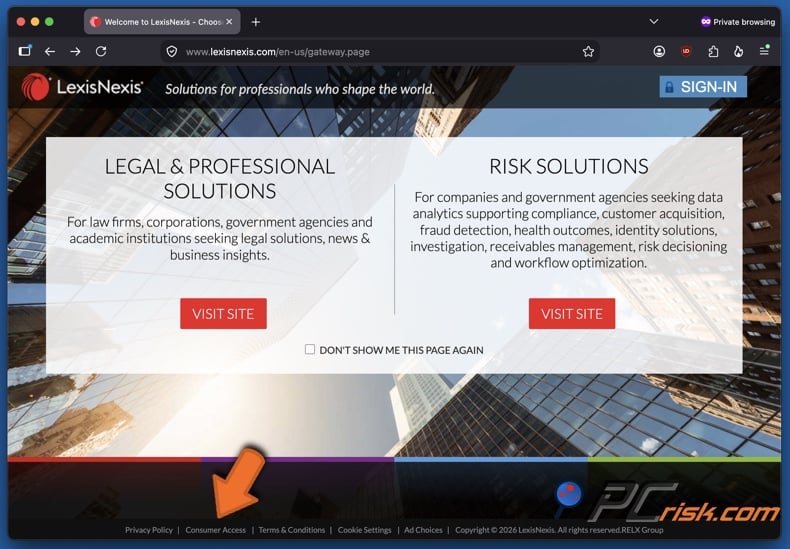
1. Open the LexisNexis website and select "Consumer Access". On the LexisNexis homepage's footer, select "Consumer Access". This section provides access to privacy and information resources for consumers.
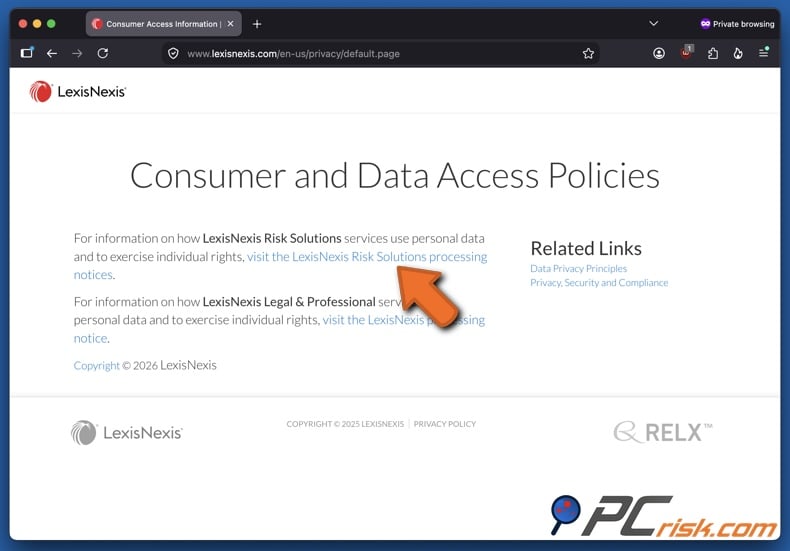
2. Open the LexisNexis Risk Solutions processing notices. The next page distinguishes "LexisNexis Risk Solutions" from "LexisNexis Legal & Professional". Click the "visit the LexisNexis Risk Solutions processing notices" option, as this process applies to Risk Solutions products.
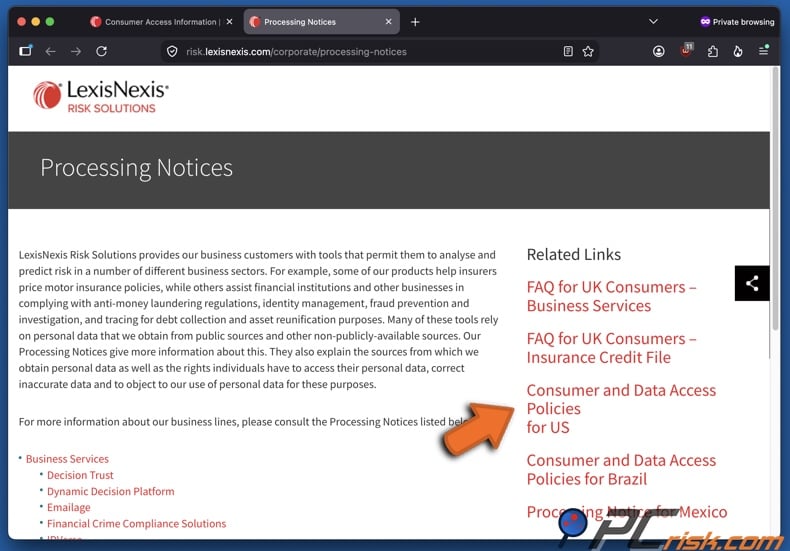
3. Open "Consumer and Data Access Policies for US". On the Processing Notices page, select "Consumer and Data Access Policies for US". This will take you to the Risk Solutions consumer policy area with US opt-out and suppression details.
4. Expand "U.S. Consumer Opt Out". Locate and expand the opt-out section for US consumers. Ensure you are reviewing this specific section, as LexisNexis offers various consumer rights and request options.
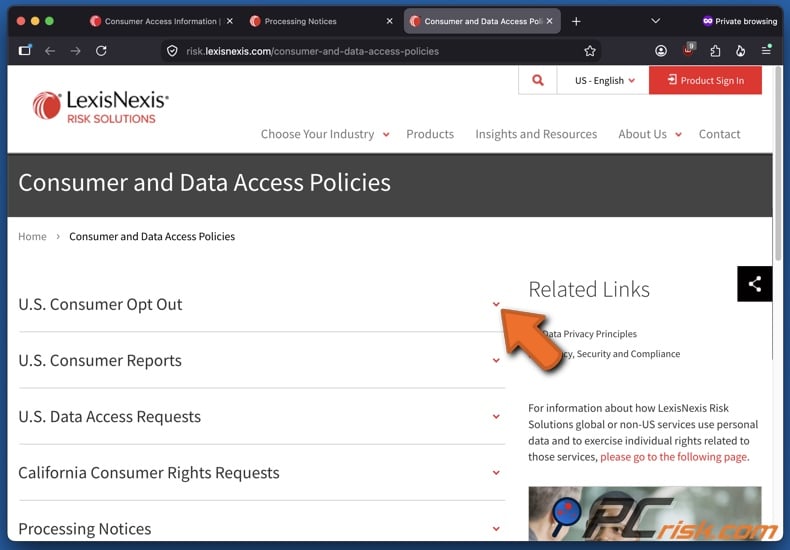
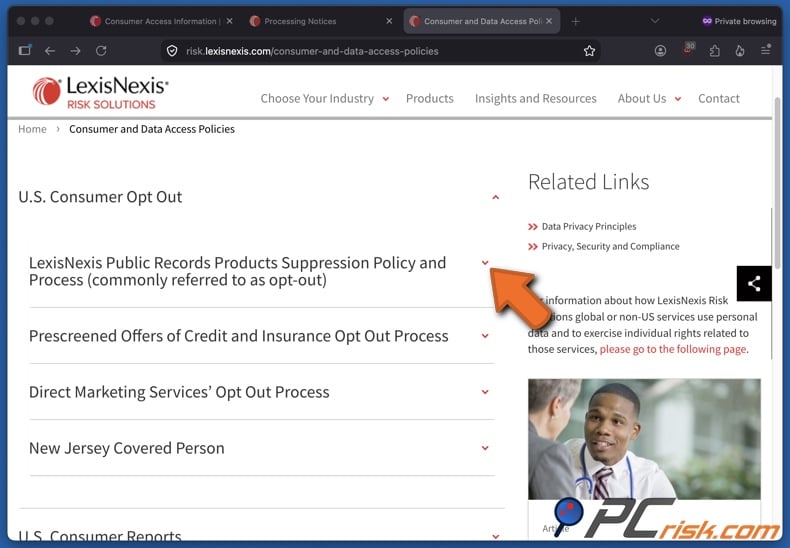
5. Expand "LexisNexis Public Records Products Suppression Policy and Process (commonly referred to as opt-out)". After opening the public-records suppression section, review the eligibility requirements carefully. Note that public-records suppression differs from general marketing opt-out requests, and supporting documentation may be required based on your reason for suppression.
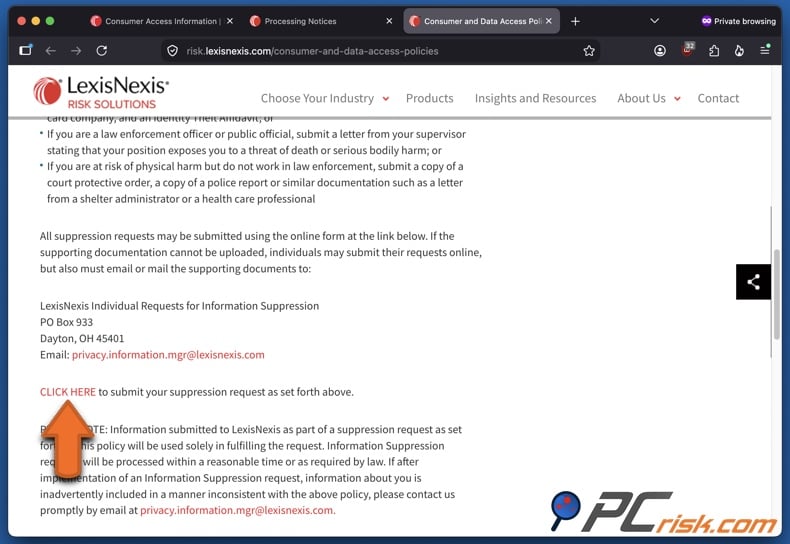
6. Proceed to the suppression form. Scroll through the policy and press "CLICK HERE" for the information suppression request submission link.
Note that website appearance and navigation, page layouts, and exact wording may change over time. Generally, data broker and people-search sites have their opt-outs located in dedicated privacy sections or website footers. Multiple access points may also exist.
How to manually opt out of LexisNexis in 2026:
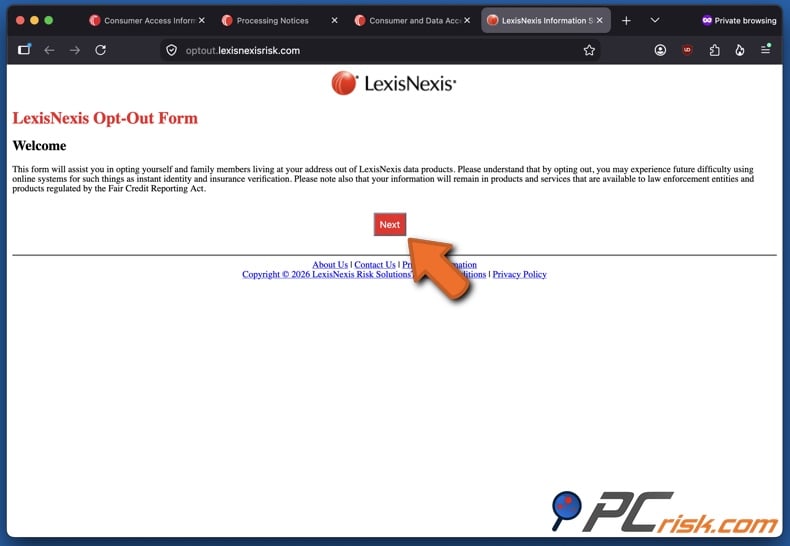
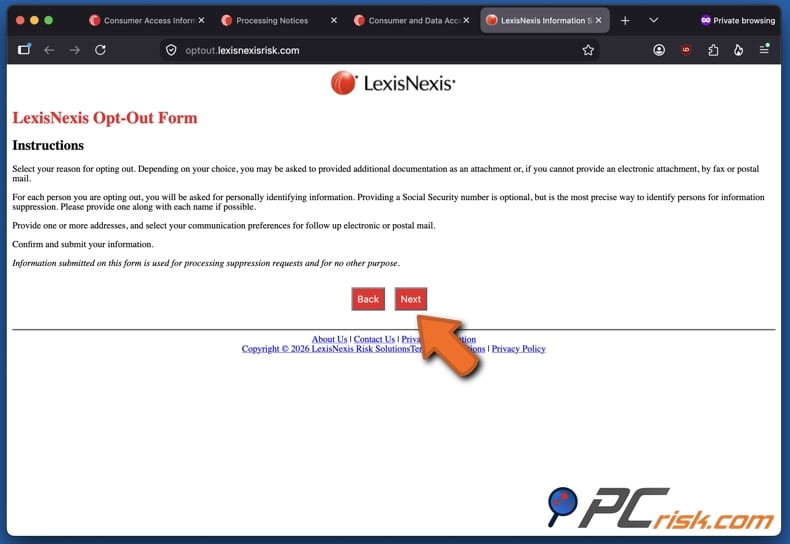
1. Click "Next" on the LexisNexis Opt-Out Form. The first screen states that you may request suppression for yourself and, in some cases, for family members at your address. It also notes that opting out may affect online systems that use LexisNexis data for identity or insurance verification. Suppressing data used to verify identity may prevent businesses from confirming your identity automatically. You may need to complete substitute verification. Consider this tradeoff before requesting extensive suppression.
2. Read the instructions and click "Next". LexisNexis requires you to select an opt-out reason and may request additional documentation. The form also asks for identifying information to locate your record. Providing a Social Security Number (SSN) is optional but may aid in matching your record more precisely. Only supply sensitive data if necessary for your request.
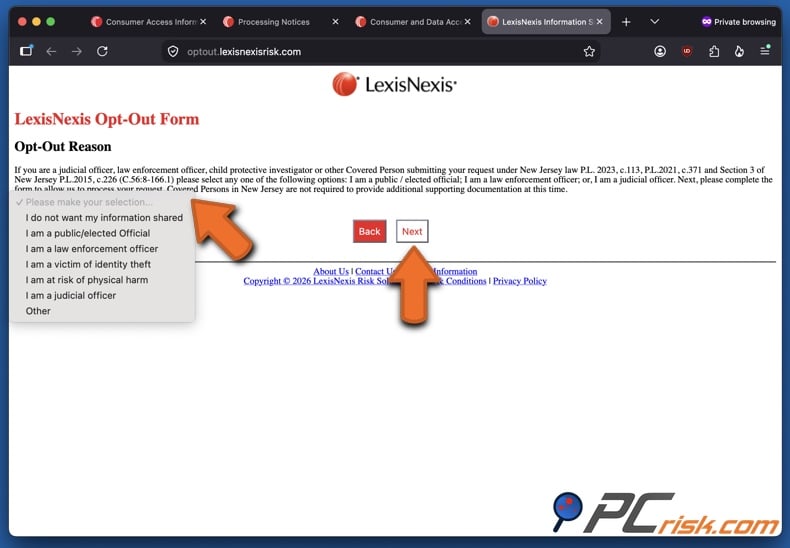
3. Select your opt-out reason and click "Next". Choose the reason that best applies to your situation. Options include not wanting information shared, being a public or elected official, law enforcement officer, identity theft victim, at risk of physical harm, judicial officer, or "Other". Do not select an inaccurate category to bypass eligibility. If supporting evidence is required, your request will not be processed until the required documentation is received and reviewed. LexisNexis policies outline documentation criteria for public officials, law enforcement, those facing safety risks, and identity theft victims.
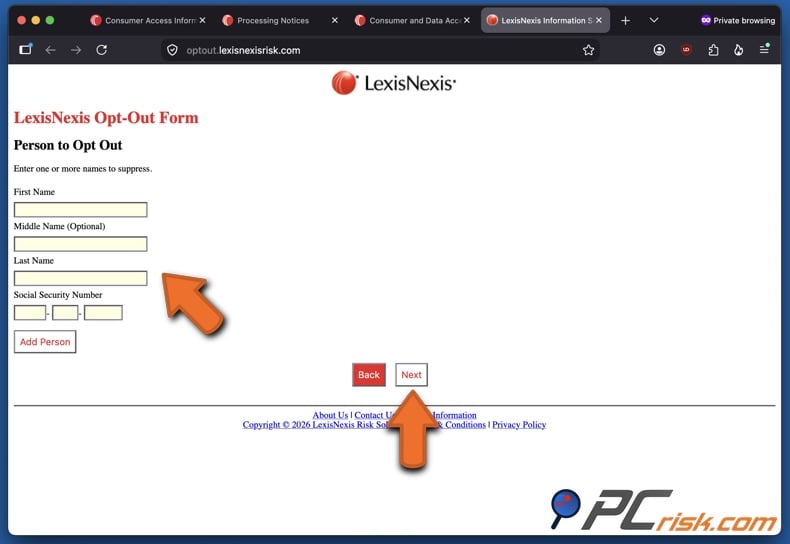
4. Enter the identity of the person you want to suppress. Enter your first, last, and, if applicable, middle name. You may also provide an SSN. You can use "Add Person" to add another qualifying individual. Review all details carefully. Incorrect spelling may prevent LexisNexis from matching your request to the correct records. After providing the data, click "Next".
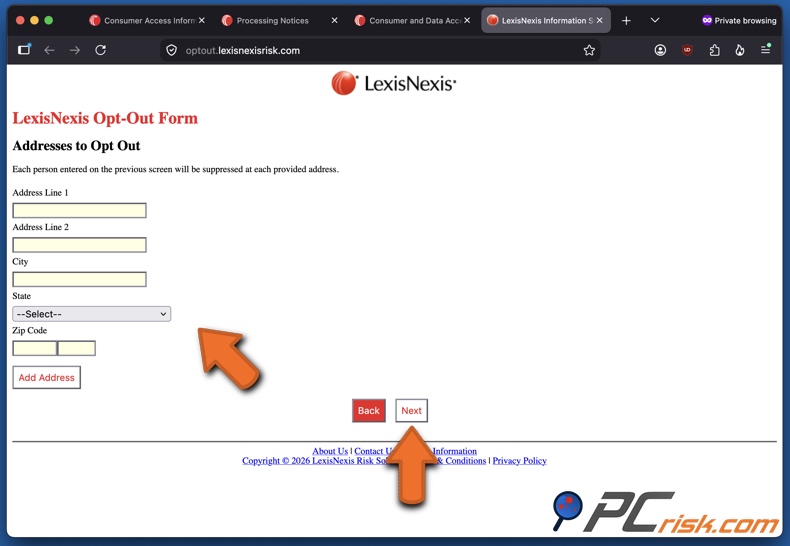
5. Add the addresses associated with the request. Enter your street address, city, state, and ZIP code. Use "Add Address" to include additional current or previous addresses. Including address history is important because LexisNexis records may contain past addresses. After entering the necessary addresses, click "Next".
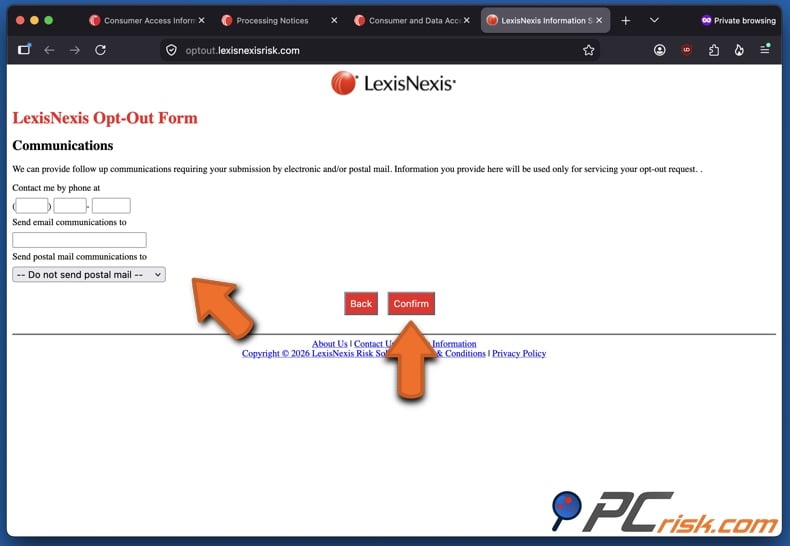
6. Enter your contact details and submit the request. The final page requests your contact information. Enter a telephone number or email address for LexisNexis to reach you. You may also select your postal communication preference. Review everything before selecting "Confirm".
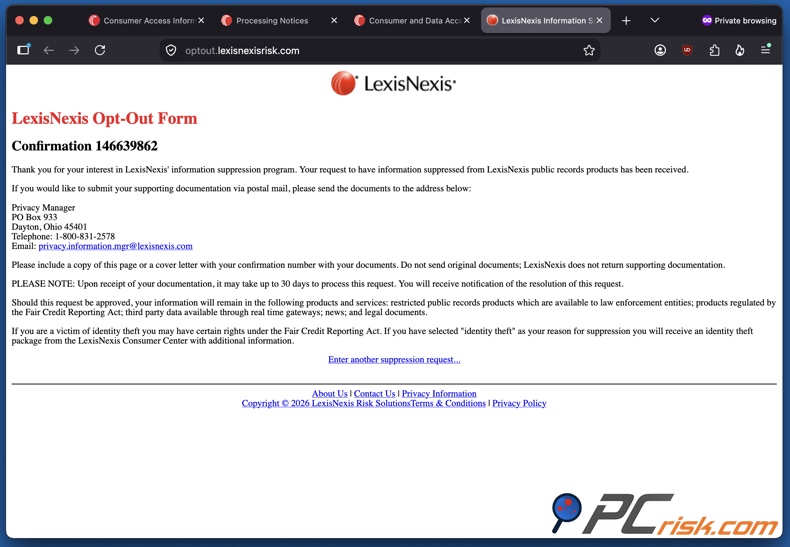
7. Document the opt-out request. After submitting your request, the confirmation page provides a confirmation number and the following steps. Save this number, along with a screenshot of the page, for future reference. If supporting documentation is required, follow the instructions and do not send original documents. Processing may take up to 30 days after LexisNexis receives the required documentation.
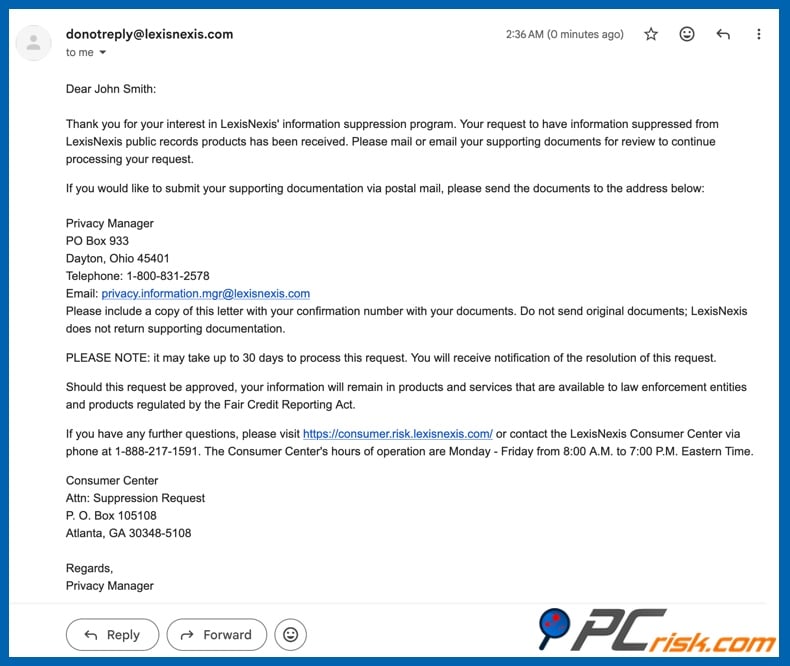
If you provided your email address, you will receive a message confirming your suppression request. Retain this email and confirmation number until you verify the outcome.
It must be reiterated that successful suppression does not remove all references to you. LexisNexis states that some information may remain in products for law enforcement, FCRA-regulated products, legal documents, or other categories outside the suppression request. LexisNexis cannot delete records held by courts, government agencies, or other third-parties.
Removing information from LexisNexis does not automatically remove related results from Google Search. If a web page has been deleted or changed but Google still displays outdated results, use Google's "Refresh outdated content" process to request an index update. Results with personal contact information may also qualify for removal via Google's "Results about you" tool.
Common issues with manual removal and alternative opt-out routes
Manual removal from LexisNexis is more complex than most people-search sites. Several types of opt-outs exist, each for a different purpose. Below are some common issues and considerations:
You may not qualify for public-records suppression, as it has particular eligibility requirements. However, you can still opt out of direct marketing, prescreened offers, or exercise rights under applicable state privacy laws.
Supporting documentation may be required for public-safety or identity-theft suppression requests. LexisNexis accepts documents such as a supervisor's letter, protective order, police report, or identity theft documentation. Submit only the necessary documents and keep copies for your records.
Some forms require sensitive information, such as date of birth, SSN, or driver's license details - to verify identity. Requirements vary by request type. For example, state privacy guidelines indicate that SSN or driver's license information is not needed for an opt-out, but stronger verification may be required for report or deletion requests.
Suppression requests only affect LexisNexis-owned databases. Other businesses or public agencies may still collect or share the same information.
Public-records suppression and consumer-report security freezes are separate. LexisNexis offers a free security freeze for certain reports, but this does not affect files at Equifax, Experian, TransUnion, or other agencies.
If your primary concern is inaccurate information, request your Consumer Disclosure Report. LexisNexis allows you to review your report and correct certain errors.
Consider other options. The LexisNexis Consumer Portal lets you request removal from direct marketing and prescreened credit or insurance lists. You can also submit requests by phone or mail.
If you live in a state with extensive privacy laws, you may have additional rights. LexisNexis allows qualifying consumers to opt out of sale or sharing, request deletion or correction, and access their information. Your specific rights and exemptions depend on your state of residence.
Search-engine cleanup is a separate process. Remove information from its source first, then check Google for outdated results and request a content refresh if needed.
How to automatically remove your information from LexisNexis?
Manual suppression is practical if LexisNexis is your sole concern. However, personal information is often spread across multiple data brokers, people-search sites, and marketing databases. Manual opt-outs are time-consuming and records may reappear as public information changes.
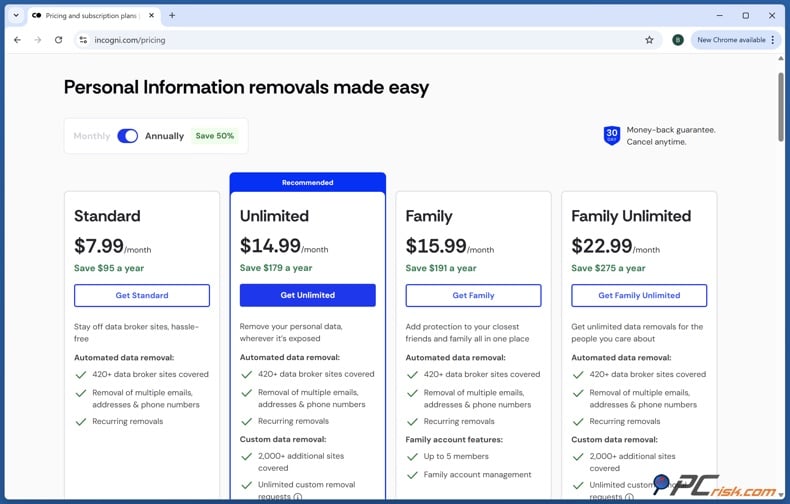
We recommend Incogni for wider personal data removal. In our 2026 review, Incogni ranked highest among personal data removal services. Its automated system covers over 420 brokers. While LexisNexis is not included in Incogni's standard automated removal, customers with higher-tiered plans can use Custom Removals to request removal from unsupported websites.
Opt out of LexisNexis with Incogni
How to automatically opt out of LexisNexis with Incogni:
1. Create an Incogni account and choose a plan with Custom Removals. Standard Incogni coverage does not include LexisNexis. For custom cases, choose a plan with Custom Removals.
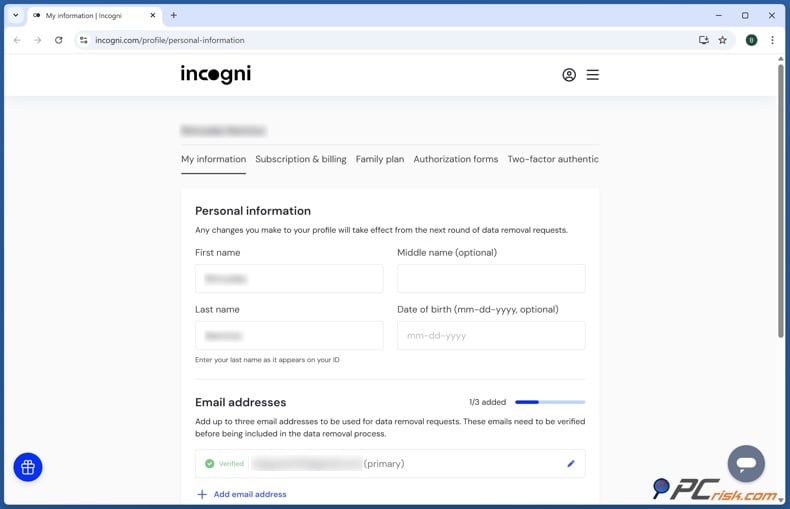
2. Enter your personal information. Provide the personal details Incogni requires to identify your records, including your name, addresses, phone numbers, and email addresses. Accurate information improves matching across broker databases.
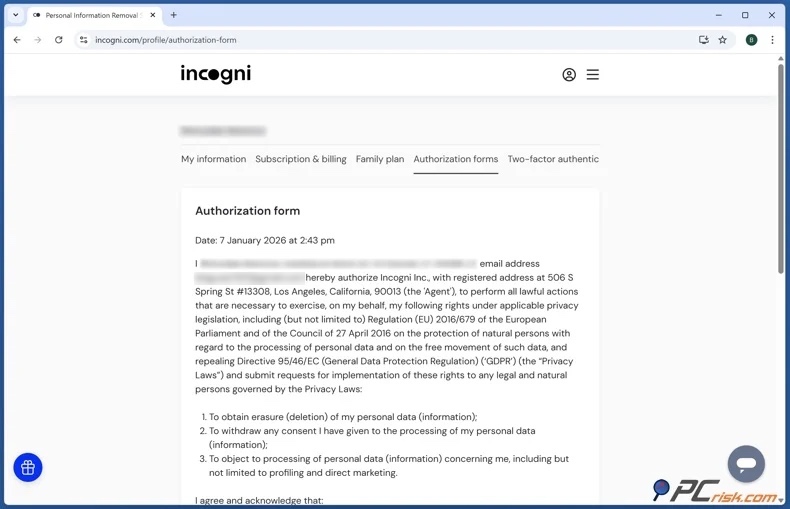
3. Sign the authorization form. Incogni requires your authorization to act on your behalf with data broker and people-search websites. Inspect and sign the form after confirming your personal information is correct.
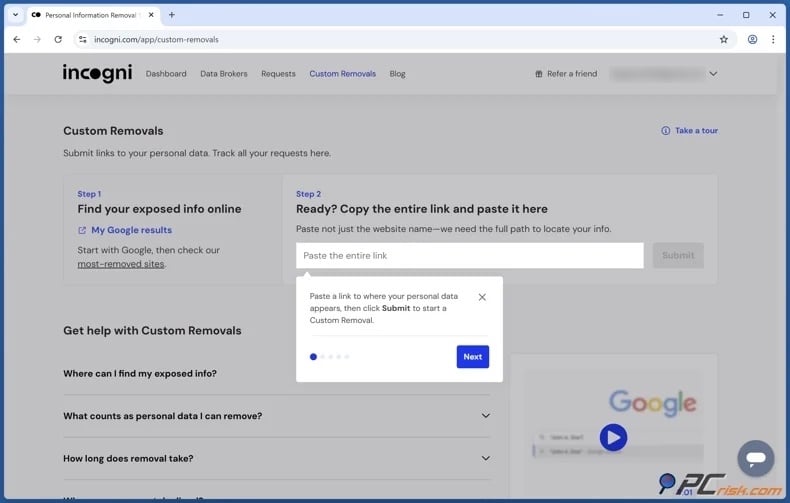
4. Use Custom Removals for LexisNexis. Access Custom Removals and submit your exposure or removal request. This system is for sites not covered by standard broker removal. For most websites, Incogni requires the exact page containing your personal information, not a homepage or search results. LexisNexis is different, as many records are not publicly searchable. Follow Incogni's specific instructions for LexisNexis instead of assuming the process matches other sites.
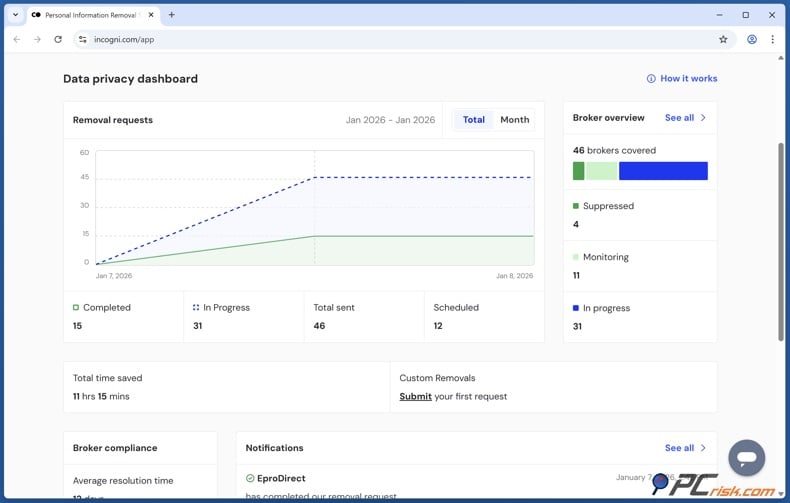
5. Monitor the request through the Incogni dashboard. Monitor your removal progress and respond if additional verification is needed. Most Custom Removals are resolved within 7 to 30 days, though some websites may take up to 60 days.
The main advantage of a removal service is broader coverage. While LexisNexis requests may be subject to its own or legal restrictions, Incogni can address hundreds of other brokers that may hold similar information. However, no personal data removal service guarantees removal from all online sources, especially governmental and similar databases.
Why should you remove your information from LexisNexis?
Reducing broker exposure is primarily about limiting your attack surface. Fraudsters do not need complete data; even a few accurate details can make phishing, fraudulent calls, account recovery attempts, or impersonation schemes more convincing. Historical information is especially valuable to social engineers. Old addresses, former phone numbers, employment history, relatives, property records, and professional details can help attackers appear legitimate. Furthermore, these details frequently overlap with those used in Knowledge-Based Authentication (KBA).
Privacy risks are heightened for individuals experiencing stalking, domestic abuse, harassment, or targeted threats. LexisNexis' public-records suppression policy handles said concerns by offering certain protections for those with documented physical safety risks.
Data concentration increases cybersecurity risk. In 2025, LexisNexis Risk Solutions experienced a breach affecting over 364,000 individuals after data was accessed through a third-party software development platform. Exposed information could include names, dates of birth, phone numbers, addresses, SSNs, and driver's license numbers. LexisNexis stated its own systems were not compromised and no financial or credit card data was involved. While no opt-out can fully prevent future breaches, as companies may be legally required to retain certain records, limiting data is still valuable. Information removed from a database cannot be exposed through that channel.
It is also important to review your LexisNexis file for accuracy. Large data collections can contain errors that create inconvenience or impact legitimate transactions. Requesting disclosure, correcting inaccuracies, and exercising your privacy rights help you retain control over your personal information.
To summarize, view removal as risk reduction, not complete digital erasure. The goal is to eliminate unnecessary copies, limit distribution, correct inaccuracies, and make comprehensive profiling more difficult.
How to prevent data brokers from collecting more of your data?
It is not possible to fully prevent data broker collection, as much of the information comes from public records, commercial transactions, government databases, and third-parties. However, you have the ability to significantly reduce the amount of unnecessary information available for collection.
Limit the personal information visible on social media. Hide your telephone number, email address, birthdate, family relationships, workplace, and residential details unless they must be public. Review both old posts and current profile settings.
Limit app permissions to only what is necessary. Applications that do not require access to your location, contacts, microphone, photos, or other sensitive data should not have it.
Use separate contact details for low-trust services. A secondary email address is useful for newsletters, promotions, loyalty programs, competitions, and similar services. Where appropriate and lawful, a separate business telephone number can help keep your primary number out of marketing databases.
Unless truly necessary, avoid publishing your home address. Business owners, freelancers, creators, and other public-facing individuals should assess whether a residential address is required on each profile. Where allowed by law, use a business address or mailbox service to separate public correspondence from your home. Never provide false information on records that legally require an accurate address.
Opt out of direct marketing where possible. LexisNexis offers a direct-marketing opt-out. The FTC manages the national Do Not Call Registry for legitimate telemarketing calls, though registration does not stop illegal calls from scammers.
Consider opting out of prescreened credit and insurance offers. Reducing these lists limits another form of commercial distribution. LexisNexis offers an opt-out for its prescreen lists.
Use browser and device privacy controls. Disable personalized advertising, review cookie settings, and restrict location access. Note that browser private mode only prevents local browsing history from being saved after a session and does not prevent websites or Internet Service Providers (ISPs) from tracking your activity.
Remove unnecessary accounts. Old shopping accounts, forums, applications, social networks, and other unused services store personal information. Delete accounts you no longer need, especially those containing addresses, telephone numbers, payment information, or identity documents.
Correct information at the source when possible. Removing a broker's copy does not change the original courthouse, licensing database, property record, or other source. If a public record is incorrect, contact the responsible organization. Do not expect a data broker opt-out to update the original source.
Monitor search results regularly. Search your full name along with your city, address, telephone number, and email address. After removing a source listing, check if Google still displays outdated results and use the "Refresh outdated content" tool as required. Results that contain certain personal information can be eligible for removal using Google's "Results about you" tool.
Repeat opt-outs as needed. Data broker privacy requires ongoing monitoring. Information can reappear, especially after public records change.
Check if your state offers relevant privacy tools. These services may make it easier to manage requests to data brokers or grant you additional rights over your personal information. Program availability and coverage, such as deletion, correction, access, or opting out of data sale and sharing, differ by jurisdiction. For example, California residents can use the state's Delete Request and Opt-out Platform (DROP) to submit a single deletion request to registered data brokers. Since August 1, 2026, registered brokers must access DROP at least every 45 days to retrieve and process requests, subject to applicable exemptions.
Automated personal data removal services help minimize the time and effort needed for repeated opt-outs. They search supported data brokers for your profiles, submit removal requests, track responses, and resubmit requests if information resurfaces. Before subscribing, review broker coverage, rescan frequency, reporting features, custom removal options, identity verification requirements, and cancellation policies. While these services enhance coverage, they cannot remove all public records or ensure permanent deletion. Periodic manual searches and follow-up are still recommended.
Check our top personal data removal services
To summarize, reducing exposure to data brokers requires a layered, ongoing strategy. Limit unnecessary public information, strengthen online privacy settings, opt out of marketing and broker databases, correct inaccurate records, use state privacy tools where available, and monitor search results for reappearing data. Automated removal services can support these efforts, but no single solution offers complete privacy. Routine monitoring and repeated cleanup remain the most effective ways to protect your personal information.
In closing
LexisNexis is more complex than a typical people-search website. It offers various information and risk products, and no single removal request will delete all your data. Direct marketing, prescreened offers, state privacy rights, consumer-report freezes, and public-records suppression each have separate processes, eligibility requirements, and outcomes.
For eligible individuals, the public-records suppression process described above can limit exposure within certain LexisNexis products. However, it does not remove information from government records, third-party databases, law enforcement products, or data required to remain accessible under the FCRA.
Check our top personal data removal services
A service like Incogni can help simplify the wider data removal process. LexisNexis requires using the Custom Removals option instead of Incogni's standard automated process, but the standard system can address many other data brokers at the same time. It must be emphasized that the most effective privacy strategy is ongoing - remove what you can, correct inaccuracies, limit unnecessary sharing, monitor for reappearance, and consistently review your online information.
Frequently Asked Questions (FAQ)
Is LexisNexis legal?
Yes. LexisNexis provides legitimate legal, analytics, identity, fraud-prevention, insurance, financial, and public-record information services. Its use of consumer information complies with applicable laws, including the FCRA and relevant state privacy regulations.
Is it dangerous to have my data on LexisNexis?
Any large database of personal information carries privacy and security risks. If accessed by unauthorized parties, aggregated data could be misused for phishing, impersonation, identity theft, profiling, or other abuse. However, it is worth noting that most LexisNexis products are available only to credentialed customers, not the general public.
How do I remove my data from LexisNexis?
The appropriate removal method depends on the type of information. You can use LexisNexis privacy tools to opt out of direct marketing, exercise state privacy rights, or request public-records suppression if eligible. Some personal data removal services can be used as well. For example, higher-tiered Incogni plans can process LexisNexis removals as a Custom Removal.
How long does it take LexisNexis to remove my data?
For public-records suppression requests requiring documentation, LexisNexis may take up to 30 days to process after receiving the necessary documents. Other request types may have different wait times or legal requirements.
Will opting out of LexisNexis remove me from Google search?
No. LexisNexis and Google operate independently. If a source page is removed or updated but still appears in Google results, you can request Google to update its search index.
Does removing myself from LexisNexis remove the original public record?
No. Suppression only applies to LexisNexis databases and products. It does not remove court documents, property records, government databases, or records held by other organizations.
How is using Incogni different from manually removing my data from LexisNexis?
Manual removal requires you to identify the correct LexisNexis process, submit your request, provide required documentation, and follow up. LexisNexis is not included in Incogni's standard automated broker-removal system, but customers with higher-tiered plans can request removal through Custom Removals. Incogni's automated system covers over 420 other brokers.
Will my data come back to LexisNexis after I opt out?
A successful suppression prevents qualifying information from appearing in the specified LexisNexis products. However, it does not remove original public records, third-party sources, FCRA-regulated products, or other excluded databases. New or updated information may still appear, so it is advisable to check your records periodically.
Share:
 Facebook
 X.com
X.com
 LinkedIn
 Copy Link

Karolis Liucveikis
Experienced software engineer, passionate about behavioral analysis of malicious apps
Author and general operator of PCrisk's News and Removal Guides section. Co-researcher working alongside Tomas to discover the latest threats and global trends in the cyber security world. Karolis has experience of over 8 years working in this branch. He attended Kaunas University of Technology and graduated with a degree in Software Development in 2017. Extremely passionate about technical aspects and behavior of various malicious applications.
▼ Show Discussion