
How to remove the WebSocket RAT (Remote Access Trojan)
TrojanAlso Known As: WebSocket remote access trojan

Get free scan and check if your device is infected.
Remove it nowTo use full-featured product, you have to purchase a license for Combo Cleaner. Seven days free trial available. Combo Cleaner is owned and operated by RCS LT, the parent company of PCRisk.com.
What kind of malware is the WebSocket RAT?
WebSocket is the name of a Remote Access Trojan (RAT). This malware allows attackers to access/control devices remotely. It was used in a highly targeted phishing campaign that involved six months of planning and was executed on the 8th of October, 2025. It was designed for maximum efficacy and the Russian-owned infrastructure set up by the threat actors was only active for a day. Individuals associated with the regional government of Ukraine and with international NGOs providing aid to Ukraine were targeted.
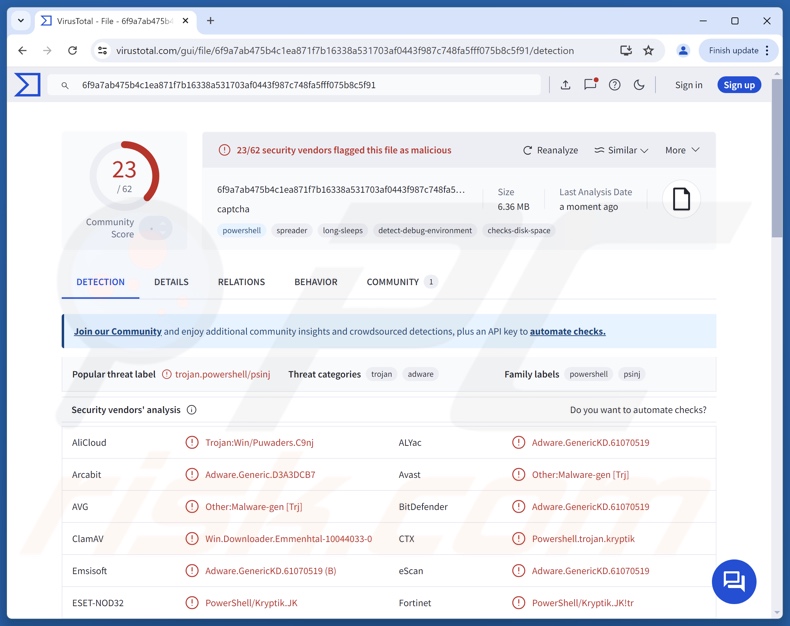
WebSocket malware overview
The campaign mentioned in the introduction, targeted Ukrainian government administrations of Dnipropetrovsk, Donetsk, Mikolaevsk, and Poltava regions and NGOs (Non-Governmental Organizations) providing war relief to Ukraine – including the local office of UNICEF (United Nations Children's Fund), International Committee of the Red Cross (ICRC), Norwegian Refugee Council (NRC), and the Register of Damage Caused by the Aggression of the Russian Federation against Ukraine (RD4U).
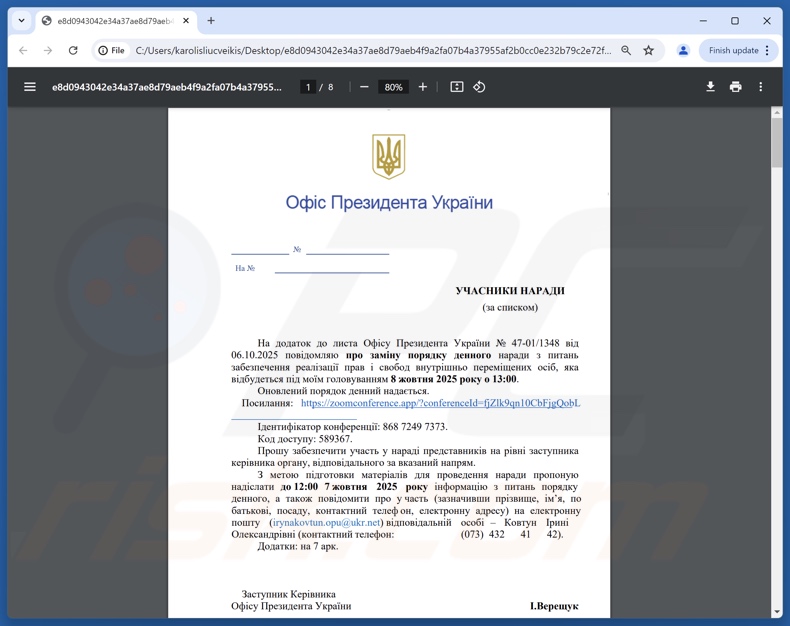
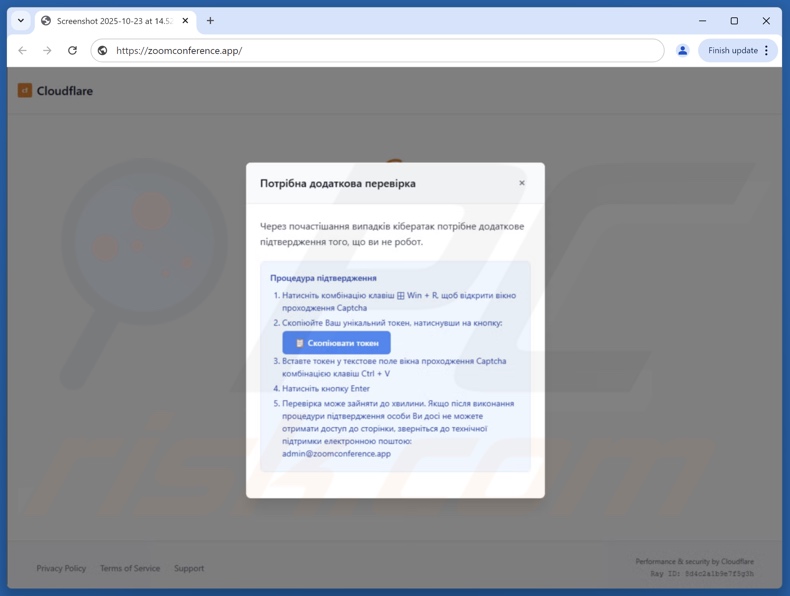
This phishing campaign involved fake emails sent to individuals of interest. The emails were disguised as missives from the Office of the President of Ukraine. Deceptive PDF documents were attached to these messages, luring victims into visiting a fraudulent Zoom website. The page used a Cloudflare-themed ClickFix scam to trick visitors into executing a malicious command on their devices – thus, triggering WebSocket RAT's infection chain.
It was a multi-stage infection that downloaded a highly obfuscated PowerShell script upon the victim executing the command. The script was responsible for downloading and executing the second-stage payload from a specific domain. This payload collected relevant device data, e.g., device name, Universally Unique Identifier (UUID), process identifier, username, network details, etc.
The gathered information was encrypted and exfiltrated to the C&C (Command and Control) server. It responded by delivering the final payload – WebSocket RAT – which was then decrypted and executed in-memory. This malware is a Remote Access Trojan – it enables remote access and control over infected machines.
The program in question seeks to connect and continuously reconnect to a WebSocket server. This trojan can execute arbitrary commands on devices. RATs can be incredibly versatile or specialized.
Generally, threats associated with this kind of malware include multiple system infections, severe privacy issues, financial losses, and identity theft. However, malicious software leveraged against high-sensitivity targets can pose dangers of even greater scope. This is true for the geopolitically motivated campaign in which the WebSocket RAT was used.
| Name | WebSocket remote access trojan |
| Threat Type | Trojan, Remote Access Trojan, Remote Administration Tool, RAT. |
| Detection Names | Avast (Other:Malware-gen [Trj]), Combo Cleaner (Adware.GenericKD.61070519), ESET-NOD32 (PowerShell/Kryptik.JK), Kaspersky (Trojan.PowerShell.Agent.ate), Microsoft (Trojan:Win32/Alevaul!rfn), Full List Of Detections (VirusTotal) |
| Symptoms | Trojans are designed to stealthily infiltrate the victim's computer and remain silent, and thus no particular symptoms are clearly visible on an infected machine. |
| Distribution methods | Infected email attachments, malicious online advertisements, social engineering, software 'cracks'. |
| Damage | Stolen passwords and banking information, identity theft, the victim's computer added to a botnet. |
| Malware Removal (Windows) |
To eliminate possible malware infections, scan your computer with legitimate antivirus software. Our security researchers recommend using Combo Cleaner. Download Combo CleanerTo use full-featured product, you have to purchase a license for Combo Cleaner. 7 days free trial available. Combo Cleaner is owned and operated by RCS LT, the parent company of PCRisk.com. |
Remote access trojan examples
We have written about numerous malicious programs; Stealit, MonsterV2, SilentSync, MostereRAT, and ZynorRAT are merely some of our newest articles on RATs. Trojans of this kind can be highly multifunctional with extensive data-stealing capabilities. Yet they can also be designed for a specialized purpose.
However, regardless of how malware operates – its presence on a system endangers device integrity and user safety. Therefore, all threats must be removed immediately upon detection.
How did WebSocket malware infiltrate my computer?
WebSocket RAT was proliferated through an email spam campaign utilizing a ClickFix scam. This attack aimed to infect devices of individuals linked to regional government administration in Ukraine and international NGOs providing aid to Ukraine in the Russo-Ukrainian war.
The spam was presented as emails from the Office of the President of Ukraine. They included attachments – legitimate-looking, eight-page-long PDF documents. These files instructed victims to open the embedded "Zoom" link. The domain imitated Zoom, yet was actually a VPS (Virtual Private Server) based in Finland, but owned by KVMka – a Russian private web solution provider.
This webpage imitated a Cloudflare DDoS (Distributed Denial-of-Service) attack protection gateway and instructed to execute a command through Run command (ClickFix scam). Completing the steps provided by this scam triggered WebSocket RAT's infection chain.
The setup for this campaign took at least half a year, and the site was up for just a single day. Hence, the campaign was built with a goal of efficiency and lowering chances of detection and discovery.
It is noteworthy that this Russian-owned infrastructure was not crafted for the sole purpose of malware proliferation. However, the other scenario has not been observed in action, as of the time of writing. Instead of opening the ClickFix scam page, the redirect would lead to a real Zoom meeting protected by a password.
It is likely that this was designed to facilitate conversation between the threat actors and victims, with the former impersonating individuals associated with genuine entities (e.g., the employees of the Office of the President of Ukraine). Social engineering of this kind could be used for a variety of nefarious purposes.
Another thing of note is that this infrastructure is linked to a different campaign, which may be related to the one spreading the WebSocket RAT. This activity is intended to proliferate an Android malware capable of stealing a variety of sensitive information (e.g., contact lists, call logs, SMSes, network info, geolocation data, photos, etc.). The campaign in question – domains and the malicious file – bore different disguises. Known lures include the "Princess Men's Club" – an adult-oriented venue in Lviv, Ukraine, generic explicit adult themes, and cloud storage.
It must be mentioned that the WebSocket RAT could be distributed using different methods. Phishing and social engineering are standard in malware proliferation. Infectious files come in different formats, e.g., archives (ZIP, RAR, etc.), executables (.exe, .run, etc.), documents (PDF, Microsoft Office, Microsoft OneNote, etc.), JavaScript, and so on. Merely opening such a file can be enough to trigger the infection chain.
The most widespread distribution techniques include: malicious attachments or links in spam emails/messages, online scams, backdoor/loader-type trojans, drive-by (stealthy/deceptive) downloads, dubious download channels (e.g., freeware and free file-hosting sites, P2P sharing networks, etc.), malvertising, pirated content, illegal software activation tools ("cracks"), and fake updates.
What is more, some malicious programs can self-spread through local networks and removable storage devices (e.g., external hard drives, USB flash drives, etc.).
How to avoid installation of malware?
Caution is essential to device and user safety. Therefore, be vigilant when browsing since the Internet is rife with deceptive and dangerous content. Be careful with incoming emails and other messages; do not open attachments or links found in suspicious mail, as they can be virulent.
Download only from official and trustworthy sources. Activate and update programs using functions/tools provided by legitimate developers, as those obtained from third-parties can contain malware.
It is crucial to have a reputable antivirus installed and kept updated. Security software must be used to perform regular system scans and to remove detected threats. If you believe that your computer is already infected, we recommend running a scan with Combo Cleaner Antivirus for Windows to automatically eliminate infiltrated malware.
PDF attachment impersonating a document from the Office of the President of Ukraine:
ClickFix scam proliferating WebSocket RAT promoted by the file above:
Instant automatic malware removal:
Manual threat removal might be a lengthy and complicated process that requires advanced IT skills. Combo Cleaner is a professional automatic malware removal tool that is recommended to get rid of malware. Download it by clicking the button below:
DOWNLOAD Combo CleanerBy downloading any software listed on this website you agree to our Privacy Policy and Terms of Use. To use full-featured product, you have to purchase a license for Combo Cleaner. 7 days free trial available. Combo Cleaner is owned and operated by RCS LT, the parent company of PCRisk.com.
Quick menu:
- What is WebSocket RAT?
- STEP 1. Manual removal of WebSocket malware.
- STEP 2. Check if your computer is clean.
How to remove malware manually?
Manual malware removal is a complicated task - usually it is best to allow antivirus or anti-malware programs to do this automatically. To remove this malware we recommend using Combo Cleaner Antivirus for Windows.
If you wish to remove malware manually, the first step is to identify the name of the malware that you are trying to remove. Here is an example of a suspicious program running on a user's computer:
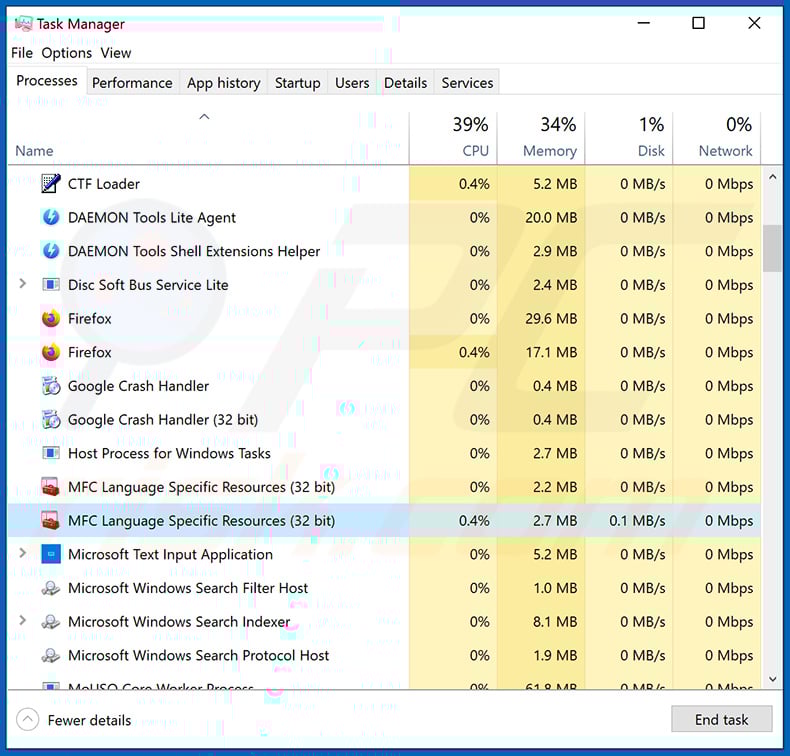
If you checked the list of programs running on your computer, for example, using task manager, and identified a program that looks suspicious, you should continue with these steps:
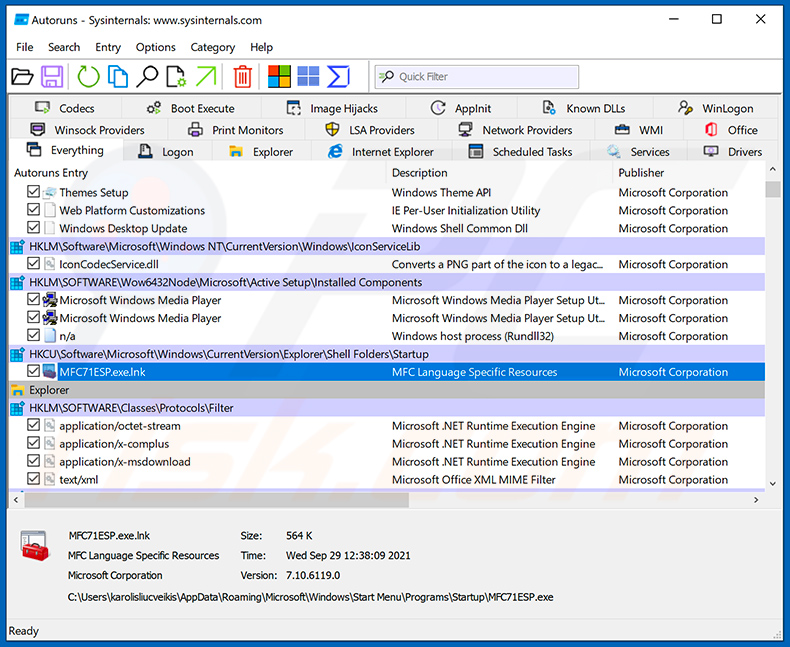
 Download a program called Autoruns. This program shows auto-start applications, Registry, and file system locations:
 Restart your computer into Safe Mode:
Windows XP and Windows 7 users: Start your computer in Safe Mode. Click Start, click Shut Down, click Restart, click OK. During your computer start process, press the F8 key on your keyboard multiple times until you see the Windows Advanced Option menu, and then select Safe Mode with Networking from the list.
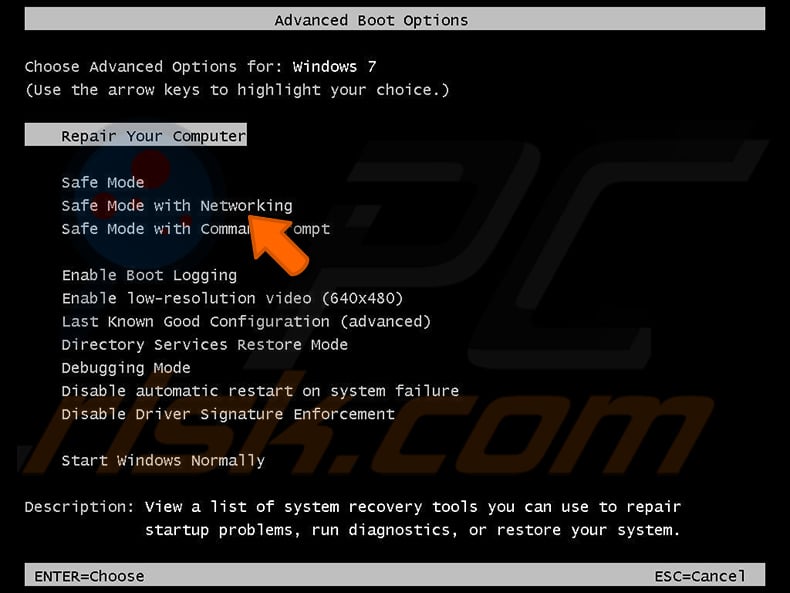
Video showing how to start Windows 7 in "Safe Mode with Networking":
Windows 8 users: Start Windows 8 is Safe Mode with Networking - Go to Windows 8 Start Screen, type Advanced, in the search results select Settings. Click Advanced startup options, in the opened "General PC Settings" window, select Advanced startup.
Click the "Restart now" button. Your computer will now restart into the "Advanced Startup options menu". Click the "Troubleshoot" button, and then click the "Advanced options" button. In the advanced option screen, click "Startup settings".
Click the "Restart" button. Your PC will restart into the Startup Settings screen. Press F5 to boot in Safe Mode with Networking.
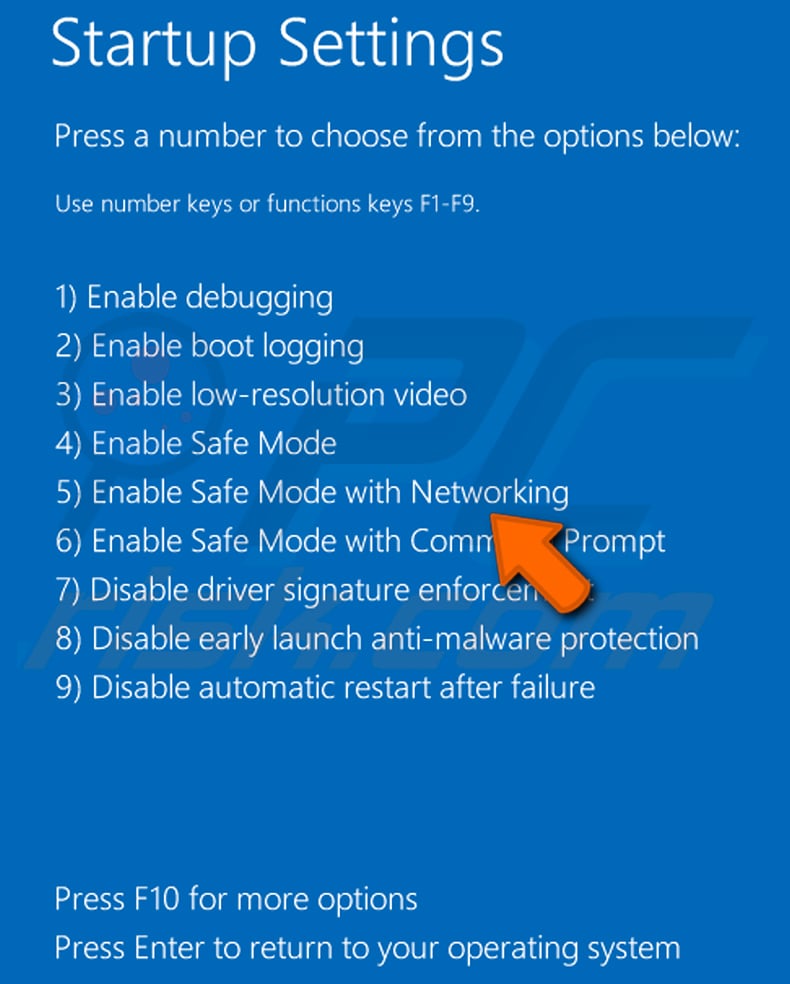
Video showing how to start Windows 8 in "Safe Mode with Networking":
Windows 10 users: Click the Windows logo and select the Power icon. In the opened menu click "Restart" while holding "Shift" button on your keyboard. In the "choose an option" window click on the "Troubleshoot", next select "Advanced options".
In the advanced options menu select "Startup Settings" and click on the "Restart" button. In the following window you should click the "F5" button on your keyboard. This will restart your operating system in safe mode with networking.
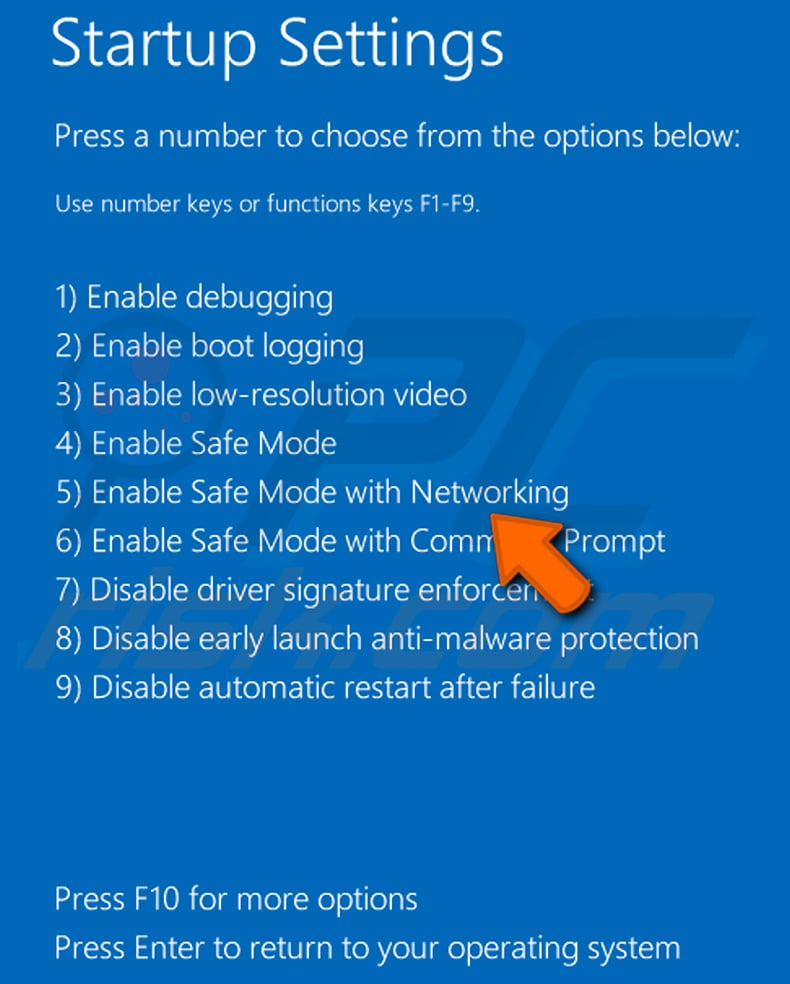
Video showing how to start Windows 10 in "Safe Mode with Networking":
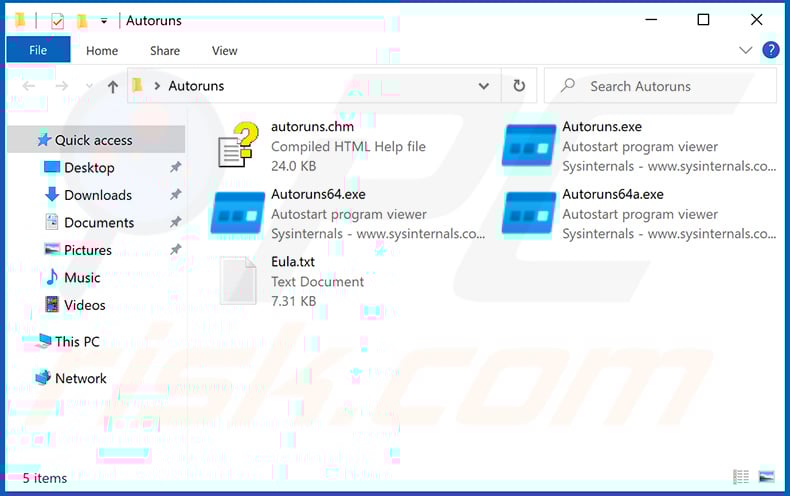
 Extract the downloaded archive and run the Autoruns.exe file.
 In the Autoruns application, click "Options" at the top and uncheck "Hide Empty Locations" and "Hide Windows Entries" options. After this procedure, click the "Refresh" icon.
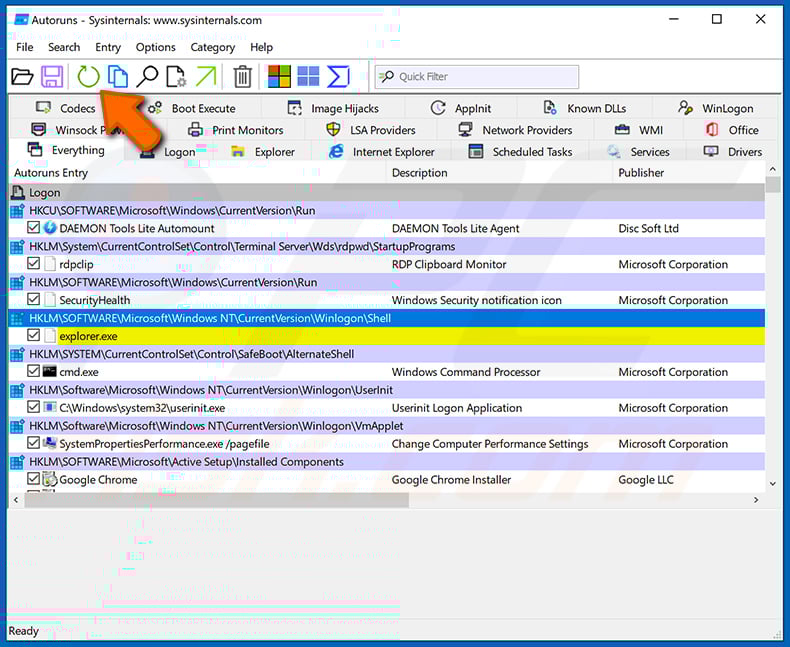
 Check the list provided by the Autoruns application and locate the malware file that you want to eliminate.
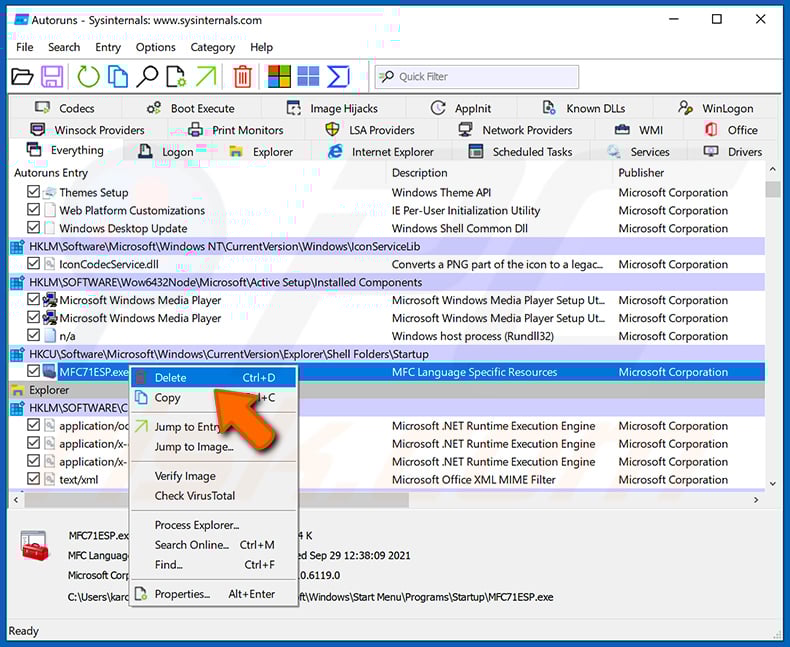
You should write down its full path and name. Note that some malware hides process names under legitimate Windows process names. At this stage, it is very important to avoid removing system files. After you locate the suspicious program you wish to remove, right click your mouse over its name and choose "Delete".
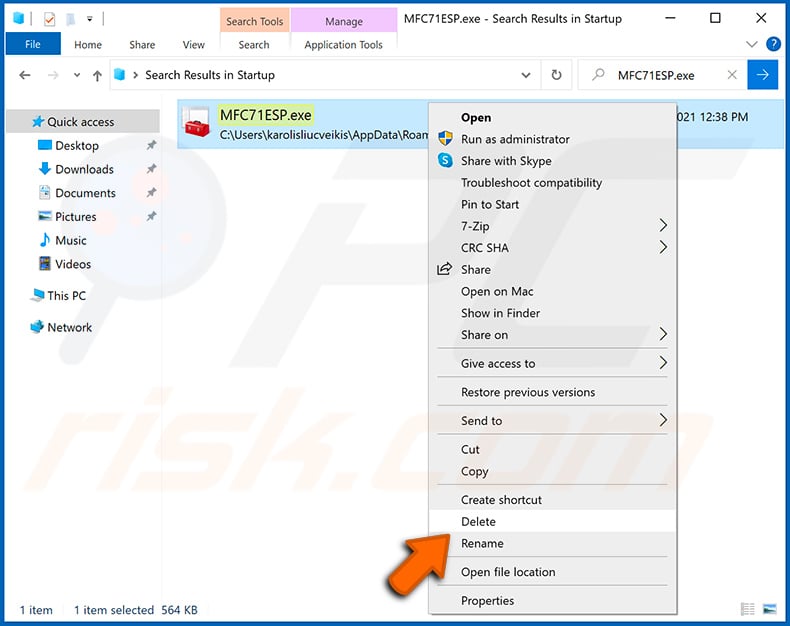
After removing the malware through the Autoruns application (this ensures that the malware will not run automatically on the next system startup), you should search for the malware name on your computer. Be sure to enable hidden files and folders before proceeding. If you find the filename of the malware, be sure to remove it.
Reboot your computer in normal mode. Following these steps should remove any malware from your computer. Note that manual threat removal requires advanced computer skills. If you do not have these skills, leave malware removal to antivirus and anti-malware programs.
These steps might not work with advanced malware infections. As always it is best to prevent infection than try to remove malware later. To keep your computer safe, install the latest operating system updates and use antivirus software. To be sure your computer is free of malware infections, we recommend scanning it with Combo Cleaner Antivirus for Windows.
Frequently Asked Questions (FAQ)
My computer is infected with WebSocket malware, should I format my storage device to get rid of it?
Malware removal rarely requires formatting.
What are the biggest issues that WebSocket malware can cause?
The dangers of an infection differ based on the malware's abilities and the attackers' modus operandi. WebSocket is a RAT – a malware that enables remote access/control over devices. Generally, this infection could lead to severe privacy issues, financial losses, and identity theft. However, the WebSocket RAT has been used in geopolitically-motivated attacks targeting governmental entities and NGOs – and infections of this kind pose threats of greater significance.
What is the purpose of WebSocket malware?
While malware is mainly used for financial gain, the WebSocket RAT has been used to launch attacks driven by geopolitical motivations. Aside from these two motivators, malicious software is used to amuse the attackers or realize their personal grudges, disrupt processes (e.g., sites, services, companies, etc.), and engage in hacktivism.
How did WebSocket malware infiltrate my computer?
The WebSocket RAT has been proliferated through a ClickFix scam promoted by spam emails sent to individuals associated with Ukraine's regional government administrations and international NGOs (UNICEF, ICRC, NRC, and RD4U). Other distribution methods are possible.
Generally, malware is spread via trojans, drive-by downloads, spam, online scams, malvertising, suspect download channels (e.g., freeware and third-party websites, P2P sharing networks, etc.), pirated content, illegal software activation tools ("cracks"), and fake updates. Some malicious programs can self-spread via local networks and removable storage devices.
Will Combo Cleaner protect me from malware?
Combo Cleaner is designed to scan computers and eliminate all kinds of threats. It is capable of detecting and removing nearly all known malware infections. Remember that performing a full system scan is paramount since high-end malicious programs usually hide deep within systems.
Share:
 Facebook
 X.com
X.com
 LinkedIn
 Copy Link

Tomas Meskauskas
Expert security researcher, professional malware analyst
I am passionate about computer security and technology. I have an experience of over 10 years working in various companies related to computer technical issue solving and Internet security. I have been working as an author and editor for pcrisk.com since 2010. Follow me on Twitter and LinkedIn to stay informed about the latest online security threats.
PCrisk security portal is brought by a company RCS LT.
Joined forces of security researchers help educate computer users about the latest online security threats. More information about the company RCS LT.
Our malware removal guides are free. However, if you want to support us you can send us a donation.
DonatePCrisk security portal is brought by a company RCS LT.
Joined forces of security researchers help educate computer users about the latest online security threats. More information about the company RCS LT.
Our malware removal guides are free. However, if you want to support us you can send us a donation.
Donate
▼ Show Discussion