
We may earn commissions from products we recommend. Learn more.
Best VPNs for FanDuel in 2026: How to Access FanDuel in Restricted US States

Best FanDuel VPNs for 2026: How to Access FanDuel in Restricted US States
FanDuel is one of the most recognizable betting and fantasy brands in the United States, but it isn’t uniformly available nationwide. Access to FanDuel’s wagering products depends on where you are physically located, what product you’re trying to use (Sportsbook vs. Casino vs. Fantasy), and whether the underlying activity is permitted under state law and FanDuel’s licensing.
At the same time, there are legitimate cybersecurity reasons people look for a VPN for FanDuel guidance - especially when traveling, using public Wi‑Fi, or signing into high‑value accounts tied to deposits, withdrawals, identity verification, and personal data. PCrisk.com’s role in a topic like this is to focus on security outcomes: protecting your connection, reducing exposure on unsafe networks, and understanding why VPN usage can sometimes conflict with location verification systems used by regulated sportsbooks.
Disclaimer: PCrisk.com does not promote, encourage, or endorse bypassing gambling restrictions, geo-blocks, self‑exclusion systems, operator controls, or local laws. This article is for informational and cybersecurity purposes. If online wagering is restricted where you are, using a VPN does not make it legal, and it may also violate platform rules, potentially leading to account restrictions or other consequences.
 Our top-rated VPN
4.5/5 in our review. Our top pick of the year: almost no slowdown in our speed tests, and it unblocked Netflix, BBC iPlayer and Disney+ without trouble.
Table of Contents:
- Introduction
- Why Should I Use a VPN to Access FanDuel?
- How to Access FanDuel With a VPN in 2026
- The Best VPNs for FanDuel in 2026
- How We Test VPNs for FanDuel
- Can FanDuel Detect My VPN?
- Where is FanDuel Blocked or Restricted?
- Common Issues and Solutions When Using a VPN
- Can I Use a Free VPN for FanDuel?
- Is It Legal to Use a VPN to Access FanDuel in the US?
- In Closing
- Frequently Asked Questions (FAQs)
Why Should I Use a VPN to Access FanDuel?
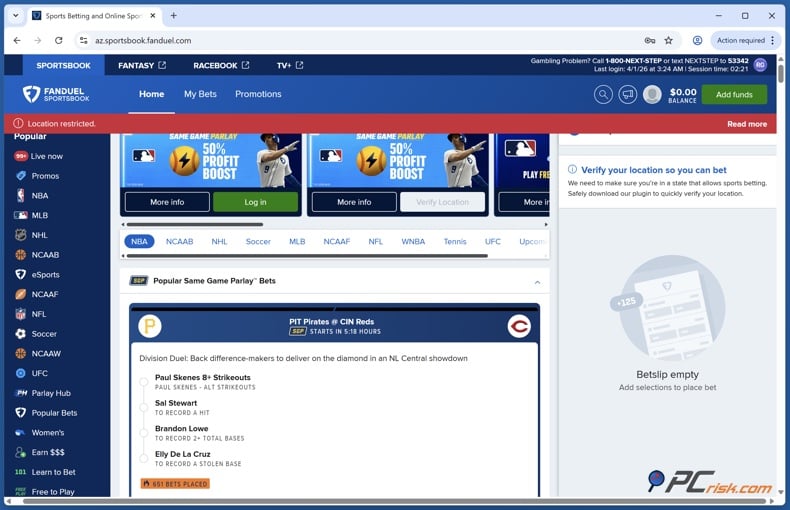
A VPN is not a “magic key” for regulated gambling platforms. In fact, for wagering on FanDuel, location verification is a compliance requirement, and the company states you can’t use wagering services without location data enabled.
So why do people still use VPNs with FanDuel? The answer is usually about privacy and basic network security, not about “unlocking” prohibited betting states.
Safer logins and account protection on public Wi‑Fi
Sports betting accounts are high‑value targets: they connect to payment methods, contain personal information, and often store transaction history.
If you’re signing into FanDuel in a legal state while on public Wi‑Fi, a high‑quality VPN can reduce risk from local network surveillance and certain forms of traffic abuse. That’s one of the most defensible reasons to keep a VPN installed and configured properly.
Less ISP visibility and reduced tracking
PCrisk’s VPN testing and rankings emphasize privacy and logging policies because your VPN provider becomes an important trust point. A reputable VPN can limit what your ISP can learn from your browsing and app usage patterns, while also reducing exposure to some forms of network‑level tracking.
Some VPNs also bundle filtering features (for example, NordVPN’s Threat Protection, Proton VPN’s NetShield) that can reduce exposure to malicious domains and certain trackers. That’s meaningful when you’re browsing promo-heavy sports content ecosystems where malvertising and scam redirects can be a real risk.
Protection against accidental IP leaks during a session
A kill switch matters because a dropped VPN connection can cause traffic to resume over your normal connection. PCrisk explicitly tests kill switches and leak protection because those are the practical points where “privacy claims” either hold or fail in real life.
This doesn’t grant you special access to FanDuel. It simply helps ensure that, if you choose to use a VPN for privacy, you don’t accidentally expose your real IP or DNS requests when the VPN connection hiccups.
A critical reality check about FanDuel and location
FanDuel’s Sportsbook privacy policy is direct: you won’t be able to place bets without location data enabled, and the service uses precise location-based services to verify location and meet legal and regulatory obligations.
FanDuel’s own troubleshooting tips for “Restricted Location” issues include disconnecting from VPNs or external networks. That’s a strong signal that VPN usage commonly interferes with verification - even for people who are physically located in an eligible state.
A VPN keeps your connection secure, but it cannot help if your device is already infected. Combo Cleaner scans for malware and unwanted programs, removes junk files that slow down your system, and finds privacy-related changes in your browser.
 Made by RCS LT, the company behind PCrisk
- Detect malware already on the device
- Block phishing pages once you open them
- Remove adware or browser hijackers
- Scans for free and shows what it finds
- Removes it with a licence, 7-day free trial
- Blocks scam and phishing sites in the browser (Windows)
How to Access FanDuel With a VPN in 2026
This section uses NordVPN, our top VPN pick for 2026, based on hands‑on testing of security, privacy, speed, and usability.
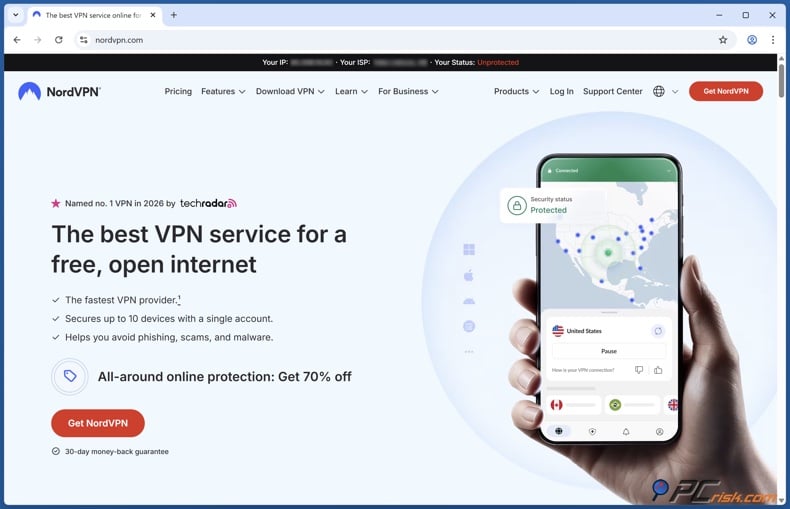
1. Install NordVPN from an official source and sign in. PCrisk’s testing framework includes usability and setup quality because poorly implemented VPN apps create security gaps. Install the app on the device you actually use (mobile or desktop), and use a strong, unique password for the VPN account.
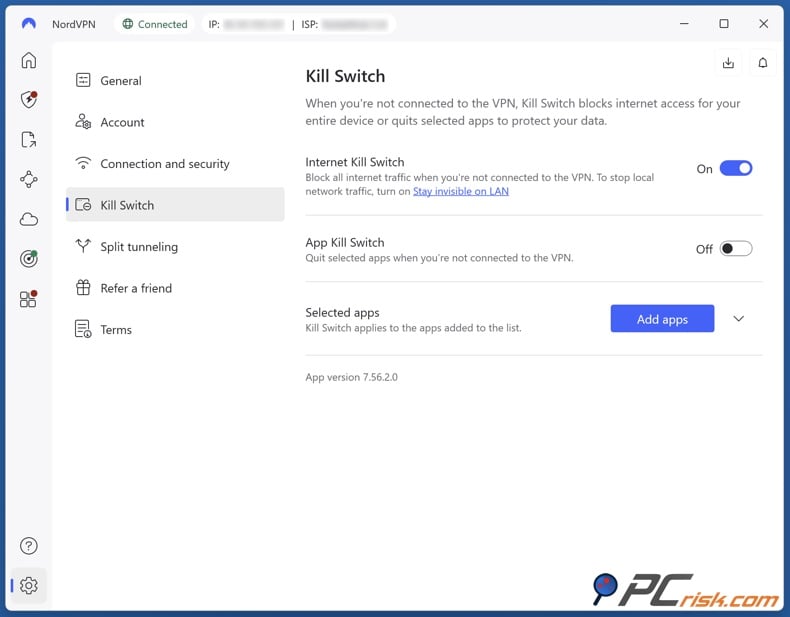
2. Enable the key safety settings before opening FanDuel. At minimum, enable the kill switch (if available on your platform) and keep DNS leak protections enabled. We at PCrisk place heavy emphasis on leak protection because it directly affects whether your IP/DNS can escape if a connection drops.
NordVPN is positioned as a feature-rich service (including AES‑256 encryption and the NordLynx protocol), but it has split-tunneling limitations on macOS and iOS, which is relevant if you want to route only some traffic through the VPN.
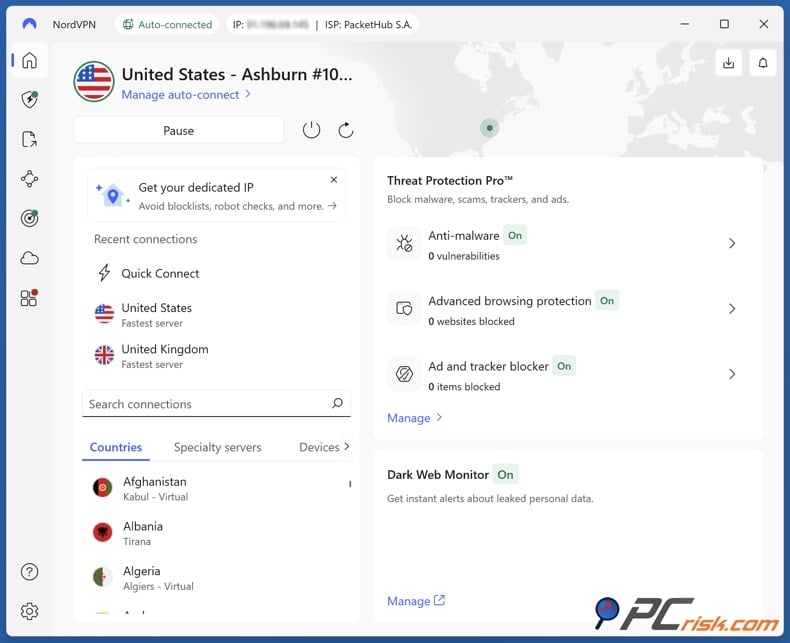
3. Choose an optimal server for privacy and performance. For everyday privacy use, the safest choice is typically a server geographically close to your real location because it reduces latency and avoids suspicious “impossible travel” patterns that can trigger fraud systems on financial platforms. A VPN is not a legal substitute for physically being in a jurisdiction where wagering is allowed.
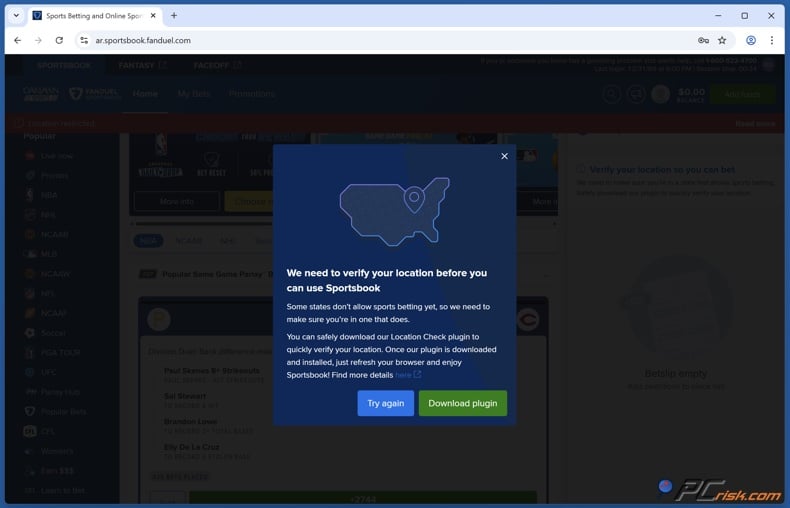
4. Open FanDuel and let the platform verify your location normally. If you’re using FanDuel Sportsbook, remember that location services are required for wagering. FanDuel states that you can’t use its wagering services without location data enabled.
If you receive “Restricted Location” errors while you are physically in an eligible state, follow FanDuel’s own troubleshooting steps, which include disconnecting any VPN or external network and resetting location services.
5. If wagering requires you to disable the VPN, do it - then re-enable it after. This is the practical compromise many security-conscious users end up with: keep the VPN for general browsing, research content, and protecting your session on public Wi‑Fi, but turn it off when a regulated betting platform requires location verification. FanDuel explicitly recommends disconnecting VPNs during location troubleshooting.
What you should not do
Do not use a VPN (or any proxy-type technology) to misrepresent your location to enter or participate in FanDuel contests. FanDuel’s Terms of Use explicitly list using proxy servers or similar technology to misrepresent identity or location as improper conduct and note violations can lead to forfeiture or account cancellation.
The Best VPNs for FanDuel in 2026
This list includes 5 VPNs PCrisk ranks as its top picks for 2026: NordVPN, Surfshark, Mullvad, Proton VPN, and ExpressVPN.




NordVPN - We rank NordVPN as the best VPN in 2026, due its balance of speed, privacy, and feature depth. It boasts AES‑256 encryption, a strict no‑logs posture with auditing references, and features like Double VPN and Threat Protection, with NordLynx positioned as a high‑performance protocol.
Country selection and number of servers: Our NordVPN review states that, as of 2026, it has over 9,100 servers across more than 167 countries.
Why it’s strong for FanDuel users (in legal states): NordVPN’s main advantage is reliability plus protective tools. If you’re signing in on public Wi‑Fi, the combination of a kill switch, leak protection, and threat filtering is a meaningful security upgrade.
- Pros: strong overall security posture; large network footprint (more redundancy if a server is slow); strong performance profile in PCrisk’s rankings; useful anti‑tracking tooling via Threat Protection.
- Cons: split tunneling limitations on macOS and iOS can reduce flexibility if you want to keep some apps outside the tunnel; no free tier; and the “all‑in‑one security suite” bundles may be more than some users need.
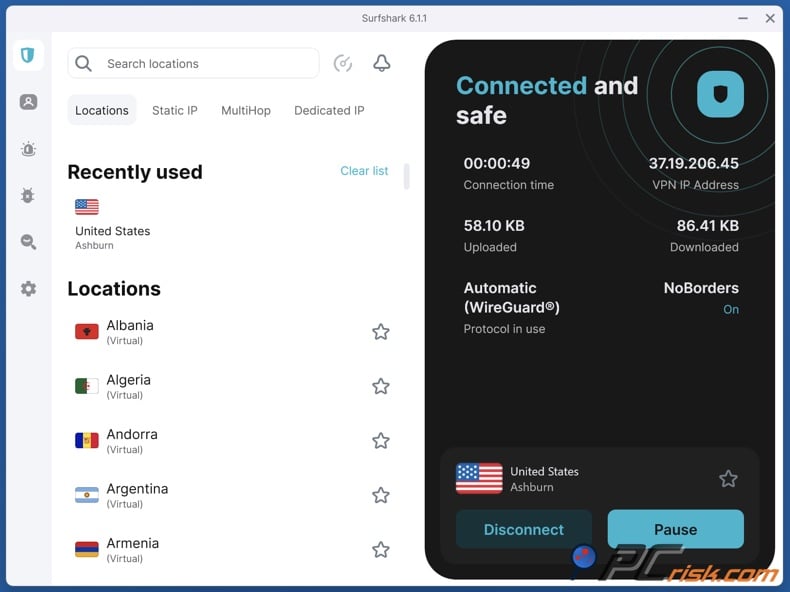
Surfshark - We rank Surfshark second in its 2026 list and position it as a feature-rich, budget-friendly VPN with strong speed results (especially with WireGuard), an audited no‑logs narrative, and a very practical differentiator: unlimited devices.
Country selection and number of servers: Our Surfshark review cites over 4,500 servers in 100 countries.
Why it’s strong for FanDuel users: If you’re protecting multiple devices (phone, laptop, tablet) on the go, unlimited simultaneous connections can be a real advantage, especially for households that don’t want to manage device caps.
- Pros: unlimited devices; broad country coverage; useful “security suite” extras; strong streaming/geo-access performance (a useful general indicator of network robustness).
- Cons: no free plan; long‑term price/value depends on renewal behavior; and (as with any VPN) its IP ranges may be flagged by platforms that strongly police VPN usage, which can matter for regulated betting platforms.
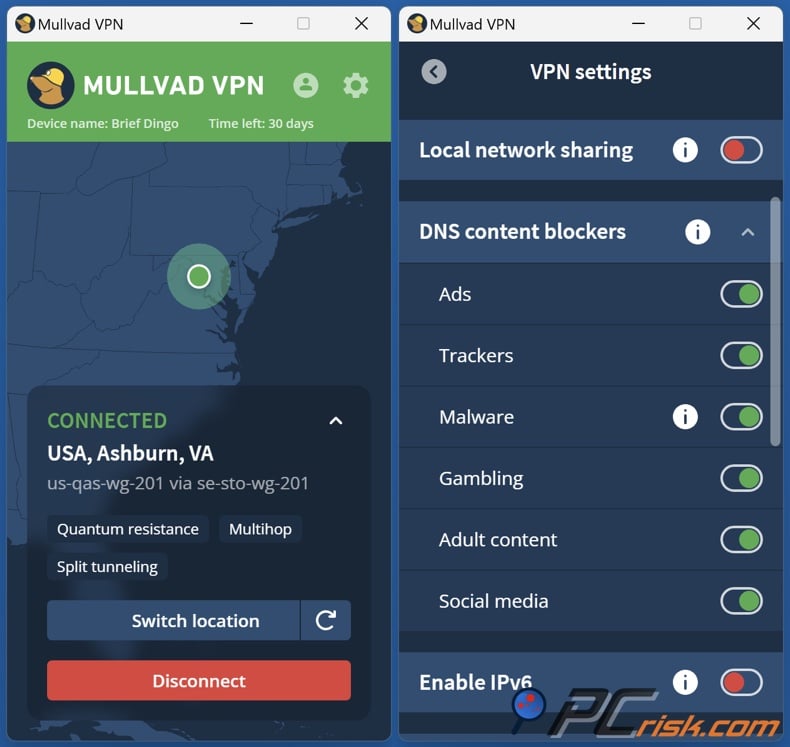
Mullvad - We rank Mullvad third and characterize it as one of the most privacy‑focused services, built around minimal personal data collection and a straightforward, fixed-price model. Our review also highlights trade-offs in streaming/unblocking and a smaller network footprint compared with the biggest brands.
Country selection and number of servers: PCrisk’s Mullvad review states that it offers 50 countries and over 580 servers.
Why it’s (sometimes) right for FanDuel users: If your top priority is privacy minimalism (reducing the amount of personal data tied to your VPN account) Mullvad’s approach can be appealing. However, for FanDuel specifically, the mismatch is that regulated platforms may be more likely to challenge “known VPN” IP ranges, and Mullvad’s smaller footprint can mean fewer alternatives if one endpoint is flagged.
- Pros: privacy-first positioning; straightforward pricing; stable performance on nearby servers; multi-hop features (Bridge mode) if you need them for privacy scenarios.
- Cons: smaller network; fewer “consumer convenience” extras; and weaker performance for unblocking major streaming platforms - often a sign that IP reputation blocks can be more frequent.
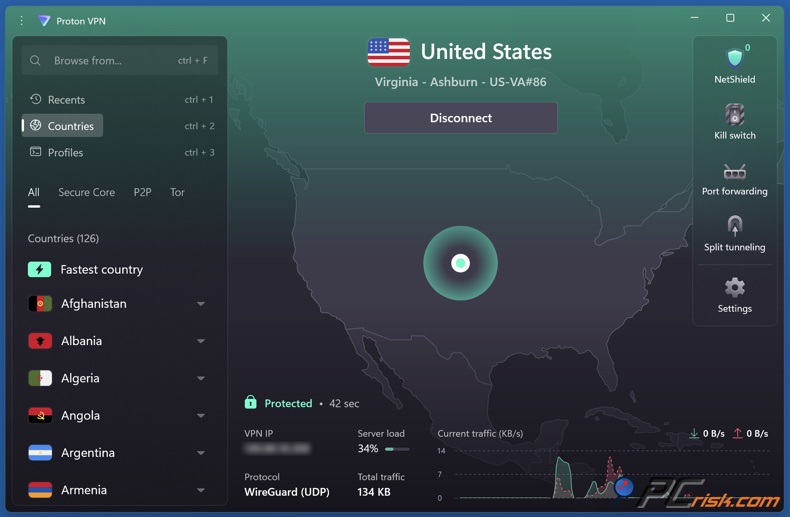
Proton VPN - We rank Proton VPN fourth and frame it around transparency and privacy culture, with a notable advantage in this lineup: a usable free plan (with real limitations) plus strong performance on paid tiers.
Country selection and number of servers: Proton VPN offers 18,700+ servers in 134+ countries as of 2026.
Why it’s strong for FanDuel users: Proton VPN is the one service with a free tier, which is relevant if you want to test basic privacy protection on public Wi‑Fi without committing up front. We can note split tunneling support on Windows, Android, and Linux - useful if you want to keep some apps outside the tunnel when a platform requires location verification.
- Pros: strong privacy posture; large international coverage; kill switch + “Always-On” option; split tunneling on key platforms; and a free plan for basic browsing use.
- Cons: free tier limitations are significant (limited servers/locations and restrictions on premium use cases); paid tiers can be relatively expensive; and for betting use cases, any VPN can still interfere with location verification depending on the platform’s compliance tooling.
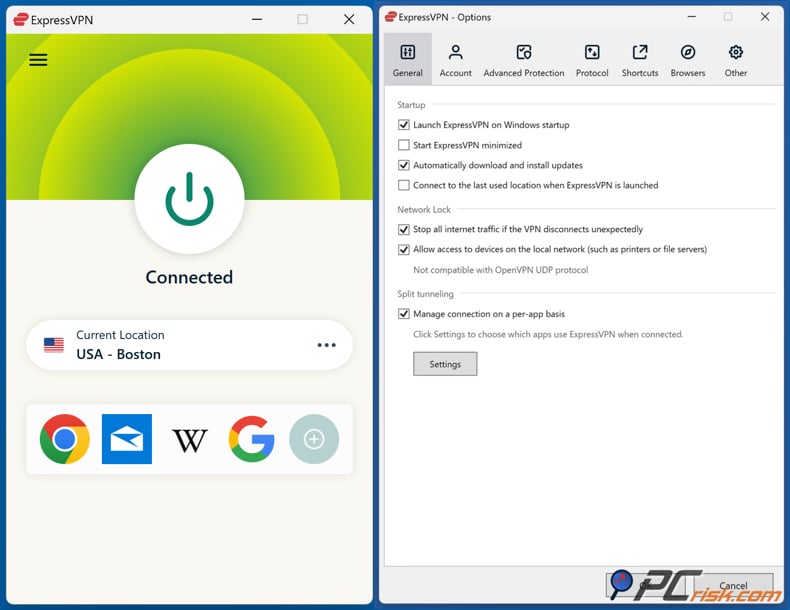
ExpressVPN - We rank ExpressVPN fifth and position it as a premium, polished option - strong on stability, user experience, and core privacy messaging - while acknowledging price as a common critique in user discussions.
Country selection and number of servers: PCrisk’s ExpressVPN review cites 105 countries and 3,000+ servers.
Why it’s strong for FanDuel users: If you want a VPN that is simple and consistent across devices, ExpressVPN’s “it just works” profile can matter. This is a practical advantage when you’re traveling or frequently changing networks.
- Pros: strong usability; broad country coverage; stable performance narrative; security fundamentals (including Lightway).
- Cons: typically pricier than many competitors; and some users consider it expensive for the feature set relative to rivals. Also, as with the rest, using a VPN can still trigger compliance-driven blocks on regulated platforms that rely on strict geolocation.
How We Test VPNs for FanDuel
PCrisk’s VPN testing approach is designed to avoid “checkbox reviews.” The goal is to identify whether a VPN actually protects users under real‑world conditions - especially around leak resistance, privacy claims, and performance stability.
What PCrisk prioritizes in VPN testing
Our testing and scoring emphasizes five main areas: security/leak protection, privacy/logging policy and trust, speed/performance, streaming & geo‑unblocking, and usability & features. We weigh security highest, privacy and performance high, and streaming/usability moderate.
For FanDuel-related scenarios, the same categories matter, but we interpret them through a betting‑platform reality: regulated services often have strict fraud and compliance tooling, and location verification is not optional for wagering.
A FanDuel-focused testing methodology
This methodology is designed to evaluate VPNs for security and stability when using FanDuel legally, not for bypassing restricted states.
Security and leak protection under “betting session” conditions. We test for DNS/IP leak resistance and kill switch behavior because a betting session can involve logins, deposits, and account access that you do not want leaking onto an unsafe network. Our methodology explicitly evaluates encryption strength, kill switch behavior, and whether sensitive data leaks.
Privacy and “who do I trust with my traffic”. We analyze privacy policies and logging practices to see whether “no‑logs” claims have substance, including attention to audits and jurisdiction. This matters because a VPN shifts trust from your ISP to the VPN provider.
Speed, latency, and stability (especially for live betting). We treat speed and performance as a high‑weight category and include stability (avoiding random disconnections) as part of that score. For FanDuel users, stability matters because inconsistent connections can interrupt sessions and increase the chance of location verification errors when network conditions change.
Usability and features that matter for compliance-driven platforms. For FanDuel, the practical feature question is often: does the VPN support split tunneling (on your OS) so you can keep general browsing protected while allowing a regulated app to verify location normally if needed? PCrisk explicitly includes usability and feature breadth (including split tunneling and multi-hop) as part of scoring.
Compatibility with location verification reality (without bypassing). We do not test “how to beat geolocation.” Instead, we test what happens when a user uses a VPN normally and then tries to access the platform. FanDuel’s own troubleshooting guidance explicitly tells users to disconnect from VPNs if location verification fails. That’s the boundary condition: a VPN that constantly triggers verification issues is less practical for this use case.
Can FanDuel Detect My VPN?
In practice, yes - at least often enough that leaving a VPN enabled is a common reason users hit “Restricted Location” or location verification failures.
The most important signal here is FanDuel’s own guidance: the “Restricted Location” troubleshooting checklist includes “Disconnect from any VPN or external network.” That instruction exists because VPNs can interfere with the platform’s location verification system.
Why FanDuel cares about location so much
FanDuel states that you cannot use wagering services or place bets without location data turned on, and that it uses precise location-based services to locate and verify you for legal and regulatory compliance (as well as payments and analytics).
In other words, the platform is not treating location as a “preference.” It’s a compliance requirement tied to how U.S. sports betting is regulated.
The role of geolocation vendors and VPN/proxy detection
FanDuel’s Sportsbook privacy policy includes a vendor list that names GeoComply Solutions, Inc. under geolocation services.
GeoComply markets compliance-grade geolocation solutions for the gaming industry and separately promotes tooling for VPN/proxy detection (GeoGuard). That’s a strong indicator of the ecosystem sportsbooks operate in: geolocation compliance and anti‑spoofing are treated as core operational requirements, not optional add-ons.
FanDuel terms and “location spoofing” risk
FanDuel’s Terms of Use for contests explicitly prohibit using proxy servers or other technology to misrepresent identity or location and warn violations can lead to consequences like forfeiture of winnings or account cancellation.
From a risk perspective, this matters as much as the technical side: even if someone could temporarily get around a block (not something PCrisk endorses or provides instructions for), the account risk is real and clearly stated in platform rules.
Where is FanDuel Blocked or Restricted?
“FanDuel access” depends on the product. FanDuel Sportsbook availability is not the same as FanDuel Casino availability, and Daily Fantasy eligibility has its own state-by-state rule set.
Where FanDuel Sportsbook is available
FanDuel’s Sportsbook & Casino Privacy Policy page links state-specific Sportsbook terms for each jurisdiction in which it operates a mobile Sportsbook. As of the policy list (which includes a February 26, 2026 update for Arkansas), the jurisdictions listed are:
Arkansas, Arizona, Colorado, Connecticut, District of Columbia, Illinois, Indiana, Iowa, Kansas, Kentucky, Louisiana, Maryland, Massachusetts, Michigan, Missouri, New Jersey, New York, North Carolina, Ohio, Pennsylvania, Tennessee, Vermont, Virginia, West Virginia, and Wyoming.
FanDuel also publicly announced its launch in Missouri on December 1, 2025 and its “now live” status in Arkansas in March 2026, reinforcing that these states are active operational markets.
Why FanDuel is blocked or restricted in other states
If you are physically outside the jurisdictions where FanDuel operates Sportsbook wagering, you can’t legally place bets there, and FanDuel’s own policy states wagering requires location verification. The reasons usually fall into a few categories:
States where sports betting is not legal (so FanDuel Sportsbook isn’t available): CBS Sports’ March 18, 2026, state-by-state overview lists these as “not legal” at the time of publication: Alabama, Alaska, California, Georgia, Hawaii, Idaho, Minnesota, Oklahoma, South Carolina, Texas, and Utah. In these places, the core issue is legality and licensing - not your internet connection.
States where sports betting is legal but online betting is limited or not statewide (often retail-only or location-limited): Some states restrict sports betting to physical locations (casinos/tribal lands) or otherwise do not permit statewide mobile wagering. CBS describes examples such as Mississippi (online still prohibited), Washington (bets must occur on tribal lands), North Dakota (tribal casino-only), and South Dakota (Deadwood property limitations). FanDuel may be restricted or unavailable in these frameworks because the market structure doesn’t support the typical statewide mobile model.
States where online sports betting exists but FanDuel isn’t the operator (exclusive/limited licensing models): Even if sports betting is legal, a state can operate under an exclusive or limited licensing model that excludes FanDuel. CBS describes Florida as a case where Hard Rock Bet is the only available online sportsbook in the period described, which naturally excludes competing brands. CBS also notes New Hampshire as having an exclusive mobile contract with DraftKings, and Maine as having only DraftKings and Caesars licensed in that period.
States with local carve-outs and sub‑state restrictions: Even in states where FanDuel operates, some jurisdictions have internal restrictions. CBS notes that Louisiana does not allow sports betting in all parishes, and FanDuel’s own promotional legal text has historically included parish exclusions.
FanDuel Casino restrictions
FanDuel’s casino availability is much narrower than Sportsbook. FanDuel’s own Casino guidance states that online casino games are legal to play with FanDuel Casino in MI, PA, NJ, WV, and CT (and also notes Ontario separately).
If you’re outside those states, the issue is that online casino/iGaming is not broadly legal nationwide. A VPN does not change your physical location, and FanDuel’s wagering products use location data for compliance.
FanDuel Fantasy (DFS) restrictions
Paid Daily Fantasy eligibility has its own legal footprint. FanDuel’s mobile terms state that when depositing funds or entering a paid contest, you must not be physically located in certain states (including Arizona, Connecticut, Hawaii, Idaho, Montana, Nevada, and Washington), and it also lists specific prohibited parishes in Louisiana.
FanDuel’s Rules & Scoring page also indicates that in some restricted locations (including several of the states above), users may be able to enter free contests but cannot deposit funds or enter paid contests.
Common Issues and Solutions When Using a VPN
The biggest “FanDuel + VPN” issues are usually not about speed. They’re about location verification and trust signals.
“Restricted Location” even though I’m in an eligible state
Start with FanDuel’s own checklist. Their geo tips explicitly recommend:
- logging out and reopening the app,
- restarting the device,
- disconnecting from any VPN or external network,
- resetting location services and ensuring FanDuel has location permission,
- disabling apps that may block location,
- resetting Wi‑Fi.
If the issue disappears after disconnecting a VPN, that strongly suggests the VPN was interfering with the location verification chain.
Location works on mobile but fails on desktop
This is a known pattern across regulated betting ecosystems because desktop flows can involve additional location tools and system permissions. The important, safe takeaway is: do not try to “game” compliance. Instead, ensure your browser and OS location permissions are correctly configured and remove interference from VPN/proxy software if FanDuel cannot verify location.
Slow odds refresh or delays when live betting
If you are using a VPN for privacy while browsing sports content, choose a nearby server, avoid multi-hop modes, and prioritize stability. PCrisk’s testing weights performance and stability heavily because random disconnects and high latency reduce usability.
Extra CAPTCHAs, security challenges, or “unusual traffic” warnings
This commonly happens when services see traffic from IP ranges associated with VPN exit servers. It is not unique to FanDuel. The practical solution (again, not bypass-related) is to switch to normal connection when a regulated service requires it, especially if you’re trying to complete location verification. FanDuel’s own guidance points in this direction.
Can I Use a Free VPN for FanDuel?
For regulated betting platforms, free VPNs are usually a poor fit - both technically and from a risk perspective.
Why free VPNs tend to fail for regulated wagering use
Free VPNs are often more congested, have fewer server options, and rely on IP ranges that are widely flagged. If your goal is simply privacy on public Wi‑Fi, a reputable free plan can be acceptable, but if your goal is wagering on a regulated platform that requires location verification, the VPN itself may trigger failures that force you to disable it anyway.
Proton VPN Free
Within PCrisk’s top five VPNs, Proton VPN is the only one explicitly noted as having a free version available.
PCrisk’s Proton VPN review describes the free plan as limited: one device, a handful of servers, capped speeds, and restrictions on premium use cases. The review also specifies that the free plan’s location options are limited (US, Netherlands, Japan) and that streaming and P2P are not available on the free plan.
For FanDuel specifically, treating Proton VPN Free as a “try it for basic privacy” option is reasonable, but it is not a reliable way to interact with compliance-heavy wagering flows because FanDuel may ask you to disconnect VPNs for location verification.
What about Windscribe and other free VPNs?
Windscribe is frequently mentioned online as a reputable free VPN option, and it’s an example of a more “decent” free VPN compared to random unknown apps.
As a general rule: for sensitive accounts and compliance-heavy platforms, the better “free” approach is often not a free VPN - it’s using a trusted network, enabling device security basics, and following the operator’s location rules.
Is It Legal to Use a VPN to Access FanDuel in the US?
VPNs themselves are legal tools in the United States, and there are many lawful reasons to use them. The legal and practical risk comes from how a VPN is used - particularly if it’s used to misrepresent location for regulated activities.
Terms, compliance, and account consequences
FanDuel’s Terms of Use for contests explicitly prohibit using proxy servers or other technology to misrepresent identity or location to enter or participate, and it describes possible consequences like forfeiture of winnings and account cancellation.
Even outside FanDuel’s terms, sports betting legality is state-by-state. A March 2026 overview notes that many states have some form of legalized sports betting, but the details (online vs retail, tribal limitations, exclusivity) vary widely.
Potential legal exposure varies by state
Some jurisdictions’ laws include penalties for bettors (not just operators), while others focus enforcement on unlicensed operators. Legal Sports Report notes that a small subset of jurisdictions explicitly include penalties for the bettor. This is one reason PCrisk does not present VPN usage as a workaround for restricted locations.
Important note: PCrisk is not a law firm. If you need legally authoritative advice for a specific state or circumstance, consult a qualified attorney or the relevant state regulator.
In Closing
The “best FanDuel VPN” question is often framed the wrong way. A VPN is a strong cybersecurity tool for privacy and safer network use, but it is not a compliant substitute for physical presence in a legal wagering jurisdiction - especially on a platform that explicitly requires location data for wagering and advises users to disconnect VPNs when verification fails.
If you use FanDuel in a legal state and want more privacy on public Wi‑Fi, focus on VPN fundamentals that PCrisk prioritizes: leak resistance, kill switch reliability, reputable privacy posture, and stable performance. In PCrisk’s 2026 rankings, NordVPN takes the top spot; Surfshark is the “many devices” value choice; Mullvad is a privacy‑minimalist option (with tradeoffs in unblocking); Proton VPN is the standout for a reputable free tier; and ExpressVPN is the premium stability pick.
Finally, if your real problem is that FanDuel is restricted where you are, treat that as a legal and regulatory issue - not a technical challenge. Use licensed local options, or restrict your activity to content that is actually permitted (for example, reading odds, viewing research content, or using non‑wagering products where available) until you are physically in an eligible jurisdiction.
Frequently Asked Questions (FAQs)
Can I use a VPN to bet on FanDuel from a restricted state?
FanDuel requires location data for wagering and advises users to disconnect VPNs if location verification fails. Using proxies to misrepresent location is prohibited in FanDuel’s Terms of Use for contests.
Why does FanDuel say “Restricted Location” when I’m traveling inside the U.S.?
Because eligibility is based on physical location, not where your account was created. If you cross into a restricted state or your device can’t be verified, you may see location errors. FanDuel’s own troubleshooting checklist includes disconnecting VPNs and resetting location services.
Is a VPN useful if I’m already in a legal FanDuel state?
Yes - primarily for privacy and protection on untrusted networks. Just be aware that it may interfere with location verification for wagering, which can require disabling the VPN.
Can FanDuel detect VPNs and proxies?
Often, yes. FanDuel’s own geo troubleshooting tells users to disconnect from VPNs, and its privacy policy indicates it uses precise location-based services for wagering compliance.
Where is FanDuel Sportsbook legal and available right now?
FanDuel’s Sportsbook privacy policy page links its state-specific Sportsbook terms for jurisdictions where it operates a mobile Sportsbook, providing an official list of operating markets.
Does FanDuel Casino work nationwide?
No. FanDuel’s own Casino guidance states it’s available only in MI, PA, NJ, WV, and CT (and notes Ontario separately).
Are Daily Fantasy paid contests available everywhere?
No. FanDuel’s DFS terms include state restrictions for paid contest participation and parish-level restrictions in Louisiana.
Share:
 Facebook
 X.com
X.com
 LinkedIn
 Copy Link

Rimvydas Iliavicius
Researcher, author
Rimvydas is a researcher with over four years of experience in the cybersecurity industry. He attended Kaunas University of Technology and graduated with a Master's degree in Translation and Localization of Technical texts. His interests in computers and technology led him to become a versatile author in the IT industry. At PCrisk, he's responsible for writing in-depth how-to articles for Microsoft Windows.
▼ Show Discussion