
We may earn commissions from products we recommend. Learn more.
Cheapest YouTube Premium countries in 2026 | Easy Guide

Cheapest YouTube Premium countries in 2026
It is easy to see why people want a cheaper YouTube Premium subscription in 2026. Prices in the U.S. have gone up, with the individual plan now at $15.99 per month and the family plan at $26.99, and the family plan still requires everyone to live together. This big price difference is why so many people look at other countries, payment options, and VPNs.
At PCrisk, we believe the real question in 2026 is not just about finding the cheapest country. It is about which cheaper country still works after you consider payment checks, travel rules, household requirements, and the risk of losing your subscription. YouTube’s help pages now clearly mention country verification, payment rules for certain countries, and the chance of cancellation if you use a VPN or give the wrong location.
 Our top-rated VPN
4.5/5 in our review. Our top pick of the year: almost no slowdown in our speed tests, and it unblocked Netflix, BBC iPlayer and Disney+ without trouble.
Table of Contents:
- Introduction
- Is the YouTube Premium VPN trick still valid in 2026?
- How to buy YouTube Premium with a VPN
- Best VPNs to buy YouTube Premium cheaper
- Countries where YouTube Premium is cheapest
- Can I get a YouTube Premium subscription with a free VPN?
- In closing
- Frequently asked questions (FAQ)
Yes, but it is not as easy as before. In 2026, YouTube says you should mostly use your subscription in the country where you signed up. If you travel for more than 30 days, your subscription could be affected, and using a VPN or giving a false location can lead to cancellation. So, while the VPN method can still help you see lower prices, YouTube now makes it clear that your location matters for pricing and access.
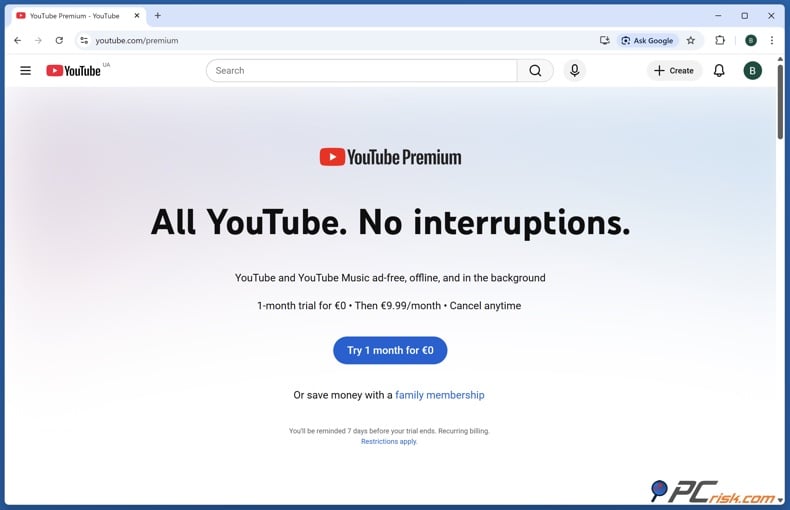
The family plan rules are now much stricter. YouTube says all family members must live at the same address as the family manager, and an electronic check-in is required every 30 days to confirm this. If your Premium access is paused, it could be because YouTube could not verify everyone lives together. Reports from 2025 also show YouTube is enforcing these rules more strictly, so a family plan is not as easy a workaround as it used to be.
Billing is another big challenge. YouTube says some countries need a payment method from that country, and you might see an error saying "We couldn't verify your country." Google also says you cannot just change the country on your existing payments profile; you need to make a new one for each country. So, using a VPN alone often is not enough. If you are actually moving to a new country, you can set things up properly. But if you are only switching countries for a better price, it is now much harder to sign up or renew than older guides suggest. We found that, in 2026, many cheap-country options no longer work well.
How a VPN can still help you get a cheaper subscription
A VPN still helps in this process. It can make YouTube think you are browsing from another country, which may show you local prices and offers. A VPN also gives you more privacy on public Wi-Fi and hides your IP address while you test different storefronts. PCRisk’s tests show VPNs are still good for private browsing, accessing blocked content, and staying safe on public networks. But in 2026, a VPN is just one part of the process. Your billing profile, payment method, and YouTube’s checks are just as important.
For this example, we use NordVPN. PCrisk rates it as the best VPN in 2026 because it is fast, works well for streaming, has many servers, and reliably unblocks major platforms. These features matter because a slow or unstable VPN can cause errors during checkout, verification issues, and problems with location detection.


Here’s a step-by-step guide on how to purchase YouTube Premium at a lower price using NordVPN:
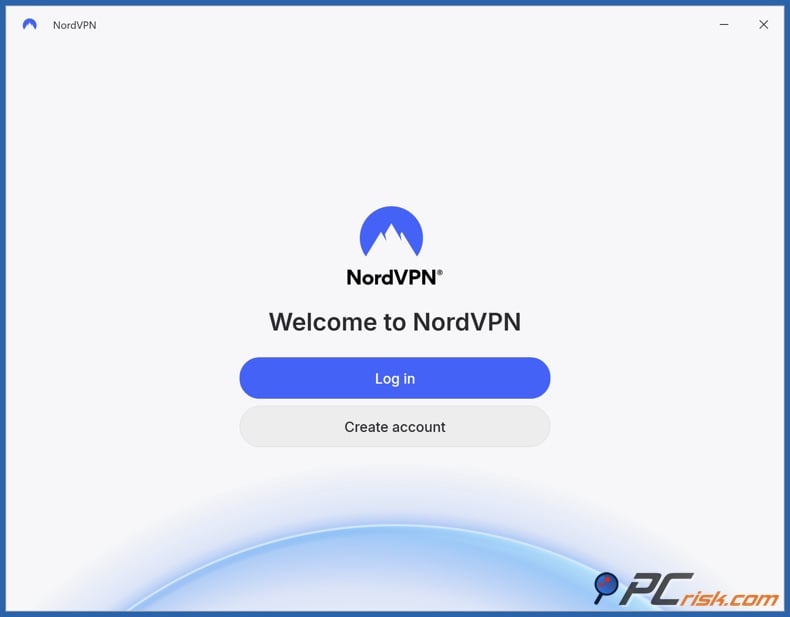
1. Install NordVPN and log in. If you want to research prices or try signing up in a specific country, start with a VPN that PCrisk found to be fast, stable, and good at unblocking streaming sites.
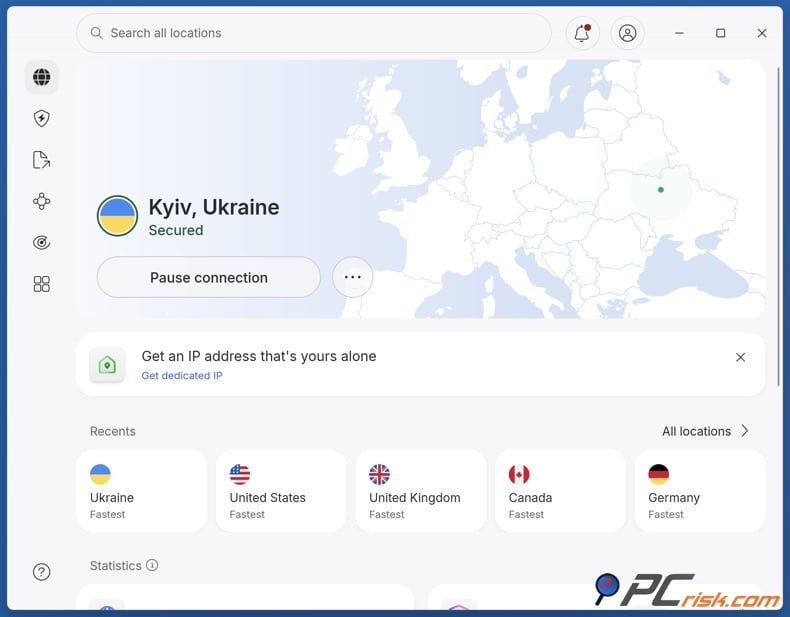
2. Choose which country you want to try before connecting. In practice, India, Ukraine, Turkey, and the Philippines are better starting points than random cheap countries because they are often mentioned in recent pricing reports and have more stable prices.
3. Connect to a server in your chosen country, open a private browser window, and visit the YouTube Premium checkout page. If you see prices in the local currency, the site is recognizing your location.
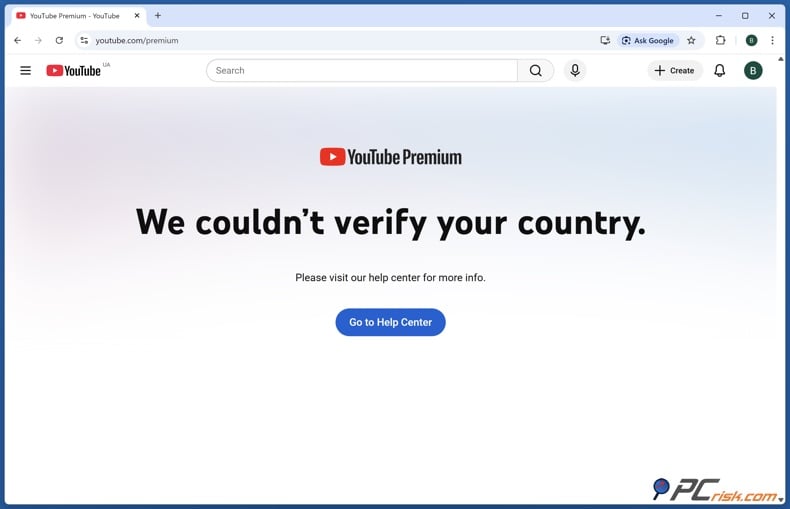
4. If YouTube says "We couldn't verify your country," follow YouTube’s troubleshooting steps: try a different network, another device, or the mobile app. This message usually means YouTube’s checks are blocking your current setup.
5. If your account is linked to the wrong billing country, you cannot just edit your old profile. Google says each payments profile is tied to one country, so if it is wrong, you need to make a new profile. Your Play country will match this profile and may take at least 48 hours to update after you change it.
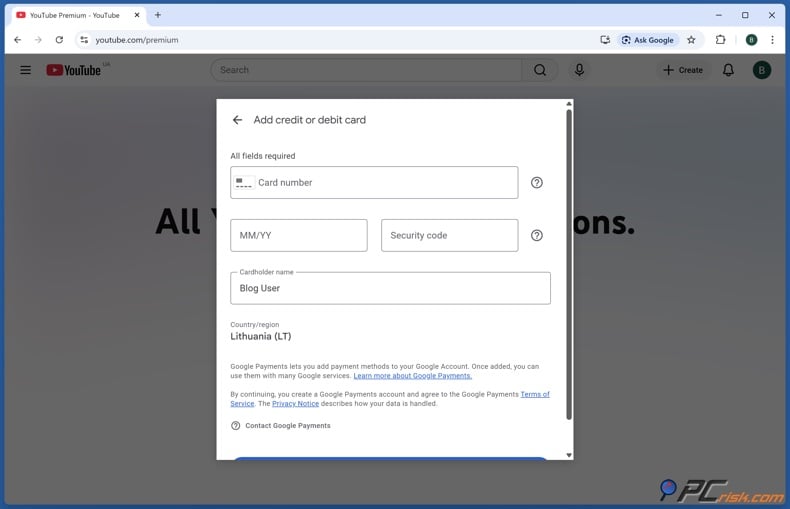
6. Add a payment method that YouTube accepts. This step often causes problems for people trying to use cheaper countries. YouTube says that in some places, you must use a payment method from that country. If your card does not match, you might get blocked even if the VPN works.
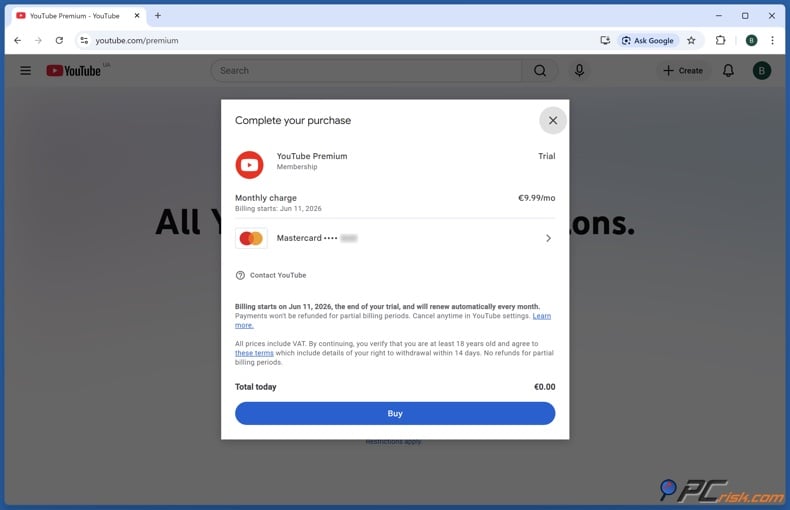
7. Finish your purchase, then check your membership details under Purchases and memberships. Here, YouTube shows your membership type, payment method, next billing date, and the price you are paying.
8. Consider your result temporary until it lasts through the next billing cycle. YouTube says you should mostly use your subscription in the country where you signed up, and using a false location can lead to cancellation. So, just making the first purchase does not guarantee your setup will last.
If this sounds more complicated than older guides, it is because things have changed. The days of easy one-click tricks are ending. In 2026, the best approach is to use a VPN to access the correct storefront and combine it with a payment profile and method that YouTube accepts.
This shortlist only includes VPNs reviewed by PCrisk. We are ranking them for this specific use, so speed, stable country switching, ease of use, and good streaming performance matter more than niche privacy features. PCrisk's top five for 2026 are NordVPN, Surfshark, Mullvad, Proton VPN, and ExpressVPN.


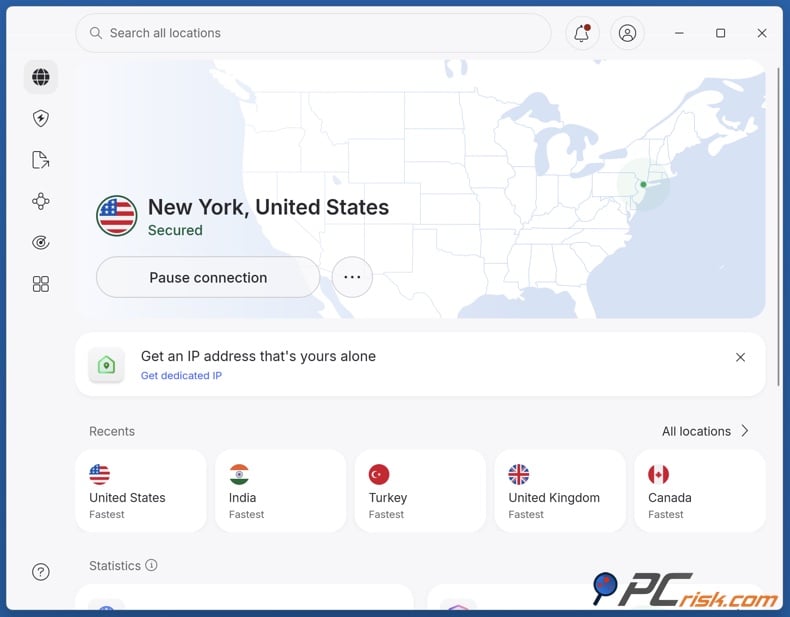
NordVPN - NordVPN is the best fit for this article because it combines the things that matter most for international subscription testing: very fast speeds, a broad server footprint, smooth switching between locations, and consistently strong unblocking results in PCrisk's tests. PCrisk gives it the top score among its 2026 VPN picks and specifically notes its speed, audited no-logs policy, intuitive apps, and reliable access to major streaming platforms. That combination makes it the safest first recommendation for readers who want to try country-based pricing with the fewest technical headaches.
The downside is that NordVPN is not the cheapest month-to-month option, and its best value is on longer plans. PCrisk also notes some feature gaps, such as split-tunneling limits on iOS and macOS, and no port forwarding. These issues do not ruin its value for YouTube, but they matter if you want one VPN for everything. Overall, it is still the top recommendation for this article.
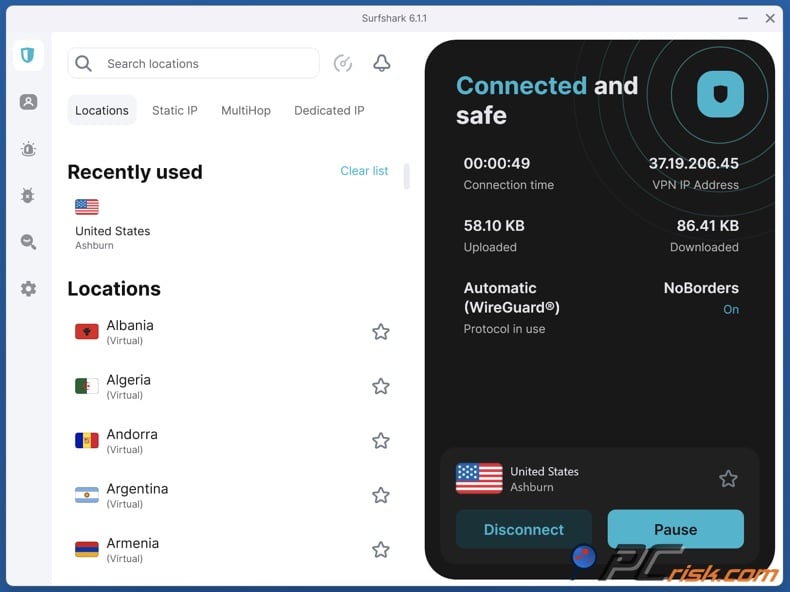
Surfshark - Surfshark is the best value choice if you want a cheaper VPN without giving up the locations and speed needed for subscription testing. PCrisk highlights its strong WireGuard performance, unlimited-device policy, MultiHop, CleanWeb, and smooth operation across major streaming platforms such as Netflix, Hulu, and BBC iPlayer. For readers who want to test multiple devices, compare store pages on desktop and mobile, or share a single VPN across a household, Surfshark is easy to justify.
Its biggest weakness is the price after renewal. PCrisk warns that Surfshark's promo pricing looks great at first, but can rise sharply when the first term ends. It also does not have a permanent free plan, and some features are limited on iOS and Linux. Still, for budget-minded readers who want a flexible, streaming-capable VPN, Surfshark is probably the best second choice.
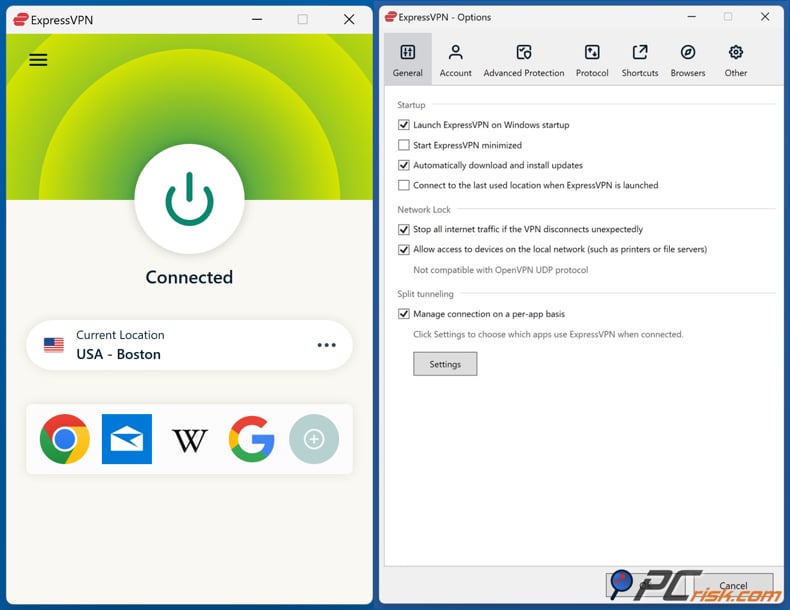
ExpressVPN - ExpressVPN is the premium "it just works" option. PCrisk's review emphasizes fast local and long-distance speeds, excellent streaming performance, easy apps, and broad unblocking success across Netflix, BBC iPlayer, Disney+, Hulu, and other region-locked services. That is highly relevant here because the same characteristics that help with streaming also help with payment page loading, country switching, and overall reliability when testing different sign-up routes.
Its main weakness is price. PCrisk calls it expensive and notes it lacks some advanced extras like built-in malware scanning or deeper multi-hop tools. Its value is best for readers who care more about polish and stability than cost. If you want the smoothest experience and are willing to pay more, ExpressVPN is excellent. If saving money is your goal, NordVPN and Surfshark usually make more sense.
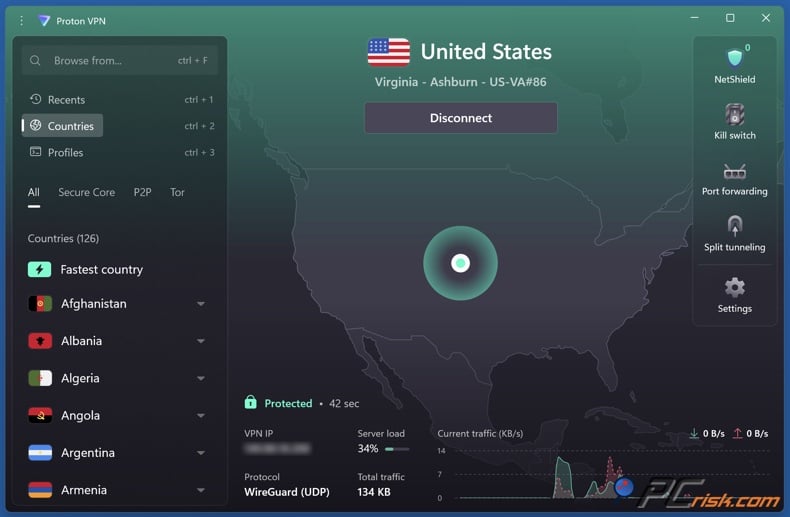
Proton VPN - Proton VPN deserves a place on this list because PCrisk's testing found strong privacy, open-source transparency, good paid streaming performance, and one of the best free plans on the market. The paid Plus tier handles streaming and geo-unblocking well, and the service benefits from a strong privacy reputation. For readers who want a serious security-first VPN and who may also value the broader Proton ecosystem, it is an easy recommendation.
However, Proton VPN is not our top pick for cheaper YouTube Premium research because PCrisk notes its higher long-term cost, mixed speed compared to the fastest rivals, and slower support. The free version is also not a good fit for this use because PCrisk says it does not support streaming services. Use Proton if you want privacy and are willing to pay for the paid plan. Do not expect the free plan to be enough for stable regional subscription testing.
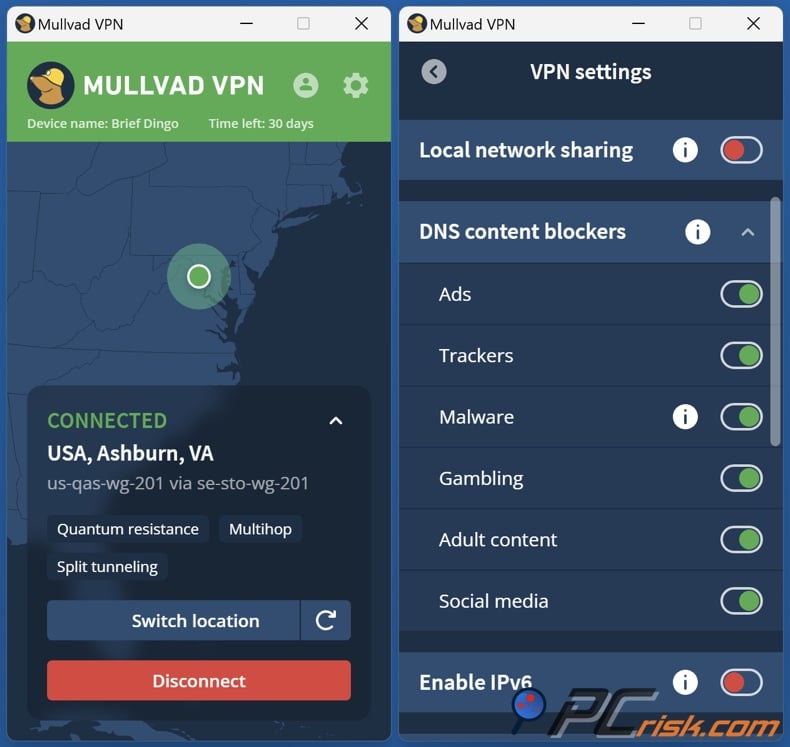
Mullvad - Mullvad is the honesty pick. It appears on PCrisk's top-five list for 2026 and is one of the most privacy-focused VPNs on the market, with anonymous sign-up, open-source apps, and a simple flat price. If your priority is minimizing exposure of your account identity rather than maximizing geo-unblocking convenience, Mullvad is a compelling service.
But this article is about getting YouTube Premium for less, not just privacy. PCrisk makes it clear that Mullvad struggles to unblock major streaming services like Netflix and Disney+, and its weaker streaming performance makes it less appealing to movie and TV users. This same issue makes it a less obvious choice for region-based subscription work. We still mention it, but only as a privacy-first alternative, not as a top pick for this task.
Before listing countries, one warning is more important than ever in 2026: "cheapest" can mean different things. It might be the lowest posted local price, the lowest price after taxes, or the cheapest country that is still practical for someone outside that country. These are not always the same. For example, Argentina often looks very cheap on paper, but local taxes can raise the real cost for residents, and YouTube's location and payment checks make cross-border setups less predictable.
For context, the U.S. price is now $15.99 per month for the individual plan and $26.99 for the family plan. Compared to that, almost every country below is cheaper, though the difference varies widely.
Based on 2026 posted prices, these are the countries that matter most:
- Argentina is the headline-grabber on sticker price. Argentine media, citing the official site, lists ARS 869 per month for the individual plan and ARS 1,569 for the family plan. At current mid-market exchange rates, that looks extraordinarily low. But local reporting also shows that taxes can push the real resident cost far higher, to roughly ARS 5,200 for an individual and ARS 10,402 for a family. That makes Argentina look better in an international spreadsheet than it does in a real billing context.
- Turkey remains one of the strongest low-cost references in 2026. Turkish reporting and local Premium Lite coverage show YouTube Premium at TRY 79.99 for the individual plan and TRY 159.99 for the family plan. In May 2026, mid-market rates from Xe that is roughly $1.76 individual and $3.53 family. On price alone, Turkey is still one of the lowest practical benchmarks outside of Argentina.
- India is still a core market for discount hunters, but it is not quite as cheap as some older guides suggest. Business Standard and Gadgets 360 continued to list India's 2026 pricing at Rs 149 per month for an individual plan, Rs 299 for a family plan, Rs 219 for a two-person plan, and Rs 89 for student pricing. At current exchange rates, the standard individual plan is roughly $1.60, and the family plan about $3.20. India no longer looks magically cheap the way it once did, but it is still one of the best combinations of low prices, clear public pricing, and relevant plan variety.
- Ukraine remains one of the most attractive low-cost markets in 2026. Ukrainian reporting from January 2026 repeatedly lists the individual plan at 99 UAH and the family plan at 149 UAH, which works out to about $2.26 and $3.40 at May 2026 mid-market rates. That is not the absolute rock bottom if you only look at sticker price, but it is one of the strongest cheap-country benchmarks because the pricing appears stable across multiple recent sources.
- The Philippines is no longer as cheap as many older articles claim. Philippine coverage in late 2025 and early 2026 points to PHP 189 for the individual plan and PHP 379 for the family plan, not the older PHP 159 and PHP 239 figures that still appear in outdated comparison pages. That means the Philippines is still cheaper than the U.S., but not quite the bargain some recycled lists suggest.
- Brazil is a useful "cheap but mainstream" market. Brazilian reporting in April 2026 listed local pricing at R$26.90 per month for the individual plan and R$53.90 for the family plan. Using the May 2026 BRL/USD rate, that is roughly $5.45 and $10.91. Brazil is clearly not in the same ultra-cheap tier as India, Turkey, or Ukraine, but it is still far below U.S. pricing and may feel more stable and less fringe to some readers.
If we ignore the gimmicks and focus on countries that are both cheap and practical in 2026, the best shortlist is India, Ukraine, Turkey, and the Philippines, with Brazil as a higher-priced but still discounted backup. Argentina is worth mentioning for its low sticker price, but local taxes make it a less reliable benchmark.
Cheaper countries to get YouTube Premium Family subscriptions
For family pricing, the best options are India, Ukraine, and Turkey because they offer low family rates and consistent pricing. India's Rs 299 family rate is still a great value, Ukraine's 149 UAH family rate is very low, and Turkey's 159.99 TRY family plan is still competitive after its 2024 price increase. The Philippines at PHP 379 is much cheaper than the U.S. family plan, while Brazil's R$53.90 family plan is a good discount but not "ultra cheap." Argentina's family price looks even lower before taxes, but taxes make it a less reliable choice.
Usually, no. A free VPN may let you check whether a country's storefront even loads, but it is a weak tool for completing and keeping a cheaper YouTube Premium subscription in 2026. PCrisk's VPN guide says free VPNs are unlikely to provide the security, speed, server selection, or privacy needed for consistent streaming. YouTube's own help pages add the harder barriers: country verification, country-issued payment methods in some markets, and the possibility of cancellation if the location is misrepresented. Those checks do not disappear just because the VPN itself is free.
There is also a product-level problem. PCrisk's Proton VPN review says the free version does not support streaming services or P2P, even though the paid one performs well. That is a useful reminder that "free" and "good enough for geo-sensitive subscriptions" are not the same thing. For this use case, a free VPN is usually either too limited, too slow, or too unreliable to be worth the friction.
Other ways to get YouTube Premium cheaper without a VPN
The safest discounts are still the official ones. First, there is the annual plan. YouTube says annual Premium plans are prepaid, non-recurring, available only for individual users, and currently offered in Brazil, Canada, Germany, India, Japan, Mexico, Thailand, Turkey, and the United States. If your country offers it and you know you will keep the service, the annual plan is the easiest legitimate discount.
Second, there is the student plan. YouTube's student page says eligible users get the same Premium benefits at a discounted rate after verification through SheerID. Third, there is the family plan, but only if everyone really lives at the same address. Fourth, there is now a two-person plan in India, France, Taiwan, Hong Kong, and Australia, which is a surprisingly good middle-ground option for couples and pairs who do not need a full family setup. Fifth, check whether you qualify for a trial or extended trial, because YouTube still offers them under specific eligibility rules.
There is one more money-saving step readers overlook: check pricing online before you subscribe on an iPhone or iPad. YouTube's support pages distinguish memberships billed by Apple from those billed directly, and users in YouTube's own support forum have reported higher Apple-billed prices than web pricing. That is not a universal law in every market, but it is common enough that comparing browser checkout against in-app billing is worth doing before you pay.
Trying to save money on YouTube Premium is not worth risking adware, a browser hijacker, or a fake installer on your device. Combo Cleaner helps check for threats that often hide behind shady "free VPN" downloads, scam payment pages, and misleading browser extensions, so you can look for discounts without risking your system.
 Made by RCS LT, the company behind PCrisk
- Detect malware already on the device
- Block phishing pages once you open them
- Remove adware or browser hijackers
- Scans for free and shows what it finds
- Removes it with a licence, 7-day free trial
- Blocks scam and phishing sites in the browser (Windows)
What is YouTube Premium Lite?
YouTube Premium Lite is YouTube's lower-priced subscription tier for people who mainly want fewer ads and do not need the full Premium bundle. YouTube's official blog launched the expanded U.S. pilot at $7.99 in March 2025, and YouTube later raised the U.S. Premium Lite price to $8.99 as part of the 2026 U.S. price changes. The support page positions Premium Lite as a lighter membership with fewer interruptions than the full service.
The key 2026 update is that Premium Lite is no longer as limited as many 2025 guides said. In February 2026, YouTube announced that Lite subscribers can now watch most videos ad-free, offline, and in the background. But Lite is still not the same as full Premium. YouTube's blog and help pages say that if you want all videos ad-free, including music content, and full access to YouTube Music Premium, you still need the full Premium plan. Ads may still appear on music content, Shorts, and in search or browse areas depending on your region and device.
So, where does Premium Lite fit in a "cheapest countries" article? It is not the best choice for people who want background play everywhere, downloads everywhere, and ad-free music. But it can be the smartest no-VPN savings option for those who mostly watch general videos, news, gaming, tutorials, commentary, and YouTube on TV, and who care more about lowering their monthly bill than getting every Premium feature.
In closing
The cheapest YouTube Premium country in 2026 depends on whether you mean "lowest posted sticker price" or "best realistic value." On sticker price, Argentina grabs attention. On a more practical basis, India, Ukraine, and Turkey are the countries worth watching first, with the Philippines and Brazil still offering meaningful discounts relative to U.S. pricing. The most important change in 2026 is that pricing alone is no longer the whole story. YouTube now explicitly ties access to country verification, payment rules, and location accuracy.
If you want the simple PCrisk answer, it is this: use a high-quality paid VPN if you are even going to test this strategy, and use official discounts first whenever possible. That means annual plans, student pricing, genuine same-household family plans, and two-person plans where available. If you do go the VPN route, NordVPN is our strongest overall recommendation from the VPNs PCrisk has reviewed for this purpose, with Surfshark as the best budget-friendly alternative.
Our top pick of the year: almost no slowdown in our speed tests, and it unblocked Netflix, BBC iPlayer and Disney+ without trouble. $3.39/mo on the 2-year plan or $4.99/mo on the 1-year plan, 30-day money-back guarantee. Compare all three
Frequently asked questions (FAQ)
Which country has the cheapest YouTube Premium in 2026?
On posted sticker price alone, Argentina often looks cheapest. But if you care about a cleaner, more practical benchmark, India, Ukraine, and Turkey are stronger countries to compare because their 2025-2026 pricing is clearer, and Argentina's local tax treatment can dramatically distort the real billed amount.
Is the YouTube Premium VPN trick still working in 2026?
It can still work in some cases, but it is not a guaranteed one-click shortcut. YouTube now says your subscription should be used predominantly in the sign-up country, and it may cancel subscriptions if the location is misrepresented or if country verification fails.
Can YouTube cancel my subscription if I use a VPN?
Yes, that risk is now clearly stated. YouTube's travel and policy page says that if you misrepresent your location, including by using a VPN to circumvent restrictions, your subscription may be canceled.
Do I need a local payment method for a cheaper country subscription?
Sometimes, yes. YouTube says that in some countries, you must use a payment method issued in that country, which is one of the biggest reasons cheap-country access fails even after the local storefront appears.
Can I just change the country on my existing payments profile?
No. Google's payments help says that a payments profile can be associated with only one country and that you cannot change the country of an existing profile. If the country is wrong, you must create a new profile.
Which countries offer the best cheap family plans?
India, Ukraine, and Turkey are the strongest practical family-plan markets in 2026, with rates of Rs 299, 149 UAH, and 159.99 TRY, respectively, as reported in the current update. The Philippines is still far cheaper than the U.S. family plan, while Brazil is discounted but not ultra-cheap.
Can I use a free VPN for cheaper YouTube Premium?
You can try, but it is usually not reliable enough. PCrisk warns that free VPNs tend to have fewer servers, slower speeds, and more privacy tradeoffs, and PCrisk's Proton VPN review says Proton's free plan does not support streaming services.
What is the cheapest official way to save money without a VPN?
Usually, the annual plan, student pricing, a real same-household family plan, or the two-person plan, where it is available. Those are all official paths that do not depend on workaround billing or location trickery.
Is YouTube Premium Lite worth it instead of the full Premium plan?
It can be, if your main goal is fewer ads at a lower monthly cost. In 2026, Premium Lite gained offline viewing and background play for most videos, but it still does not replace full Premium for music content or YouTube Music Premium.
What is the best VPN for buying YouTube Premium at a lower price?
Among the VPNs reviewed by PCrisk, NordVPN is the best overall fit thanks to its speed, server coverage, ease of use, and strong streaming unblocking capability. Surfshark is the best lower-cost alternative if you want unlimited devices and excellent value.
Share:
 Facebook
 X.com
X.com
 LinkedIn
 Copy Link

Rimvydas Iliavicius
Researcher, author
Rimvydas is a researcher with over four years of experience in the cybersecurity industry. He attended Kaunas University of Technology and graduated with a Master's degree in Translation and Localization of Technical texts. His interests in computers and technology led him to become a versatile author in the IT industry. At PCrisk, he's responsible for writing in-depth how-to articles for Microsoft Windows.
▼ Show Discussion