
We may earn commissions from products we recommend. Learn more.
Best VPNs for Gambling and Sports Betting in 2026

Best VPNs for Gambling and Sports Betting in 2026
Online gambling and sports betting are easier to access than ever in 2026. However, these activities are also more closely monitored. Licensed platforms now use geo-blocking, identity checks, and strict location verification to prevent access from restricted areas, reduce fraud, and comply with local regulations.

At the same time, factors such as public Wi-Fi, ISP monitoring, workplace and school network restrictions, and privacy risks during financial transactions provide valid reasons to use a VPN when you gamble legally. A good VPN can encrypt your traffic, lower your exposure on insecure networks, and help you keep your browsing private by limiting what your ISP can see.
Disclaimer: PCrisk.com does not promote, encourage, or endorse bypassing gambling restrictions, geo-blocks, self-exclusion systems, operator controls, or local laws. This article is for informational and cybersecurity purposes only. If online gambling or sports betting is restricted in your area, using a VPN does not make it legal. It may also violate a betting site’s terms, leading to account closure, withheld withdrawals, or other penalties.
Access gambling websites with NordVPNSpecial deal30-day money-back guarantee→
Table of Contents:
- Introduction
- Why Do I Need a VPN for Gambling?
- How to Use a VPN for Gambling
- Best VPNs for Online Gambling and Sports Betting
- Is Using a VPN for Gambling and Sports Betting Safe?
- Is Online Gambling Legal With a VPN?
- Where is Online Gambling and Betting Legal?
- Can I Use a Free VPN to Access Betting Websites Abroad?
- Wrapping Up
- Frequently Asked Questions (FAQ)
Why Do I Need a VPN for Gambling?
A VPN is not a "magic key" that allows access to restricted gambling sites, and it does not bypass a sportsbook's compliance controls. In many regulated markets, especially those that require location verification, betting operators need to identify VPNs, proxies, and other spoofing methods as part of their compliance and anti-fraud programs.
So why do people still use VPNs for gambling? In 2026, the main reasons fall into three categories: differences in access due to licensing, gambling bans and restrictions, and network-level limitations.
Our top recommendation for streaming and privacy. NordVPN consistently leads our tests with fast speeds, reliable geo-unblocking, and a strict no-logs policy.
- ✔ Unblocks geo-restricted streaming services reliably
- ✔ 202+ locations across 111 countries
- ✔ 30-day money-back guarantee · Special deal available
Licensing and geo-restrictions
Licensing is the main reason gambling sites act differently depending on your location. Many markets require operators to hold a local license to offer online betting. For instance, in the United Kingdom, gambling businesses must be licensed to provide remote gambling to consumers. In Denmark, operators need a license from the Danish Gambling Authority to offer online casino games or betting. In France, online gambling is divided and regulated: online sports betting, horse racing betting, and online poker are allowed through licensed channels, while online casino games, especially online slot machines, are not permitted in the French market.
These licensing realities lead to outcomes that gamblers notice right away:
Some sites do not allow sign-ups from specific countries. They may provide "read-only" access, block certain products, such as sports betting but not casinos, or require additional location verification beyond checking the IP address.
Gambling bans and restricted markets
In some countries, online gambling is banned or tightly restricted. For instance, Singapore limits remote gambling to a carefully controlled model. Unlicensed remote gambling is illegal, and the government says that Singapore Pools is the only operator licensed by the Gambling Regulatory Authority to offer remote gambling services.
In Australia, national rules under the Interactive Gambling Act make it illegal for gambling providers to offer specific online services to people in Australia. This includes online casinos and in-play sports betting, as well as other banned offerings.
In New Zealand, the Department of Internal Affairs states that laws ban online racing and sports betting by any organization except TAB NZ. It is now illegal for anyone other than TAB NZ to promote or take bets on racing or sports events from someone in New Zealand.
What often gets overlooked is that a VPN does not change the legal status of the activity. If online betting is restricted in your area, you must follow local rules and licensed options.
Network restrictions and privacy risks
Even if betting is legal for you, networks can still cause problems. Workplaces and schools may block gambling websites. Some hotels, cafés, and public Wi-Fi hotspots restrict access to categories like "gambling" or limit encrypted traffic. In these situations, a VPN can sometimes help by encrypting your connection and routing traffic through a different endpoint. However, this heavily depends on the network and the VPN's ability to connect reliably.
There is also a clear reason for cybersecurity: gambling accounts include payments, identity verification, and sensitive personal data. A VPN provides an encrypted layer between your device and the internet. This is particularly important when you're using public Wi-Fi or traveling often.
If you bet online while using public Wi-Fi or other restricted networks, it’s important to keep your information safe. Betting accounts usually include payments, identity checks, and personal details. Combo Cleaner can help by scanning for malware in real time, blocking scams and dangerous websites, and removing harmful browser extensions that cause redirects, pop-up ads, or tracking.
A VPN encrypts your traffic — but your device still needs protection against malware and ransomware. Combo Cleaner adds the missing layer of defense.
Download Combo CleanerAntivirusDetect & remove malware threats→How to Use a VPN for Gambling
This section uses NordVPN as an example because we at PCrisk rank it as our top VPN choice for 2026. It includes detailed test coverage of speed, leak protection, and features like kill switch and obfuscation.
Step-by-step NordVPN setup for a safer gambling session:
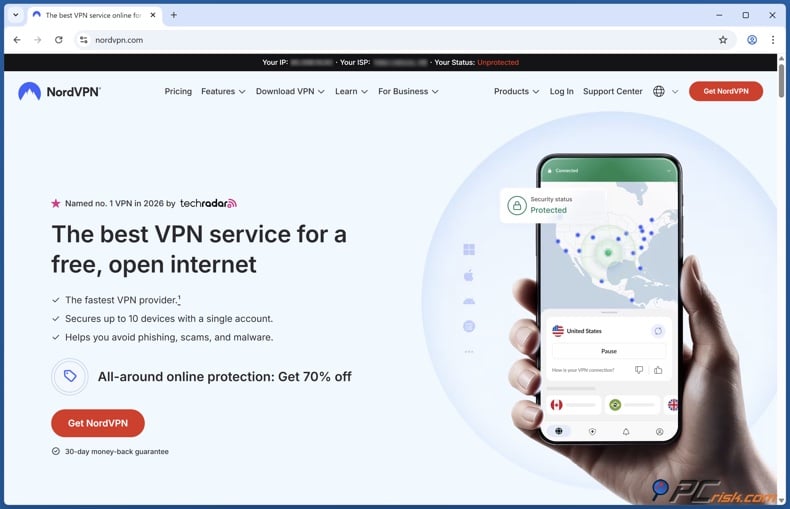
1. Create your NordVPN account. Sign up for an account using credentials you control and secure, like a unique password. A password manager is recommended. If your VPN subscription includes security add-ons, think about whether you want to enable them, such as threat blocking. It's worth noting NordVPN's broader security features alongside its main VPN features.
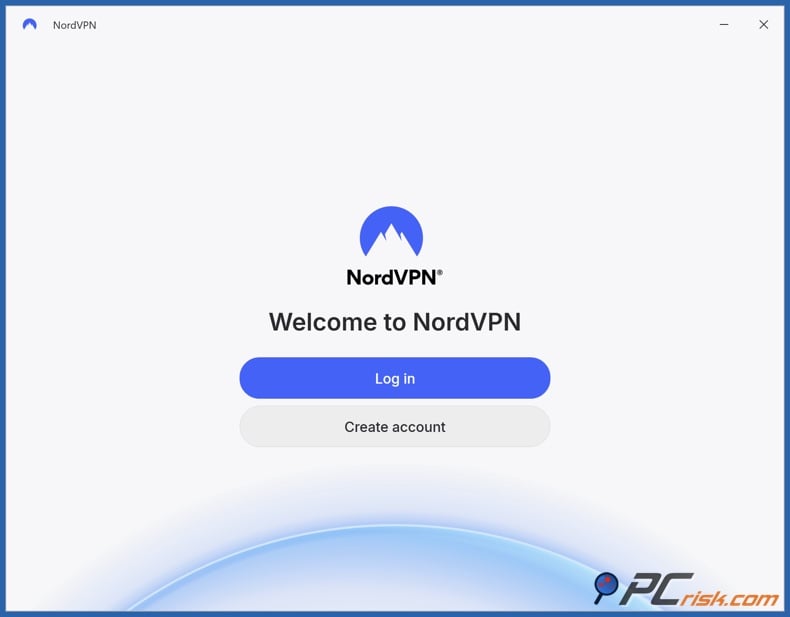
2. Install NordVPN on the device you actually bet from. Install the NordVPN app on your main betting device, whether it's a Windows or macOS computer, an Android phone, or an iPhone. If you place bets from tablets or other devices, you can install it there as well. NordVPN allows up to 10 devices to connect at the same time per account.
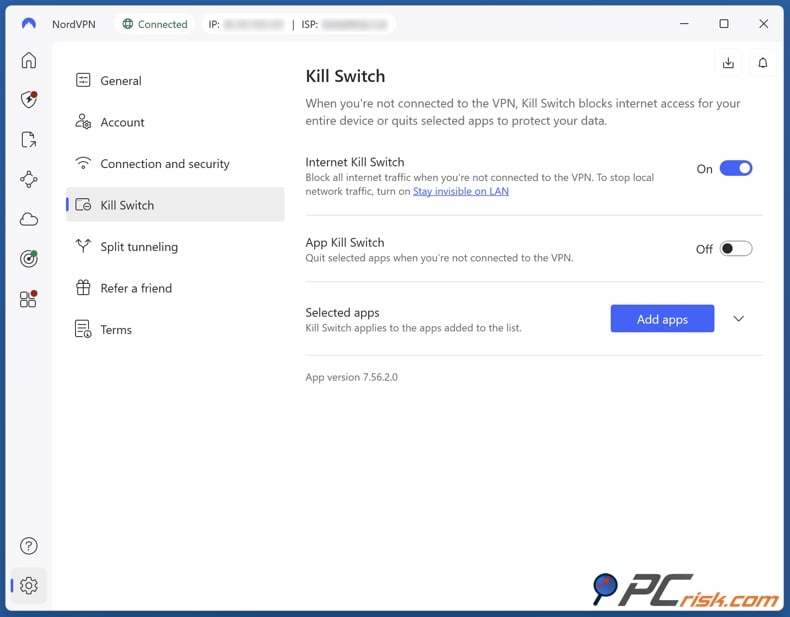
3. Enable the key safety settings before you log in. Kill Switch: Turn on the kill switch to prevent your real IP from leaking if the VPN disconnects. We tested NordVPN's kill switch and detailed both system-wide and app-specific settings on some platforms. DNS leak protection / use VPN DNS: Keep leak protections on. NordVPN uses its own DNS by default. Consider turning on Threat Protection, if available on your device, for added safety against harmful domains and ads.
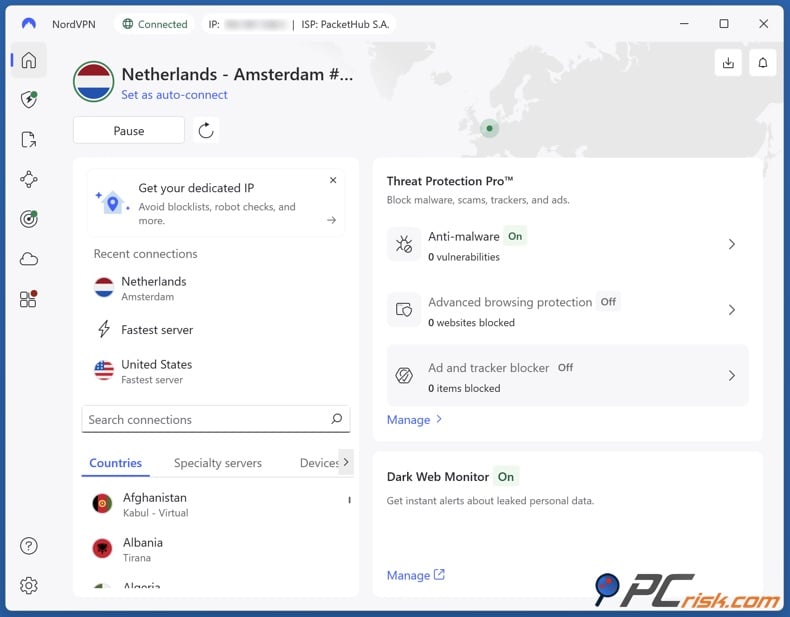
4. Choose an appropriate server. For gambling and sports betting, the safest approach is usually to connect to a server that is geographically close to your real location. This helps keep latency low and reduces fraud triggers caused by sudden "impossible travel." If your licensed operator requires you to be physically present in a specific country, state, or province, using a VPN is not a legal substitute for being there. Some jurisdictions clearly require geolocation controls and restrict betting to people who are physically located within the jurisdiction.
5. Connect and verify you are protected before opening the betting site. Open NordVPN and connect. Confirm that the app shows you are "protected" (connected). If the app shows server load or latency indicators, choose lower load and lower ping for live betting. It's worth mentioning NordVPN's quick-connect feature and usability details that support this process.
6. Test for leaks and basic performance. Run a quick check to make sure the VPN is active and that you can see the IP change. If your connection feels slow, switch to another nearby server or try NordLynx, which is NordVPN's WireGuard-based protocol, if it is not selected by default. Our in-house testing shows that NordLynx has strong speed, with only slight slowdowns.
7. Log in to your sportsbook/casino and monitor stability. Keep the VPN connected throughout the session. Don't switch between countries or servers during the session unless you have a good reason, such as a failing server. If you need to change servers, disconnect from the betting site first. Then switch VPN servers and reopen the site or app.
8. Troubleshooting: what to do if something breaks.
- If the site refuses login or throws a "proxy/VPN" error: Do not try to get around compliance systems. First, disconnect the VPN and try again on your regular connection, if it is secure. If you are traveling, think about using the operator's accepted travel options or local licensed alternatives.
- If odds refresh is slow or bets fail to place: Switch to a closer VPN server in the same country or region and try again. Avoid multi-hop or double-VPN modes during live betting since they add extra delays. NordVPN offers Double VPN and Onion over VPN features, but these are meant for improving privacy, not for betting with low latency.
- If you are repeatedly logged out: Ensure your kill switch is on to stop IP changes. Avoid switching between Wi-Fi and cellular during a session if you can. If necessary, use auto-connect features to keep the VPN stable during network changes.
Best VPNs for Online Gambling and Sports Betting
PCrisk's "Best VPN software in 2026" roundup features five top picks for the year. These are not "gambling VPNs" because they do not guarantee access to restricted sportsbooks; no trustworthy VPN can make that promise. Instead, these are solid general-purpose VPNs. Their speed, privacy features, and reliability can help with legal online gambling and sports betting. This is especially true when you want safer browsing and encrypted connections on untrusted networks.
NordVPN - We rank NordVPN as the best VPN in 2026 for its strong blend of speed, privacy, and versatility. The VPN has security features such as a kill switch, DNS leak protection, and an audited no-logs policy.
For gambling and sports betting, NordVPN's best feature is the combination of stability and protective tools that can lower risk while you're logged into financial accounts. The kill switch is important because betting sessions often involve deposits, withdrawals, or switching between sportsbooks and verification processes. A kill switch ensures that if the VPN connection drops, traffic is stopped rather than continuing unnoticed on your regular network.
NordVPN also has Threat Protection. This feature blocks harmful websites, trackers, and ads. Depending on the platform or version, it can scan downloads for malware and operate even when you're not connected to a VPN server. This is useful if you're researching promotions or browsing ad-heavy sports content, where harmful ads and scam redirects can be a real issue.
Another point relevant to 2026 is flexibility in more restrictive networks. NordVPN offers obfuscated servers that disguise your VPN use by making VPN traffic look like normal HTTPS traffic. This can be helpful in areas where VPN connections are blocked.
- Pros: strong security and privacy, quick speeds and streaming access, and user-friendly apps that support 10 devices.
- Cons: higher cost on short plans, no unlimited free tier, and some platform feature gaps. For example, there are limitations with split tunneling and no port forwarding.
Surfshark - We rank Surfshark second for 2026 as Surfshark is a budget-friendly VPN that still offers high-quality features and strong performance.
For betting households, Surfshark's biggest differentiator is its unlimited device policy. This is useful if multiple family members or devices, such as phones, laptops, tablets, and smart TVs, need VPN protection under a single subscription.
From a "live betting" perspective, connection stability is just as important as raw speed. It's worth mentioning Surfshark's Everlink technology, which can redirect you to another server without dropping the VPN connection when a server goes down for maintenance. This reduces the chance of accidental exposure. When paired with a kill switch, this increases reliability for sessions where you don't want your connection to unexpectedly switch back to your real IP address.
Surfshark also offers MultiHop, a double-hop, two-server routing option. This feature gives users an extra layer of anonymity. However, for gambling, it's usually unnecessary and can increase latency. Therefore, it's better seen as an optional privacy mode rather than a default setting.
- Pros: good value with unlimited devices, a toolkit full of features (MultiHop, CleanWeb, split tunneling, kill switch/Everlink), and fast speeds, especially with WireGuard.
- Cons: renewal price increases after the first term, no free plan, and some platform gaps with missing features on iOS and Linux, plus no port forwarding.
Mullvad - We rank Mullvad 3rd in our top 5 VPNs. It's one of the most privacy-focused options in 2026 and emphasizes its design choices that prioritize anonymity.
Mullvad's biggest differentiator is account privacy. We can note the anonymous sign-up process and a strict no-logs policy. It also emphasizes strong security through open-source, audited apps, along with fast, stable performance, especially on nearby servers.
For gambling and sports betting, there's a tradeoff. Mullvad's strengths appeal to users who care about privacy and want a simple VPN that requires little personal information. However, it's worth pointing out that Mullvad has difficulty unblocking primary streaming services and can encounter blocks or CAPTCHAs since its IP ranges are well-known as VPN endpoints. This issue is also significant for betting sites, which often use anti-fraud systems that flag "datacenter" or "known VPN" IP ranges.
Pricing is simple. It has a flat monthly fee model. It costs €5 per month, with no discounts. Some users like this because there's no introductory offer that gradually increases in price when it's time to renew.
- Pros: top-notch privacy through anonymous sign-up, strong security with open-source and audited apps, and solid stability.
- Cons: poor streaming and unblocking performance, no discounts, and a more limited network with fewer locations and missing extras like live chat or dedicated IPs.
Proton VPN - We rank Proton VPN 4th in 2026. We highlight the service's reputation for transparency and privacy. The free plan for basic use is notably strong.
For people who gamble legally while traveling or using public Wi-Fi, Proton VPN's security tools are a major attraction. Secure Core, a multi-hop setup made for better protection, and NetShield, a built-in DNS filtering feature that blocks ads, tracking domains, and known malware sites.
Proton VPN can be helpful if you want a "research mode" VPN. This is something you keep on while reading sports news, checking odds, or browsing. NetShield helps reduce exposure to scammy ad networks. However, for betting on regulated platforms with strict geolocation checks, keep in mind that a VPN may still cause access issues.
Proton VPN's free plan offers unlimited data and no ads, making it a fairly safe way to try the service. However, it has some restrictions, such as limited server locations, and does not support streaming services or P2P on the free tier.
- Pros: strong privacy and security with open-source apps and a no-logs policy, many features like Secure Core and NetShield, and a surprisingly good free plan for basic use.
- Cons: higher long-term cost, not the fastest in all cases, and support response times that can lag, especially for free users or billing issues.
ExpressVPN - We rank ExpressVPN 5th in our 2026 top picks. It is known as a premium option for privacy and reliable performance.
For sports betting, speed and stability are important, especially if you are using live betting markets and want to avoid losing your connection while placing a bet. We want to point out that ExpressVPN's Lightway protocol offers a fast connection option designed to improve speed and reconnection time.
ExpressVPN is frequently mentioned in relation to restrictive networks. ExpressVPN has a history of functioning in areas with heavy censorship, thanks to its obfuscated servers. These servers can be useful in situations where VPN use is actively blocked. This is important for travelers, but it does not excuse breaking gambling laws or avoiding operator restrictions.
We can highlight important privacy features, such as strong encryption, a verified no-logs policy, and RAM-only servers. For someone who bets online, this means better security when handling payment logins and personal information, especially on unsafe networks.
- Pros: strong security and privacy measures, fast and reliable connections, and easy-to-use apps on various devices.
- Cons: higher price, fewer "extra" features than some competitors, missing multi-hop and malware scanning, and a shorter maximum plan length compared to some rivals.
Is Using a VPN for Gambling and Sports Betting Safe?
Using a VPN can be safe when used legally and when you choose a trustworthy provider with modern security features, such as strong encryption, a kill switch, DNS leak protection, and a verified privacy policy. Kill switches, leak protection, and additional features like threat blocking are important differences among reliable VPNs.
The bigger safety risk is not the VPN itself. It's what users sometimes do with it:
Using low-quality "free VPN" apps can put your data at risk. These apps often sell your information, show ads, or redirect you to harmful sites.
Assuming a VPN makes you anonymous is misleading. VPNs provide a layer of privacy but don't fully protect you from malware, phishing, or account theft. This is especially true if you log into your accounts as usual, which often happens when you gamble.
Triggering wagering site security systems. Gambling platforms may see VPN usage as a sign of fraud. This can result in extra verification, temporary account locks, or blocked transactions. In regulated markets, operators might have to identify VPNs and attempts to spoof locations.
If your goal is safe, legal betting, treat a VPN like a seat belt. It's helpful, but not invincible. Combine it with strong, unique passwords, multi-factor authentication, careful app downloads, and caution with promo links.
Is Online Gambling Legal With a VPN?
A VPN does not change the law. If online gambling is illegal or restricted where you live, using a VPN does not make it legal. It may put you at risk of account penalties and legal trouble.
Two practical realities matter most in 2026:
Operators' rules. Some platforms clearly ban circumvention of measures that limit access to prohibited areas. For instance, Betfair's terms state that users agree not to bypass measures that are in place to prevent or restrict access to services in these areas.
Regulatory compliance systems. In strict jurisdictions, especially in parts of the United States, operators use compliance-grade geolocation and anti-spoofing systems. DraftKings clearly states that if a VPN or proxy is running, you will not pass geolocation checks, and you will not be able to play.
If you are traveling, the best approach is to follow the rules of the area you are in and use legal, locally licensed platforms when necessary.
Where is Online Gambling and Betting Legal?
Gambling laws change over time, and they often differ by region within a country. For example, this includes U.S. states, Canadian provinces, and region-based licensing in parts of Europe. This section provides a general overview for 2026 and is not legal advice.
Countries where online gambling or betting is legal and regulated
- Malta is an important EU licensing area for remote gaming. The Malta Gaming Authority outlines the requirements for a B2C gaming service license to provide gaming services from Malta under specific conditions.
- Sweden has a license-based model. The Swedish Gambling Authority stresses that license holders must implement responsible gambling measures. The authority also takes action against illegal gambling.
- The Netherlands requires games of chance to be licensed. The Kansspelautoriteit is responsible for supervision and handling illegal providers.
- Germany regulates its online gambling market through the Joint Gambling Authority of the federal states. Its main tasks are to oversee the German online gambling market, approve cross-state offerings, and fight against illegal online gambling and advertising.
- Spain has a national gambling regulator, the DGOJ. Regional authorities are also involved. Spain actively enforces laws against illegal operators.
- Italy allows online gambling through a concession model issued by its gambling authority, ADM. Italian and European regulators are working together to enforce rules against illegal online gambling.
- Canada is not uniform nationwide. A prominent example is Ontario: iGaming Ontario announced the launch of its regulated online gaming market on April 4, 2022, allowing registered private operators under an operating agreement to offer games to players in Ontario under provincial oversight.
- The United States is state-by-state. As of February 4, 2026, the National Conference of State Legislatures reported that sports betting is legal in 39 states and Washington, D.C., though availability and online/mobile status vary by state.
Countries where online gambling is illegal or heavily restricted
- Australia limits online gambling through the Interactive Gambling Act. The Australian Communications and Media Authority provides a list of banned services. This includes online casinos and in-play sports betting, among other restricted services available to Australians.
- New Zealand only allows TAB NZ to offer online racing and sports betting. It is clearly against the law for anyone in New Zealand to promote or accept bets on racing or sporting events. At the same time, new laws are being created to regulate online casino gambling.
- Singapore limits remote gambling to one licensed operator. Participation in unlicensed remote gambling is considered an offense. The Gambling Regulatory Authority outlines the penalties for this.
- Qatar makes gambling illegal in its Penal Code. Article 275, as listed in Qatar's legal database, outlines the penalties for gambling.
- China considers online and virtual gambling illegal under its domestic law. Recent official communications have reinforced the view that gambling is against the law for citizens, including in online situations.
- The United Arab Emirates has a long history of broadly prohibiting gambling, but its rules are changing. The federal commercial gaming regulator in the UAE says that it is illegal to engage in commercial gaming without a license. It also warns consumers about unlicensed operators, including online options.
In practice, if you gamble while traveling, you should assume that rules vary by jurisdiction, change often, and may be enforced through payment controls and advanced location verification, not just website blocks.
Can I Use a Free VPN to Access Betting Websites Abroad?
Using a free VPN to access betting sites in other countries raises two main issues: legality and cybersecurity.
Top VPN ReviewsExclusive dealsExpert-tested · hands-on reviews→
From a cybersecurity standpoint, free VPNs often have serious limitations, such as slower speeds and fewer servers. They can also pose privacy risks; some impose data caps, show ads, and some have been caught logging or selling user information. In other words, "free" can cost you your data.
From a gambling access standpoint, depending on a free VPN is also unreliable. Many betting operators block known VPN endpoints. Free VPN IP ranges are often abused and quickly flagged. Regulated environments may require anti-spoofing or device-level geolocation, which a basic VPN cannot meet.
If you need a free option for basic privacy testing, Proton VPN offers a free tier with unlimited data and no ads. However, this free tier does not support streaming services and comes with other limitations. It is better for basic browsing than for more demanding tasks.
If the goal is to engage in legal sports betting in a regulated market, the safest "free" option is generally not a free VPN. Instead, it's best to use a licensed local operator with your regular connection while following their terms.
Wrapping Up
In 2026, VPNs can still be helpful for gambling and sports betting. However, their primary purpose will be privacy and security, not getting around restrictions. The industry is shifting toward stricter geolocation and VPN/proxy detection. As a result, many regulated sportsbooks will completely block VPN usage.
If you're betting legally and want better security, especially on public Wi-Fi, PCrisk's top VPN picks for 2026 include NordVPN, Surfshark, Mullvad, Proton VPN, and ExpressVPN. These options meet key needs: encryption, leak protection, kill switches, and, in some cases, ad and malware blocking features that provide real safety beyond just hiding your IP address.
Frequently Asked Questions (FAQ)
In which countries is online gambling legal?
There is no universal answer because legality depends on local laws and licenses. Some countries have regulated licensing systems, such as parts of the EU. Others permit only certain types of games or maintain monopolies. Examples of regulated frameworks include Great Britain's remote gambling license model, Denmark's licensing requirements for online betting and casinos, and the Netherlands' licensing and supervision model.
Conversely, some countries heavily restrict online gambling categories. For example, Australia bans online casinos and in-play sports betting for its residents. Other countries limit remote gambling to one licensed operator, such as Singapore.
Can the government see if you use a VPN?
In many cases, a network operator, like your ISP, can tell that you are connected to a VPN service. However, a well-configured VPN can prevent your ISP from seeing the specific websites you visit by encrypting the traffic between your device and the VPN server.
Whether governments can compel, log, or observe more depends on local law, the VPN provider's policies, and whether you are using the VPN legally. The legality of VPNs also varies in some countries.
What countries block VPNs?
VPN legality and enforcement change over time. Countries with bans or strict restrictions often include Belarus, China, Iran, Iraq, Oman, Russia, Turkey, Uganda, the United Arab Emirates, and Venezuela.
In some areas, restrictions are increasing and may involve advanced blocking techniques. For example, reports from February 2026 described Russian authorities using DNS manipulation and DPI methods while they intensified efforts to target circumvention tools.
Can Betfair detect VPN?
Betting platforms can identify or flag VPN use. They may enforce this through their terms and anti-fraud measures. Betfair's terms state that accounts must not be accessed or operated in restricted areas. Users agree not to circumvent measures intended to limit or block access.
Can I use DraftKings with a VPN?
DraftKings clearly states that if you have a proxy, VPN, or remote desktop program running on your device, you will not pass the necessary geolocation checks. As a result, you will not be able to play.
Can betting sites detect VPN?
Yes. Many betting sites use multiple approaches, including IP intelligence, proxy and VPN databases, device signals, and geolocation systems that meet compliance standards. Industry guidance on geolocation verification for iGaming states that operators may need to detect VPNs and other methods of bypassing restrictions. Commercial tools are available specifically to identify IP masking tools and anonymizers.
Is it illegal to use a VPN for online gambling?
Using a VPN is legal in many countries, but it is illegal or restricted in others. The legality also depends on how you use it.
Separately, even when using a VPN is legal, using it to circumvent gambling restrictions can violate operators' rules. For instance, Betfair clearly states that bypassing access restrictions for prohibited areas is not allowed. Additionally, some regulated operators will block access if they detect a VPN.
What is the best VPN for sports betting?
If your goal is safer, legal sports betting on public Wi-Fi, or better privacy from your ISP, we rank NordVPN as our top choice for 2026. It highlights speed, strong security features, and additional protections such as Threat Protection.
If you need unlimited device coverage for your household, our runner-up, Surfshark, stands out for unlimited simultaneous devices. It also offers strong reliability features, including Everlink and a kill switch.
If you're using a regulated platform that has strict geolocation checks, the "best VPN" may not work at all. Some operators, like DraftKings, will deny access if you are using a VPN.
Share:
 Facebook
 X.com
X.com
 LinkedIn
 Copy Link

Rimvydas Iliavicius
Researcher, author
Rimvydas is a researcher with over four years of experience in the cybersecurity industry. He attended Kaunas University of Technology and graduated with a Master's degree in Translation and Localization of Technical texts. His interests in computers and technology led him to become a versatile author in the IT industry. At PCrisk, he's responsible for writing in-depth how-to articles for Microsoft Windows.
▼ Show Discussion