
We may earn commissions from products we recommend. Learn more.
How to access Pornhub in Brazil in 2026 with a VPN

How to access Pornhub in Brazil in 2026 with a VPN?
In 2026, Brazil is in the process of implementing stronger online protections for minors under the Digital Statute of the Child and Adolescent (ECA Digital). In essence, platforms that may expose minors to harmful or adult-only content are now expected to replace basic self-declaration prompts (e.g., "I am over 18" buttons) with more reliable age verification methods.
Therefore, adult users accessing Pornhub or similar platforms may see vigorous age assurance, pages failing to load, or blocked websites. What exactly a visitor encounters may differ depending on the site itself, the ISP (Internet Service Provider), and the platform's chosen verification method. This article explains Brazilian regulations regarding age assurance and guides on using a VPN (Virtual Private Network) service to access age-restricted or blocked websites.
Disclaimer: PCrisk.com does not promote, encourage, or endorse the bypassing of age verification measures or geoblocks and geo-restrictions. This information is provided for educational purposes to help adult users understand their privacy options. It is not intended for minors, and we strongly advise that underage individuals do not attempt to circumvent age checks. Always abide by local laws - use any methods described at your own risk.
 Our top-rated VPN
4.5/5 in our review. Our top pick of the year: almost no slowdown in our speed tests, and it unblocked Netflix, BBC iPlayer and Disney+ without trouble.
Table of Contents:
- Introduction
- Why is Porhub inaccessible or requires age verification?
- How to verify your age on adult sites in Brazil?
- Privacy risks of verifying your age
- Access Pornhub in Brazil with a VPN in 2026
- Best VPNs to access Pornhub
- Can you use a free VPN to access Pornhub in Brazil?
- Common issues and solutions when accessing Pornhub with a VPN
- How to access Pornhub without a VPN?
- Is using a VPN to access Pornhub legal in Brazil?
- In closing
- Frequently Asked Questions (FAQ)
Why is Porhub inaccessible or requires age verification?
Discussions around access restrictions to adult content in Brazil are partly linked to the Digital Statute of the Child and Adolescent (Lei nº 15.211/2025), enacted in 2025 and in the process of implementation as of March, 2026. This statute is building on the principles of the Statute of the Child and Adolescent (Estatuto da Criança e do Adolescente, ECA).
The Digital Statute of the Child and Adolescent imposes broad requirements across the digital ecosystem. Its purpose is to protect children and adolescents from risks such as cyberbullying, exploitation, misinformation, and inappropriate content. It reinforces data protection and privacy rights, aligning with the General Data Protection Law (Lei Geral de Proteção de Dados Pessoais, LGPD), which regulates minors' personal data collection and use.
This statute covers more than just social media; it extends to digital products or services aimed at minors or likely to be accessed by them. Hence, providers of content deemed inappropriate, unsuitable, or prohibited for minors - are expected to mitigate or restrict access by children and adolescents. One of the critical changes is that self-declaration (e.g., "I am over 18") prompts are no longer sufficient. These types of age gates are easily circumventable, and compliance with these regulations obligates platforms to introduce robust age assurance, but no single model is specified.
As a result, some platforms seek compliance by implementing strong verification processes, such as document checks, biometrics, or similar. Others elect not to meet these requirements and raise associated privacy concerns by restricting regional access.
Access blocks are not unique to Brazil. For example, Pornhub has blocked access in several jurisdictions and stated that such age assurance regulations raise privacy and free expression issues, and could drive users to less regulated websites. As these verification requirements are new in Brazil, the entire ecosystem remains in transition.
Access disruptions often occur because there is a gap between legal expectations and technical implementation. The law allows for sanctions to be imposed on providers and intermediaries (e.g., official warnings, fines, suspensions, and operational prohibitions). Therefore, if regulators deem a platform to be noncompliant, they may increase pressure through infrastructure and ecosystem measures.
Even if Pornhub decides not to enforce strict age checks, it could choose to block access from Brazil, or users may encounter inconsistent access due to other reasons. IP-based policy changes, ISP-level filtering, and inaccurate or cached geolocation data can cause some users from Brazil to see prompts or be blocked from accessing the platform - while others experience nothing of the sort.
How to verify your age on adult sites in Brazil?
The age assurance requirements are not a universal ID check in Brazil; they encompass verification, estimation, or inference - depending on the service's risk level and chosen method. The legal obligation lies on platforms and service providers, and many choose their models in alignment with privacy and data protection principles. Regardless, age assurance typically requires sharing sensitive information, which inherently comes with privacy and security concerns.
In practice, platforms may use a range of age assurance methods:
- Document-based verification (ID upload): users provide a government-issued document, often with additional steps such as a selfie or liveness check.
- Document-selfie matching: users submit both an ID and a selfie or live recording to verify their identity against the document.
- Facial age estimation: AI analyzes facial features to determine whether a user meets the minimum age requirement; this is often combined with other methods due to accuracy concerns.
- Payment-based signals (e.g., debit or credit cards): card ownership can serve as a proxy for adulthood, though reliability and usage vary.
- Financial identity systems (e.g., open banking): new methods use financial data or identity signals to support age verification.
- Mobile network operator verification: carrier data is used to infer a user's age, though availability and accuracy vary.
- Digital tokens or wallet-based credentials: privacy-focused systems where a trusted third-party confirms eligibility, such as being over 18, without sharing full personal data.
- Zero-knowledge proof systems: cryptographic methods that let users prove age eligibility without disclosing personal information. These are being researched as promising privacy-preserving solutions.
Typical user experience:
- When you access an age-restricted page or feature, and the website detects your location in Brazil (typically by checking your IP address), it may display an age verification prompt.
- You are presented with age assurance options and may be redirected to a third-party service for verification.
- With services using privacy-preserving models - following verification, the accessed platform receives a confirmation token (e.g., "yes/no") and not your full identity profile.
Note that if you are asked to provide sensitive data (such as documents or biometrics) - the verification process must be treated as high risk. Verify that you are using the legitimate service and assess whether the age check is appropriate for the context - to avoid malicious impersonator pages.
Privacy risks of verifying your age
Age assurance aims to protect minors, but it introduces new risks for adults. Serious privacy concerns are raised in cases where sensitive browsing is linked to personal identities. The following are some of the key threats associated with age verification:
Data leaks and breaches: age verification often involves vulnerable information, such as identity documents, selfies, or biometric data. If a platform or verifier is breached, leaked identity data could be used for fraud, impersonation, and long-term identity theft. Even minimal leaks that link user identity to their browsing habits carry risks, including stigma, social repercussions, and sextortion/extortion.
Data over-collection and "function creep": online age verification regulations are often criticized for normalizing the collection of unnecessary amounts of data. The storage of identity data poses risks of reuse for targeting or profiling.
Loss of anonymity and increased linkability: when age verification is linked to accounts or a shared verifier, it becomes easier to connect user activity across platforms. This raises profiling and behavioral tracking concerns.
Biometric risks: facial biometrics and voiceprints cannot be reset if compromised, unlike passwords. Systems using biometric data have a higher risk of false positives, bias, and increased vulnerability to deepfake-facilitated fraud.
Third-party verifier trust: even if the accessed platform does not collect age verification data, it is processed by third-parties. It may be difficult or even impossible to verify if or how long the gathered information is stored, as well as who has access to the data.
If you choose to comply with age verification, use the least intrusive method. If available, select options utilizing systems based on cryptographic tokens or zero-knowledge proofs, as they can confirm your eligibility without revealing unnecessary personal information.
Age checks online can put your privacy at risk if you end up on a fake site or download something unsafe. Combo Cleaner blocks scams, phishing, dangerous downloads, and harmful browser add-ons, so you can feel safer while browsing.
 Made by RCS LT, the company behind PCrisk
- Detect malware already on the device
- Block phishing pages once you open them
- Remove adware or browser hijackers
- Scans for free and shows what it finds
- Removes it with a licence, 7-day free trial
- Blocks scam and phishing sites in the browser (Windows)
Access Pornhub in Brazil with a VPN in 2026
A VPN (Virtual Private Network) encrypts your connection and routes your Internet traffic through a VPN server. Hence, accessed websites typically see the VPN server's IP address instead of your own. This is relevant in Brazil, as many age restrictions and access controls rely on IP-based geolocation and ISP-level filtering. Therefore, by changing your apparent location with a VPN - you can access websites enforcing Brazilian regulations based on IP addresses. Likewise, using a VPN may allow you to bypass other basic blocking techniques, such as restrictions imposed by an ISP or network operator.
The typical VPN setup is a straightforward four-step process:
1. Select a reputable VPN provider. When choosing your service, prioritize these three aspects - server coverage, speed, and privacy. Large server networks are essential for having the best access chances when geoblocking/geo-restrictions necessitate servers in specific regions or when certain IP ranges are blocked. High speeds are critical for bandwidth-intensive activities, such as streaming or browsing media-heavy sites. Privacy features protect your browsing activity from ISPs, network administrators, and other intermediaries by encrypting Internet traffic, masking your IP address, and blocking third-party monitoring/logging. We recommend our Top VPN Choice for 2026 - NordVPN.
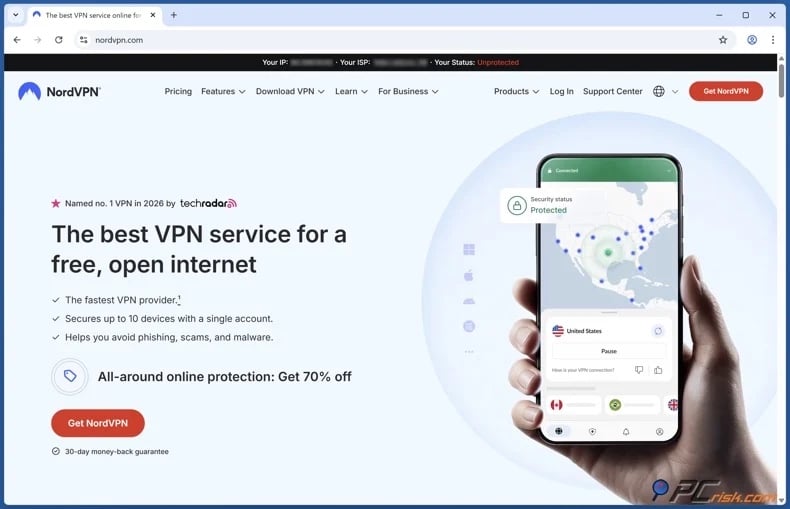
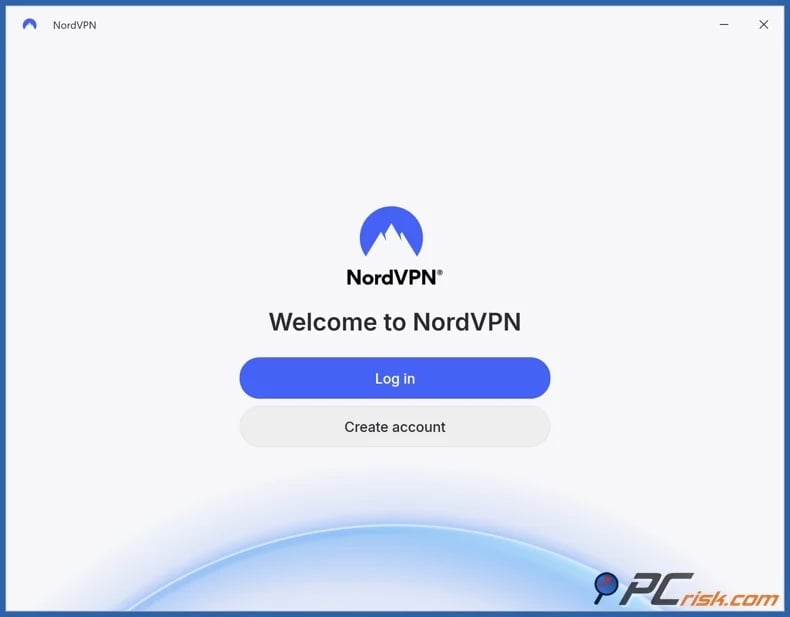
2. Install the VPN app on your device and sign in. Major VPNs usually support multiple platforms, including Windows, macOS, Android, and iOS.
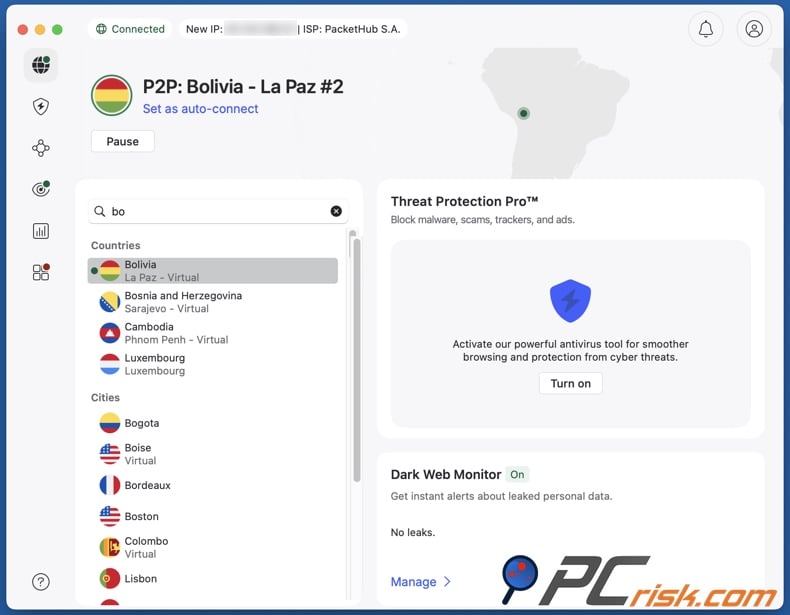
3. Connect to a server in a region with no restrictions analogous to Brazil. Choosing a server close to your actual location can help minimize latency and buffering.
4. Open Pornhub and start streaming. If blocks or age prompts keep appearing, connect to a different server. Note that location signals revealing your actual location could have been stored (particularly if you have attempted accessing Pornhub prior), so clear your browser's cookies and cache to remove any conflicting data.
Check out the "Common issues and solutions when accessing Pornhub with a VPN" section of this article if you continue experiencing access problems.
Best VPNs to access Pornhub
Accessing Pornhub from Brazil can be complex due to rapidly changing enforcement policies and potentially enhanced efforts in blocking VPN traffic. Therefore, you need a reliable VPN with a strong reputation for bypassing such hurdles. A broad server network and often refreshed IP ranges will help maintain consistent access to Pornhub and other platforms. Strong speeds are necessary for a smooth streaming experience, and privacy-focused VPN services are crucial for sensitive browsing.




Based on research and our own hands-on testing, we have narrowed down our top VPN choices for 2026 (for detailed service comparisons, read our dedicated article):
1. NordVPN
NordVPN is our number one choice because this VPN offers strong performance, speed, server availability, and privacy policies. Its large server network provides more options if streaming services block or limit certain IP ranges. NordVPN also offers the speeds needed for streaming and the safety features critical to protecting your privacy online.
2. Surfshark
Surfshark is the perfect option for households, as this budget-friendly service offers unlimited device connections on a single subscription. It is also a strong option in regard to available servers, speed, and privacy.
3. Mullvad VPN
Mullvad VPN emphasizes privacy. This service prioritizes minimizing data collection; it has a strong no-logs policy, account registration does not require personal details (not even an email address), and there are anonymous payment methods. However, compared to its competitors - Mullvad VPN has a lesser server coverage.
4. Proton VPN
Proton VPN is a service focusing on transparency and security. Its paid plans offer strong streaming and server coverage, while its free plan is widely regarded as a credible choice for basic privacy needs.
5. ExpressVPN
ExpressVPN is recognized for its user-friendly applications and broad platform compatibility. While costlier than many competitors, its value depends on whether you prioritize simplicity and reliable performance.
It must be mentioned that no VPN can guarantee continuous and uninterrupted access to any site or service, including Pornhub. Regulated and compliant platforms are often proactive in blocking VPN traffic.
Can you use a free VPN to access Pornhub in Brazil?
Free VPNs often disappoint in terms of performance and security. While such a service may allow you to access Pornhub from Brazil, actually streaming might be incredibly frustrating if not downright impossible. Free VPN services commonly come with significant limitations and risks.
Running a VPN service requires substantial infrastructure, bandwidth, and maintenance - hence, providers offering free access must often find alternative revenue sources. Many free VPNs profit through data collection, intrusive ads, or by selling aggregated usage data to third-parties. Others impose strict limitations, such as on data or speed - in hopes of luring users into purchasing a subscription sans the restrictions.
Performance issues can arise from various factors. Bandwidth-heavy activities (such as streaming) can easily exhaust imposed data caps. Speed limits or other factors that impact speed - such as overcrowded servers - can dramatically decrease the browsing experience and lead to issues like video buffering, pages failing to load, and other problems. Overused IP ranges are more likely to get blocked by platforms, making streaming and consistent browsing difficult.
In addition to performance limitations, free VPNs raise security concerns. Some providers log user activity despite claims to the contrary, while others include trackers or request questionable permissions. Hence, users seeking privacy may inadvertently expose themselves to greater risks. Even well-intentioned providers often have limited resources, leading to a weaker security infrastructure, fewer security audits, and slower updates.
If you still wish to try a free VPN, we recommend the free plan offered by Proton VPN. This provider is known for transparency; its paid tiers support the service, reducing the incentive to monetize user data. However, even reputable free plans have drawbacks. For example, Proton VPN's free plan offers fewer servers than its paid plans. To summarize, free VPNs may suffice for occasional use or basic privacy needs, but they are rarely suitable for streaming, consistent access to restricted content, and other demanding activities.
Common issues and solutions when accessing Pornhub with a VPN
Access issues may persist even when using a reliable VPN. Some websites utilize detection methods beyond IP geolocation, including browser signals, cookies, DNS behavior, and VPN-linked IP address databases. The following are some of the most common issues and solutions:
Website remains inaccessible or repeatedly requests age confirmation
This could be because the server you are connected to has been flagged. Alternatively, it may be located in a region with age verification requirements similar to those in Brazil. Another reason could be your browser leaking location information through cookies or local storage.
Solutions:
- Connect to a different server (if the initial server is not located in a similarly restricted country, it would be best to select one in the same region).
- (If available) Change protocols (some work better on certain networks).
- (If available) Try stealth/obfuscation mode offered by your VPN.
- Clear cookies and cache.
- Try starting a private browsing session.
Slow loading times, buffering, or reduced video quality
Some speed reduction is expected with VPN usage, as your traffic is encrypted and routed. This can be exacerbated by overcrowded servers. Slow base Internet connection could be the cause as well.
Solutions:
- Connect to a server that is geographically closer to you.
- (If available) Check the server load in your VPN app, and connect to one that is not crowded.
- Check your base Internet connection.
Frequent CAPTCHA tests or "unusual traffic" warnings
Extensive VPN usage, especially repeated server switching, can resemble automated activity. It could also be caused by an IP range that is recognized as belonging to a VPN.
Solutions:
- (If you have recently switched servers) Wait before connecting to a different server.
- (If available) Create a consistent setup by setting a dedicated IP address.
- Clear cookies and cache.
- Try starting a private browsing session.
IP address or DNS leaks
Typically occur when the VPN connection drops. Stored location data may also reveal your real location.
Solutions:
- (If available) Enable DNS-leak protection in your VPN app.
- (If available) Enable the "kill switch" feature in your VPN app.
- Clear cookies and cache.
Reputable VPN services usually have reliable customer support. Therefore, if you experience issues when accessing Pornhub (or other platforms) with a VPN and they cannot be eliminated by conventional solutions, contact the support provided by your VPN service.
How to access Pornhub without a VPN?
Open (web-based) proxies and the Tor Browser are two common alternatives to VPNs. Both can change your apparent IP address and may grant access to geoblocked or age-restricted content. However, neither matches a reputable VPN service in performance, privacy, or reliability.
Open (web-based) proxies
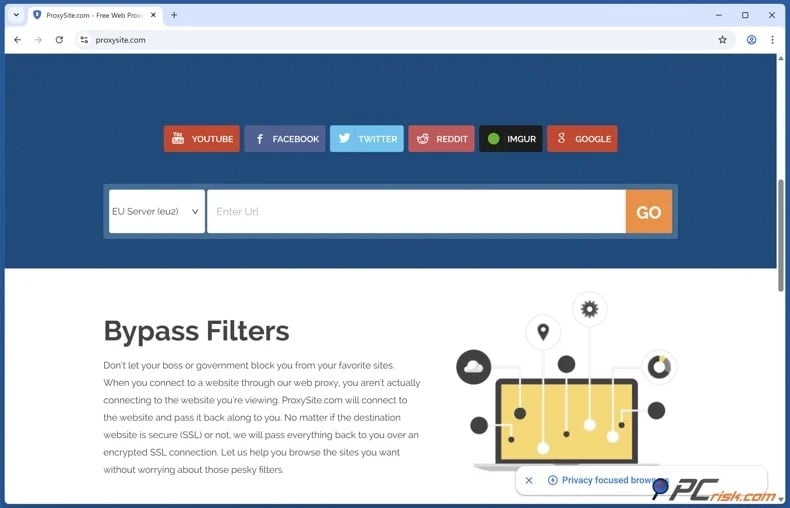
Open proxies are web-based tools that act as intermediaries between you and the websites you visit. Rather than connecting directly, the proxy retrieves the page and displays it in your browser - thereby masking your IP address from the destination site. These proxies are usually accessed through a simple webpage and require no installation.
Pros:
- Free and easy to use (no setup required).
- Quick option for basic, one-time access.
- Can bypass simple location-based restrictions.
Cons:
- Weak privacy (e.g., proxy operators can potentially monitor/modify traffic).
- Limited or inconsistent encryption.
- Potentially poor compatibility with modern websites.
- Reliability concerns (e.g., blocked on mainstream platforms).
- Unsafe for sensitive data (e.g., passwords, payments, personal information, etc.).
Tor Browser
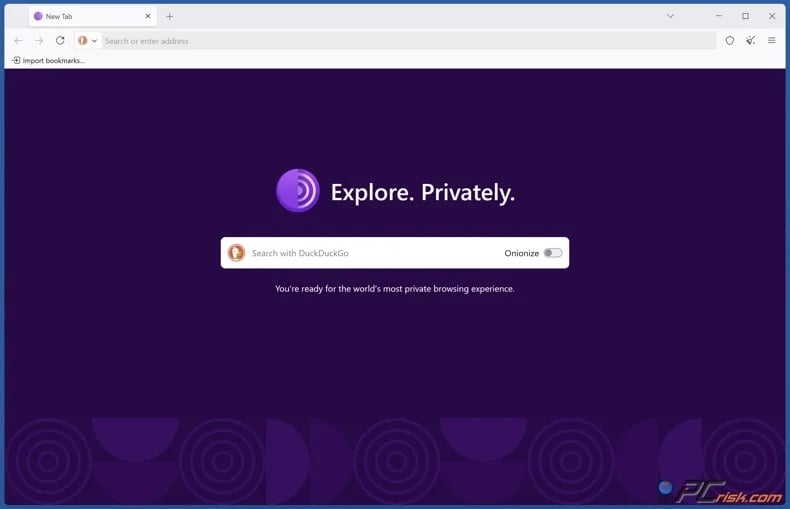
The Tor Browser is a specialized browser that routes your Internet traffic through the Tor network, consisting of volunteer-operated servers (relays). Each relay knows part of the connection path, thus making it difficult to trace activity back to the original user. This multi-layered routing enhances anonymity and reduces tracking.
Pros:
- Strong privacy through multi-hop ("onion") routing.
- Helps reduce tracking and surveillance.
- Free and open-source.
- Useful for anonymity-driven browsing.
Cons:
- Slow speeds due to multiple relays.
- Poorly suited for streaming and other bandwidth-heavy activities.
- Frequently blocked or challenged by mainstream platforms.
- May trigger CAPTCHAs or cause limited functionality.
- Compatibility issues (some devices do not support Tor).
- Risk of malicious exit nodes monitoring/modifying non-HTTPS traffic.
These two options can change your apparent IP address, but both have considerable drawbacks. Open proxies offer convenience but lack security. Tor provides privacy but reduces speed and usability. Therefore, neither is a comparable replacement for a reputable VPN service - which can provide consistent performance, encryption, and ease of use.
Is using a VPN to access Pornhub legal in Brazil?
VPNs are legal in Brazil. These services are commonly used to secure public Wi-Fi, limit ISP tracking, and for other legitimate purposes. However, legality depends on how these tools are used. To elaborate, Brazil has demonstrated in practice that bypassing a court-ordered block may result in penalties, even though VPNs are otherwise legal. In 2024, when the social media platform X was blocked, court orders allowed for significant daily fines against individuals using tools like VPNs to access the service. Although there is no strong confirmation that these fines have been issued as of 2026.
Regarding Pornhub and age verification, enforcement under the ECA Digital framework focuses on platform and provider compliance. Potential penalties like fines or operational restrictions are intended to target noncompliant service providers, instead of home users. However, laws and enforcement may change. It must also be stressed that using a VPN does not protect users from liability if they engage in illegal activity or violate court orders.
In closing
The purpose of Brazil's age verification regulations is to limit the exposure of minors to harmful content throughout the digital ecosystem. While these regulations aim to respect and uphold user privacy and data protection standards, age assurance usually raises significant security concerns nonetheless.
Adult users in Brazil seeking to access legal pornography, such as the content hosted by Pornhub, may now be required to wrestle with potentially invasive age verification. Repeated ID or biometric checks pose serious privacy risks, and a reliable VPN service is often the best solution.
VPNs can help users to bypass restrictions based on IP addresses or imposed by managed networks and ISPs. VPNs are powerful privacy tools because they encrypt Internet traffic and can reduce ISPs' and local networks' visibility into browsing activity. However, no VPN service can guarantee access to any given site, prevent verification requests in their entirety, or remove legal accountability. Therefore, stay informed, keep up to date with current law, consider your alternatives, and use trustworthy tools.
Our top pick of the year: almost no slowdown in our speed tests, and it unblocked Netflix, BBC iPlayer and Disney+ without trouble. $3.39/mo on the 2-year plan or $4.99/mo on the 1-year plan, 30-day money-back guarantee. Compare all three
Frequently Asked Questions (FAQ)
Why are adult websites in Brazil asking for age verification?
Brazil's Digital Statute of the Child and Adolescent (ECA Digital) requires reliable age verification for content and services that are inappropriate or prohibited for minors. Hence, age checks like basic "I am over 18" prompts are considered insufficient.
Can I watch adult content in Brazil without verifying my age?
While some websites still use self-declaration ("I am over 18" checks), this approach does not meet current compliance standards. More platforms are expected to implement stronger measures, restrict access, or face enforcement. Note that using noncompliant services exposes you to various risks, including scams and malware. If you want to access a site that does ask for robust age verification in Brazil, yet do not wish to complete it - you will be unable to do so without a bypass tool like a VPN.
How do websites verify age without ID in Brazil?
Available age verification methods depend on risk assessment and the platform being accessed. In general, aside from ID-based verification, common models include AI-based facial age estimation, credit/debit card checks, mobile carrier signals, open banking, and privacy-preserving systems (such as cryptographic tokens and zero-knowledge proofs).
Is it legal to access Pornhub in Brazil using a VPN?
VPNs are legal in Brazil, but using one does not exempt you from liability if you engage in illegal activity or bypass a court-ordered block. Authorities have previously threatened severe fines for VPN-based access to banned platforms, although none seem to have been issued as of the time of writing.
Share:
 Facebook
 X.com
X.com
 LinkedIn
 Copy Link

Karolis Liucveikis
Experienced software engineer, passionate about behavioral analysis of malicious apps
Author and general operator of PCrisk's News and Removal Guides section. Co-researcher working alongside Tomas to discover the latest threats and global trends in the cyber security world. Karolis has experience of over 8 years working in this branch. He attended Kaunas University of Technology and graduated with a degree in Software Development in 2017. Extremely passionate about technical aspects and behavior of various malicious applications.
▼ Show Discussion